
Observation
A dog's best friend
Individuals and nongovernmental organizations care for hapless strays
The indomitable human spirit cares for the millions of homeless and abandoned stray animals in Bombay and in particular the stray dogs and cats in Dadar Parsi Colony. India has the dubious distinction of being the "stray dogs’ capital” of the world. The dog, they say, is man’s best friend — yet to say people treat stray dogs harshly will definitely be an understatement.
Until a decade ago, indiscriminate destruction by drowning of scores of stray dogs and wayside puppies every day was the normal way of reducing the stray dog population for the Municipal Corporation of Bombay, until the intervention of the Court in a writ petition filed by BSPCA (Bombay Society for Prevention of Cruelty to Animals) and other organizations. It was abundantly clear that euthanizing was never going to reduce their numbers, nor have any effect on reducing the incidence of rabies among humans.
Even in the depth of such inhumane behavior there were some compassionate and determined people who devoted their lives in aiding these poor strays. One such was the late Sheroo Khory who committed 50 years of her life feeding street dogs in Dadar Parsi Colony. I remember seeing her walking the streets with a bagful of biscuits. There was almost a spiritual connection between them. Even in her last two years of failing health in the hospital, she had a strong desire to get well and catch a last glimpse of her faithful friends on the streets.
The last 20 odd years has seen a gradual rise in nongovernmental organizations (NGOs) in Bombay and other cities of India. The Welfare of Stray Dogs (WSD), All India Animal Welfare Association (AIAWA) and In Defense of Animals (IDA) are some of these organizations whose primary objective is to stop the brutal practice of electrocution of stray dogs and instead embark on a sterilization program, with the intent of reducing the number of stray dogs and cats on the streets and improving the quality of their life through sterilization, vaccination, healthcare and adoption. There almost seems to be a renewed relationship between stray dogs and humans. It was quite apparent during my recent visit to Bombay in January 2006. The street dogs looked healthy and happy with no major sign of stress or injury.
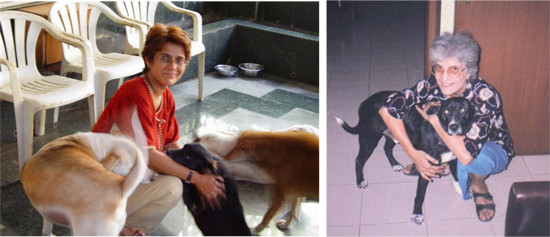
Goodicia Vaidya (left) and Armaity Tirandaz (above): animal care and concern
In Dadar Parsi Colony, I was told by Goodicia Vaidya (née Colabawalla) that street dogs are now called compound dogs. Each building adopts one or two dogs and someone feeds them regularly. They live inside or outside the building compound. This means that they are quite territorial but at the same time respect the territory of other dogs. There is harmony and at the same time less of infighting amongst them. Goodicia is the president of IDA which has a shelter for 250 dogs, cats, injured birds, isolation wards for rabies and first aid treatment facility in Bombay. They also have an ambulance which caters to calls from all over the city. When I met her in Dadar, she was in the middle of picking up a stray dog which had been recently released after sterilization without the stitches being removed. She took it upon herself to carry the dog in her car back to the BSPCA for investigation and putting guidelines in place for the future release of such animals. She sounded like a no nonsense person and firmly believed that NGOs have a responsibility and duty to care for the animals.
Goodicia was of the opinion that chronically ill, and severely injured dogs should be put to sleep in a humane way rather than made to suffer. Her deep love for stray dogs was evident at her husband’s office in Bandra which also doubles up as an informal shelter for some 10 dogs. Each dog has a sad or traumatic story behind it, but that seemed to be a distant past, and the joy and happiness and their enthusiasm to live each day was now a new sign of hope for a better tomorrow. Amongst them was Jumbo, a 13-year-old white male, who had been almost given up for dead by the doctors. Jumbo had suffered multiple spine injuries when a car reversed and ran over his whole body. Doctors told Goodicia to put him down and relieve him from his misery. Goodicia did not lose hope and personally looked after him each day for four months. He could only drag himself around. Goodicia put him on a strict diet to reduce his weight. Then a miracle happened and one day he managed to stand up. Goodicia recalls that day which happened three years ago and even today when she remembers that day, tears of joy fill her eyes. Jumbo now walks with a wobble and even tries to do a slow gallop.
Another animal lover in Dadar Parsi Colony who has been actively involved with the protection of stray cats and dogs is Armaity Tirandaz. Armaity grew up with a menagerie of pet animals in her childhood. Her natural affinity towards small animals has been inherited by her children. Her son Faredoon daily makes the rounds of the Colony on his scooter with a bucket full of food for the stray dogs. He knows each dog and they obediently approach him at the appointed time of the meals. There is a quiet chemistry between Faredoon and the dogs. As Dr Jivanji Modi had noted, "One must not rest satisfied with having done no wrong in this world. One must… try to do good to others, when God has blessed one with the power to do so.”
Armaity is on the BSPCA hospital working committee in addition to several other volunteer commitments towards the poor and downtrodden. The only hospital facility of its kind for animals in Bombay BSPCA owes its legacy to the visionary Petit family and is named after Sakarbai Petit, the wife of the first baronet. Armaity’s Karani Mansion compound has been a shelter for cats and dogs for many decades. Once a day the animals are fed milk and pedigree food – and no costs are spared for them. But all this comes at a huge cost to her savings and although some discounts are offered when she takes the stray animals for sterilization, money spent is all from her own pocket. People in the Parsi Colony directly report any new strays or injured animals to Armaity. Mother and son round up the animal using a basket and personally take it in their little car to the hospital. Of the many stories of trials and tribulations, sadness and joy in her ongoing work with the stray animals for last 30 odd years, Armaity had a special story to tell. One day a cute little female terrier appeared at her doorstep unmindful of the pack of stray dogs that lived in her compound. She had a huge maggot wound, was skinny and hungry. She was taken to the BSPCA, was sterilized and kept for two to three months for treatment. Thereafter Armaity requested Goodicia to keep the skinny dog with jerky movements at IDA as she was unable to survive on her own. Now living at Goodicia’s Bandra shelter Kajal, as she has been named, has started to put on some weight. Her newfound safety and security are reflected in her shining eyes.
Lucy, a compound dog fed by well meaning and compassionate people, is now called Speedy because she would run behind the car of her adopted owners: she thought that she was being abandoned again each time the car sped off.
The story of Lily, a white Pomeranian cross, is also one of a special relationship between man and dog. Run over by a taxi, her leg had to be amputated. Adopted by Rohinton Unwalla she now lives in his compound. Tenants from Rohinton’s building have generously donated towards Lily’s medical and other expenses.
Late Rohinton Taraporewala’s special bond with small animals and in particular with dogs requires a special mention. His homeopathic medicines worked wonders on dogs and he gave special preference to dogs when it came to jumping the queue at his Dadar Clinic. There is also a lady who regularly feeds cats at Godrej Baug and Napean Sea Road. People took objection to that. Rather than abandoning the cats she shifted her feeding location to a garbage dump site. No one bothers to object any more and she continues to go about her business as usual!
Kajal and Jumbo, Speedy and Lily and many other such animals owe their existence to scores of such saviors and caring individuals, activists, volunteers and the dedicated staff of various public and private organizations; to the veterinarians and surgeons who work tirelessly and cheerfully, to the ward boys who strive to keep the kennels clean. All shelters — public and private — need volunteers and funds if they are to reduce euthanasia of stray dogs and cats.
It is not the intent of this article to analyze the different options and solutions on this gigantic issue of stray animals. The intent is to bring out the depth of the human-animal bond and more important it calls each of us to be involved in this crucial endeavor. The work started by the NGOs and various other government agencies faces an uphill task, but through concentrated effort of volunteers and staff, education in school, innovative projects and dog adoption programs and public awareness, we may be able to reduce the stray dog population in India to an acceptable level.
Welfare organizations looking after strays are: IDA (In Defense of Animals) Tel: 9821036075, website: www. idaindia.org; WSD (Welfare of Stray Dogs) tel: 23733433/23891070, e-mail: wsd@wsdindia.org; SOS (Save Our Strays) tel: 9820141310, e-mail: saveourstrays@rediffmail.com; PETA (People for the Ethical Treatment of Animals) tel: 26281880, fax: 26281883, website: www.PETAIndia.com; SPCA (Society for the Prevention of Cruelty to Animals) tel: 24137518.
◆ ◆ ◆
From the archive