
Politics and Policy
Keep the faith, trustee
An aspiring trustee of the Bombay Parsi Punchayet must have moral fiber and preserve our customs, especially dakhmenashini
A genuine Parsi Zoroastrian lives his religion in his daily life. A Bombay Parsi Punchayet (BPP) trustee should therefore be a Parsi who lives a true Zoroastrian life and does not merely give lip service to the community and the religion.
As administrator of community trust funds and properties, a BPP trustee should be scrupulously honest and manage the trust strictly in accordance with the wishes of the donors. Personal views and prejudices should not be allowed to influence the working and management of a trust which was set up with very specific aims and objects for the welfare of the Parsi community.
A trustee must understand the importance of keeping the socioreligious fabric of the community intact and recognize the foolishness of breaking away from time-tested religious traditions. A trustee should preserve and protect all beneficent, time-tested customs and traditions since they help to strengthen the community and its faith in religion.
Responsible leadership includes the quality of humility. BPP trustees should, at all times, treat recipients of community aid/charity who turn to them for help with respect. A Zoroastrian sage of Iran has advised persons in power thus: "When you are in authority, be humble, honest and merciful to the needy.”
A BPP trustee should be humble enough to realize that his knowledge in religious matters is limited and must acknowledge and accept the authority of learned high priests in religious matters and be guided by them. In all religious matters, a BPP trustee must allow the opinion of a majority of the high priests to prevail.
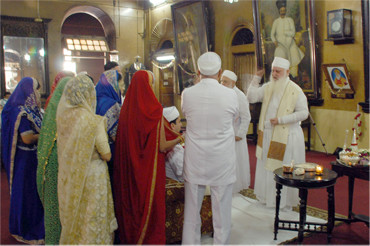
Dastur Firoze Kotwal (extreme right) "high priests’ opinions must prevail”
An aspirant to BPP trusteeship may be educated in any field and be an expert in any profession, but he must, above all, be a devout Parsi. There is no substitute for a good person whose sole motivation for standing for trusteeship is to protect community assets and use them wisely for the benefit of the Parsi community.
In recent times, a few irresponsible leaders and a small but powerful group of ultra radicals have been persistently attacking the sanctified practices of the faith. The BPP elections assume great importance in view of these attacks and a greater onus lies on voters to elect persons who will safeguard our religious institutions from such attacks.
In view of the present controversy about the mode of disposal of the dead, I would like to refer to dakhmenashini, in particular. The community’s well-being is intimately linked to the perpetuation of its religiously mandated practices. Dakhmenashini is one such religiously mandated practice. It is vitally important that the community elects persons who will uphold and strengthen the system of dakhmenashini. A BPP trustee, who is mandated to safeguard community interests, cannot accord recognition to any other system/mode of disposal of the dead. Only the Zoroastrian system, i.e. dakhmenashini, must be followed. Where there have been no dakhmas from the beginning, and no facility/capability to consecrate new ones, other systems are resorted to out of sheer helplessness. But that is not the case in Bombay and other parts of India. It is certainly not correct to say that cremation and burial are acceptable in the Zoroastrian religion. Therefore, an aspirant to trusteeship should enter the portals of the BPP understanding that he/she cannot encourage un-Zoroastrian practices like cremation or burial by giving facilities to those who want to use these modes of disposal which are distinctly non-Zoroastrian and religiously mandated against. No religion is meant to fall in line with the whims and fancies of an individual’s choice or requirements as religious customs and traditions are mandated for the collective good of the community.
If the system of dakhmenashini has weakened somewhat, it is the community’s duty and the BPP trustees’ responsibility to strengthen it. Experts have studied the situation at Doongerwadi and opined that it is possible to bring the vultures back. The few who are against the system will create all sorts of obstacles to prevent the vulture project from being brought to the Towers of Silence. That is why we need strong BPP trustees whose commitment to upholding dakhmenashini is unwavering and who will work vigorously with the experts to bring the vultures back. This single action will strengthen dakhmenashini permanently, thereby removing much of the controversy and confusion created by the anti-religion coterie.
To conclude, the community must be alert and elect persons of integrity and strong moral fiber who will not succumb to irreligious demands, but will work with zeal in conjunction with learned high priests to strengthen the beliefs and practices of the faith; who will protect our religious institutions as well as other community institutions; who will safeguard the religious identity of the community; and who will have no affiliation to organizations whose aims and objects run contrary to those of the BPP, thereby avoiding conflict of interest in administering the BPP trust.

Former high priest of the H. B. Wadia Atas Bahram in Bombay, Dastur (Dr) Firoze M. Kotwal is the author of several books and articles on Zoroastrianism. He was formerly principal of the M. F. Cama Athornan Institute, a visiting lecturer at the School of Oriental and African Studies, Harvard University and a visiting fellow at Clare Hall, Cambridge University.
◆ ◆ ◆
From the archive