
Zoroastrians Abroad
"The other side of the picture"
Novelist Boman Desai speaks of the interweaving of fact and fiction that makes for literature
"Writing is a way of understanding people, how and why they do the things that they do,” says novelist Boman Desai.
In Bombay for the launch of his grandmother’s autobiography, Soonamai Desai of Navsari, on March 16 (see "Soonamai’s free spirit,” page 40) the author of Trio, The Memory of Elephants, A Woman Madly in Love, shared his memories with the audience at the K. R. Cama Oriental Institute and related how occasions in Soonamai’s life, recalled at his bidding when she was all of 98 years, had provided elements of characterization to his work. To emphasize the point he was making, Desai read out parallel passages from the autobiography and his own novel Servant Master Mistress.
Depicting the lives of two generations of the Sanjana family — more than four, if you take in the upbringing of the first generation and the children of the second — Servant… begins with a tableau of the main protagonists in their holiday home in Navsari where each one faces a moment of reckoning as an adolescent tiger gets his first taste of human blood. The terror of the moment unravels in each mind its own history of perceptions, experiences, mistakes… Some of the venues of the events as they unfurl, as much as the life and character of the matriarch Dolly, reflect facets of Soonamai’s life. And Desai peers into the motivations behind sexual overtures as much as social mores.
In A Woman... he had drawn on the recollection of his 17-year-old student colleague in Bombay dating a teacher. "An image of the two of them walking together had stayed in my mind because I had been impressed with his confidence. Other classmates would have fidgeted or bounced on their feet or otherwise displayed their insecurity. At the time we envied him because she was an attractive woman, but years later my envy turned to curiosity. However fine he may have been, he was just 17, and I wondered what may have prompted her interest. The book is my answer to the question. I don’t know what actually happened and needed to imagine what may have happened,” Desai had told Indira Rodericks of the Afternoon Despatch and Courier (March 15, 2004).
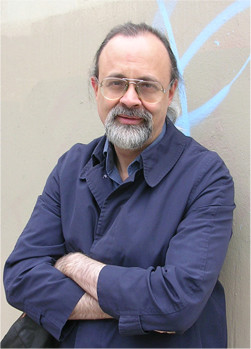
Boman Desai: books and music, landscapes and seascapes
It is an artist’s privilege to mold the raw material of life in the fire of his own imagination and experience. As "farmhand, bartender, dishwasher, short-order cook, secretary, musician, bookstore clerk, telephone operator, auditor and teacher” as notes the descriptive blurb in A Woman…, Desai’s part-time jobs have endowed him with enough of the latter.
"Growing up in Bombay, everything was done for me; in the States, I was taking up jobs that, in a sense, were servant jobs. I saw the other side of the picture…. I didn’t take as many things for granted,” he had told Anupreeta Das who had asked him how valuable this experience was (The Indian Express Magazine, March 4, 2001).
"Writing was not a gleam in my eye…When I was in Bombay in the 1960s I didn’t think of writing, never thought of journalism… I don’t read much news, only go to the TV for news,” the middle aged, pony-tailed author told Parsiana in the course of a subsequent interview on March 22, 2007. "The what of life is, to me, journalism. I don’t mean that as a pejorative, only a description. Journalists don’t have time to dig deep, but novelists are not unlike psychologists for their characters. Literature concerns itself as much with the why as the what,” he noted in an interview featured on his website (www.bomandesai.com).
The seed had been laid a long time ago when he had read Lilith by J. R. Salamanca — the story of a schizophrenic woman and the therapist who falls in love with her. "Schizophrenia is a retreat from life…The author had shown how the woman had taken paths that diverged from reality,” says Desai, appreciating not only the author’s "phenomenal lyricism” but the analysis of character that stayed with Desai even when he subsequently majored in psychology. "It meant a lot to me,” he says of the book he has read and reread four to five times.
Desai’s most ambitious undertaking to date has been the two volume Trio — the fictionalized biographies of Robert Schumann, his concert pianist wife Clara and Johannes Brahms and the attraction between the latter two which held together during the lifetime of Schumann and dissipated after Schumann’s death. Noting that he had used "correspondence in the form of dialog,” Desai revealed some of the intricacies of Brahms’ life as it was woven with Schumann and the much younger Clara, the greatest woman pianist of the century "who was billed as the widow of a living man” despite the couple having eight children together, because Schumann was schizophrenic. "Brahms’ First Piano Concerto was booed when it was first performed. Now it is recognized as a classic,” says Desai. Also, he refers to Brahms’ Freudian failing: "Where he felt passion, he felt no love and when he felt love, he felt no passion.”
As these lives play themselves out in Desai’s book, 19th century Europe provides its own background drama — the unification of Germany under Otto von Bismarck and the great musicians of the time, composers and showmen like Louis Berlioz, Felix Mendelssohn, Frédéric Chopin, Franz Liszt. And, straddling their achievements, the inspiration from Johann Sebastian Bach, Wolfgang Amadeus Mozart, Ludwig van Beetho-ven, Franz Schubert…So well has Trio been appreciated by its readers, a Mexican reader has registered his enthusiasm to translate it into Spanish.
Desai’s other works include The Memory of Elephants, Asylum USA, articles and short stories published in a vast cross-section of magazines in India and North America. He has also appeared on various platforms to read from his books.
The son of Phiroz and Vera Desai, Boman grew up in Bombay, securing a diploma after three years at the Academy of Architecture. The institution then functioned from the Bharda New High School and Desai remembers that the drafting department shared space with the office of Pradeep Amerkar, then headmaster of the Academy. Never truly interested in the subject, Desai says his diploma was a "lot of rubbish…I worked on 30 buildings in 30 days…I only got the diploma for completing the course!” Nonetheless, he went on for another two years (of a five-year course) to the Illinois Institute of Technology in Chicago where he says he took two arts and two science subjects. "Literature and physics clashed…I never liked science, I felt I had no aptitude for it (though the aptitude tests showed I had equal propensity for arts and science)…I liked the artistic elements of architecture, not the structural.” Nonetheless, he notes that he was one of four who passed from among 14 in the first two years of the course.
The focus on architecture had its uses, however. "If I had not focused on architecture, I couldn’t have gone to the US,” he admits, recalling that at that point in time (in 1969) visas were only available for students pursuing science subjects. The university experience also came in handy as background material in The Memory of Elephants. Besides, "father was gung-ho about it. He was convinced he’d let me go and let me stay on. I liked the (prospect of) independence. When you are here, you are subject to your parents’ decisions. You have to grow up before you realize that parents are human, that they can be wrong. You have to find a way to break with them without upsetting them.”
Adept at the piano, Vera (née Saklatvala) had been unable to pursue a career as a concert artiste because of family commitments; she took to teaching the piano instead. Boman says the classical music he heard her play seeped into his subconscious. He says he has "studied music in theory rather than practice; I know more about the composer…At one stage I couldn’t have said anything about the difference between Beethoven and Mozart.” Now he says he composes music as a hobby, his music "a blend of Brahms and rock-n-roll...for the base, drums and electronic keyboard.” He has played at coffeehouses and a friend had wanted him to join a band. He has composed the music and lyrics for The Beatle Song — "You can’t go wrong with a Beatle song,” he tells us. "It’s got 20 Beatles’ titles in it!”
The sound of music his mother made at home also affected his younger brother — and only sibling — Ronnie who has made a name for himself as a music man in the advertising profession and even released two cassettes in the 1970s and 80s, as notes Boman.
Over the years Boman has pursued a course in creative writing, falling off every time he started to work on a book of his own, as he notes on his website. For a long time he lived an alienated existence in Chicago. Not of religious bent of mind, it’s only in the latter years that he has made an occasional trip — "once or twice a year” — to the Darbe Mehr, when there is a prospect of a ride. He does not own a car, does not drive. He says he came to know Rohinton and Roshan Rivetna and the rest of their family when they attended his book readings in the city. Another point of contact was Zarine Weil — a relative, as Boman’s grandmother Soonamai and Zarine’s grandfather were brother and sister. He counts architect Kamalrukh Katrak, who lives in the vicinity, among his friends. Though he has attended one or two North American congresses, his interface with the community has been limited and the issues the community is constantly debating seem to be unknown to him and of scant interest.
"A book can take you to different places, but so can music,” feels Boman, speaking of "landscapes and seascapes… The landscape in Brahms’ Fourth Symphony just stayed with me!”
◆ ◆ ◆
From the archive