
Books
“King of venues”
The Rupa Companion to the ICC Championships Trophy 2006 including a history of the Brabourne Stadium by Bakhtiar K. Dadabhoy. Published in 2006 by Rupa and Company, 7/16 Ansari Road, Daryaganj, New Delhi 110002. Pp: 114. Price: Rs 95.
The Rupa Companion to the ICC Championships Trophy 2006 including a history of the Brabourne Stadium by Bakhtiar K. Dadabhoy. Published in 2006 by Rupa and Company, 7/16 Ansari Road, Daryaganj, New Delhi 110002. Pp: 114. Price: Rs 95.
The Rupa Companion to the ICC Champions Trophy 2006 is a comprehensive handbook for cricket fans interested in the ICC Champions Trophy held in India from October 7 to November 5, 2006.
The book begins with a chapter on the format and history of the tournament, profiles the venues and provides a detailed itinerary of the tournament. A detailed history of the Brabourne Stadium is the subject of the next chapter. The following four chapters cover in some detail the four tournaments played so far.

Bakhtiar K.Dadabhoy: recording scores
For the statistically minded there are chapters on ICC Champions Trophy records and One Day International (ODI) records updated till July 31, 2006. Handy blank score cards have been provided at the end of the book for readers who might wish to keep their own record of how the tournament progressed.
In the world of cricket the ICC Champion Trophy (previously known as the ICC Knockout) is second only to the ICC World Cup in order of importance, often referred to as the Mini World Cup.
The book has synoptical bird’s eye-view notes on all the prior 49 ICC Champions Trophy matches held in 1999, 2000, 2002 and 2004 along with the current ODI records.
The crowning jewel of the book and actually the meat of the book is a fascinating chapter on the Brabourne Stadium with eight hitherto unpublished rare photos of Lord Brabourne and the Brabourne Stadium from the Cricket Club of India (CCI) archives. This chapter takes us through the myriad ups and downs in the fortunes of CCI and the painstaking effort that went into the creation and maintenance of this great stadium and the cricket ground, especially the contributions of Sir Roger Lumley, Lord Brabourne, Anthony de Mello and the erstwhile maharajas of Porbundar, Patiala and Idar. The book traces the munificent contribution from the Tata Memorial Fund and the financial adroitness of Sir Nowroji Saklatvala and A. A. Jasdenvala without whose efforts the CCI which was facing a serious financial crunch would have crashed. The stadium was inaugurated on December 7, 1937 on a budget of 19.9 lakhs but paradoxically the renovation of the Brabourne Stadium in 2006 for the ICC Champions Trophy cost the Club Rs 13 crores of which the lighting, cabling and the cost of generators was six crores to hail it as a day-night venue. When asked about the expenses Raj Singh Dungarpur said, "The idea behind starting the Club in 1937 was to promote cricket. Forget the expenses, it is a privilege to host these events.”
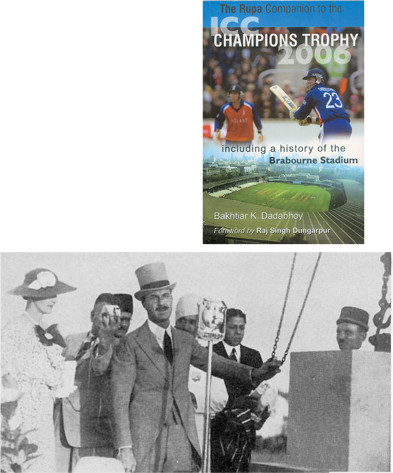
Lord Brabourne laying foundation stone of Brabourne Stadium on May 22, 1936
This lovely chapter on the Brabourne Stadium contains a rich and fascinating account of some very important matches be they Pentangular, Ranji Trophy or the Test matches played in this "king of venues.” Dadabhoy’s style in unfolding these old gems is both exhilarating and exciting.
The book has almost nothing on tactics and technique of the game. It is a book for the aficionado of cricket rather than a budding cricketer. It is nostalgic, not instructive. If you are a lover of cricket you’ll cherish it. If you are a cricketer seeking insights into the theory and practice of the sport you’ll be disappointed. It is a good book... not a great one. Readers who have read Dadabhoy’s A Book of Cricket Days will find this book under-researched and perhaps hurriedly collated. But then at 114 pages and costing a mere Rs 95 it is indeed packed with enough statistics to be a good and authoritative little volume of ready reference.
Dr ROHINTON MEHTA
◆ ◆ ◆
From the archive