
Books
Cricket 366 days!
A Book of Cricket Days by Bakhtiar Dadabhoy. Published in 2004 by Rupa and Company, 7/16, Ansari Road, Daryaganj, New Delhi 110002. Pp: xv+793. Price: Rs 595.
Bakhtiar Dadabhoy’s A Book of Cricket Days is a goldmine on cricket and cricketing trivia, anecdotes and incidents both on and off the field. This work is painstakingly researched and innovative in content and style. The book embroiders bare facts with statistics for each day of the year. Yes, 366 days! It tells us what happened on each day throughout the history of world cricket!
Dadabhoy’s single-minded and innate fascination with cricketing dates translates itself into a stunning work that breathes, eats and lives cricket.
Each day is clinically analyzed to include cricketing milestones, happenings, history, birth dates, debuts, centuries (including double, triple and quadruple), unusual dismissals, quotes, anecdotes, deaths, controversies, scandals, achievements and all else ‘cricket!’
It is a remarkable and unprecedented piece of work by this Delhi School of Economics educated civil servant who was featured on BBC’s Mastermind in 2000 and who is a regular columnist for the Hindustan Times. He had earlier authored A Dictionary of Dates.
The book indeed makes incredible reading like Sarfraz Nawaz’s seven wickets for one run in 33 balls when the invincible Australians collapsed from 305 for three to 310 all out! Or the day when Malcolm Nash was savaged by Gary Sobers for 36 runs in an over! The community will be thrilled to read about the Test between India and England in Calcutta in 1984 where both umpires, Dara Dotiwalla and Pilloo Reporter, were bawas! And a rhyming scoreboard which read: D. K. Lillee c. P. Willey b. G. Dilley!
It was on January 31, 1890 that "G. F. Vernon’s XI lost to the Parsis by four wickets at Bombay. The first overseas team to visit India, they had been unbeaten on the tour thus far. The captain of the Parsi team was J. M. Framjee Patel who is now more famous for his pioneering book Stray Thoughts on Indian Cricket. The visitors were feted by a reception organized by a committee headed by Sir Jamsetjee Jejeebhoy and hosted by Sir Dinshaw Petit in his mansion. Framjee Patel described this as the advent of the golden age of Parsi cricket.”
Among the Parsis mentioned in this work are Indian wicketkeeper K. R. Meherhomji who played his sole test against England in 1936. He was one of the key cricketers in the 1930s playing in the Bombay Quadrangular. Farokh Engineer, the "flamboyant Indian wicket- keeping batsman was the first Indian to win a Man of the Match award at the World Cup and was at 36 the oldest Indian player to make his ODI (one day international) debut.” The first Indian to score a double century in Test Cricket was Pahlan Ratanji ‘Polly’ Umrigar who also held the record for the most tests played, most runs and most centuries for India before Sunil Gavaskar.
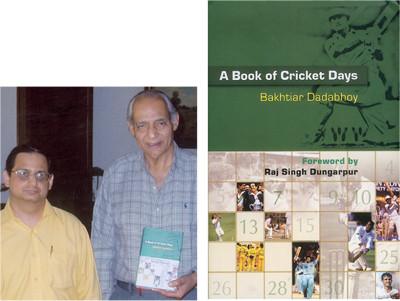
Dadabhoy (left) with Raj Singh Dungarpur, president of the Cricket Club of India
The Kanga Memorial Library in Bombay and the Kanga League played during the monsoons are named in honor of Dr Homi D. Kanga who made the first double century in the Presidency matches. The Irani Trophy contested by the Ranji Trophy champions and the Rest of India is named after Zal R. Irani, former president of the Board for Cricket Control of India (BCCI).
Critical of the communal nature of the Pentangular tournaments, A. F. S. ‘Bobby’ Taleyarkhan had reportedly played an important role in their demise. Famous for his cricket commentary and lively wit, he was loathe to sharing the mike with others! A gate at Bombay’s Cricket Club of India is named in his memory.
The author of Parsi Cricket, published in 1901 was Dr Mehallasha Edulji Pavri, "arguably the first great cricketer from India... (who) played for the Parsis for 28 years (24 years as captain).”
If you want to know who did what, where, how, when and why in the unending expanse of world cricket you can rest assured you will find it in the over 3,000 detailed entries in Dadabhoy’s book which has almost all the cricketing answers. For example, did you know that there were cricketers by the name of Julius Caesar and Yasir Arafat? Or that Peter Jackson, director of the Lord of the Rings asked the crowd in an ODI to make growling sounds for use in the war scenes in his movie The Two Towers!
The book is a cricket lover’s delight guaranteeing hours of entertainment and perhaps in the process creating even more ‘cricket widows!’
Dr Rohinton R. Mehta
◆ ◆ ◆
From the archive