
Comment
The sacred encounters - II
Ilm-e-Khshnoom is divine spiritual knowledge, state the mystical movement’s devotees
The first installment (Parsiana, January 21, 2007) dealt with the life and times of the Ilm-e-Khshnoom founder, Behramshah Shroff. This second installment explains the philosophy of the mystical movement he established.
What is Ilm-e-Khshnoom? The word "Ilm” belongs to the Farsi (Persian) and Arabic languages. It means knowledge; information; a branch of worldly or mystical science; mysticism; gnyan. Both the languages, Farsi and Arabic are the daughters of the Pahlavi language. Pahlavi as a language has its roots in Keyaan Pahalvi, a language current in the times of Keyaan Shahs (kings) and Asho Zarathushtra [for further elaboration on this theme see Dr Faramroze Chiniwalla’s series on western oriented studies of the Zoroastrian religion in Parsi Avaz (1947-48).]
The word "Khshnoom” occurs directly in the Gathas at two places, Gatha Spentomad: Yazashney Has 48-12, and Gatha Vahishtoisht: Yazashney Has 53-2. Different scholars of oriental philology have given various meanings to the word. Altogether they would culminate into: Divine spiritual knowledge which sprinkles bliss, peace, ecstasy, devotional calm and contentment into the heart and mind, and which requires a keen intellect to grasp it (see Kavasji Kanga’s translations of the Gathas).
The purport of Gathas, Has 48-12 and 53-2, is that Khshnoom is the divine possession and property of the "Saoshyants” who bring it down to humanity from time to time. They are the saviors and deputies of the Prophets, who descend on the earth to show the humans the divine paths of "din”s (religions) leading to Ahura.
Ilm-e-Khshnoom is a term used by the Ashavans of the Daemavand Karsh themselves to indicate the mystical knowledge and spiritual wisdom contained in the Zarthosti din.
Zarthosti din proclaims that every religion on earth is sent by Ahura Mazda through His ordained Paigambars, Prophets, Avatars and Saoshyants [see Gatha Has 31-11, 33-13, 34-13, 46-6 where the word "daenao” — plural of "daena” (=religion) occurs. K. R. Cama has taken Daenao as such plural in his Gujarati Zarthushtra Nameh. The Gujarati book Vatlavana Savaal no Vaad-Vivaad by Dr Faramroze Chiniwalla deals with this topic extensively].
The first and foremost truth declared and revealed by every religion is that a supreme divine entity exists, call it God, Ishwar, Allah or Daadaar Ahura Mazda. This is not just a matter of belief; it is the truth which very much exists. But that truth is not intellectually provable. [Goddel’s Incompleteness Theorem propounds that even an ordinary statement has an unprovable element inherent in it. Science and common sense are not the ultimate proofs of truth and reality. Mind of God by Paul Davis (Touchstone 1992) and End of Science by John Horgan give an idea of the present plight of science (Helix 1996). Also, US magazine Discover (October 2006, pg 57).] It is a mystical truth beyond the senses and consciousness of the ordinary non-saintly humans. It is the Truth to be attained by actual experience and spiritual exertions. Different exertions are provided by different religions, but their aim and object is the same, namely to reach and experience God. Every religion teaches that every moment of life on earth is a spiritual exertion, a journey on the divine path leading to God. And, therefore, every religion provides "do’s and don’ts,” some general and common and some specially provided for each. Every human is duty-bound to follow the religion of his or her birth.
Is not the preceding paragraph a narration of mysticism i.e. a science which points to the truths that lie beyond the capacity of our senses and intelligence? And that is the definition of mysticism. Thus, religion by itself is mysticism. No religion can be without it. The Jewish religion has its own mysticism, Kaballah. Sufism is the mysticism of Islam. The Christian religion has Gnostic, Rosicrucian and other mysticisms. The Hindu dharma (religion) has several branches of mysticisms such as Vedant, Tantra, Vaam Marg, different Devtas, etc.
The mysticism of Mazdayasni Zarthoshti daena is Ilm-e-Khshnoom, a small spring of which was poured into the heart of Behramshah Shroff by the Ashavans of the Daemavand Karsh.
Who are they? A cluster of the holy Zarthoshti Abeds, who have attained the high spiritual status and level of Ashavans, reside in the sacred Karsh. There also reside a couple of thousand Zarthoshtis leading a family life. They are mainly agriculturists, but have extremely good destiny of being born in this sacred place. Their spiritual positions are higher than any humans who are born on the earth of our observation and experience. Khshnoom writings have recorded the amazing accounts of the life in the holy place as seen by Behramshahji.
What does Ilm-e-Khshnoom teach? There is a very popular notion among the majority of Parsis that our religion is very simple — MGK — Manashni (thought), Gavashni (word), Kunashni (deed). Actually this notion is an excuse for running away from religion. Firstly this MGK is not a "simple” affair. What is "good” is a huge question. All religions proclaim that good is defined by God through His Prophets and not by this minuscule insect called man. Secondly, all religions teach MGK; it is not a monopoly of the Parsi religion alone. Thirdly, thought, word and deed are too difficult to define. Thought involves a most complicated science of the mind (the magazine Scientific American offers six special issues on the science of the mind, in the year 2007). Word, language, expression are the most wondrous and incomprehensible faculties of the humans. And deeds — doing, living — are the mysteries wrapped in enigma.
The human is more inclined towards dushmata, dujukhta, dujvarshta — thoughts, words and deeds declared as evil by all the religions (see Bhagwad Gita 2-67; Gatha 53-6; Mathew 6-13). The humans have to alchemize the seeds of evil stuck within them. For this, every second of our life is to be spent according to the path and prescriptions provided by religion [Gatha 30-2 ("Vichithahyaa”)]. The prescriptions of religions, i.e. the procedures — tarikat — commanded by them are to be practised every moment of life to alchemize the evil within us to good.
The Zarthoshti din prescribes sudreh-kusti, Manthra prayers, Atash-Parasti, Yasna-Kriyakaam, dakhme-nashini, Meher-Patet (to be away from sins as enumerated by the din and repent if we fall) and Boonak-Pasbaani, the preservation of the racial gene. All these are gifted to us to give us strength and energy to practise MGK.
Ilm-e-Khshnoom teaches the mystical science behind each of these prescriptions and shows how to practise them and to immerse your heart in the fountains of spiritual devotion and bliss. Only the tongue which has tasted Khshnoom knows its divine taste; the tongue which has tasted it not, just burbles and gibbers. Those Parsis who have ignored it know not what they are missing. Concluded
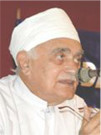
A lifelong student of comparative religions, science and Ilm-e-Khshnoom, Ervad K. N. Dastoor is editor of the quarterly Khshnoom organ, Parsi Pukar and is a practicing lawyer.
◆ ◆ ◆
From the archive