
Zoroastrians Abroad
To rouse the soul
A devotee of Behramshah Shroff, Silloo Mehta carries her message of religious devotion to the Zarathushtis of North America
Silloo Mehta lives by the adage "It is better to light a candle than to curse the darkness.” For the past 25 years she has been nurturing The Mazdayasnie Connection – a religious body in California whose mission, she says, is to spread the original teachings of the Zarathushtrian religion through the light of Ilm-e-Khshnoom (see "The sacred encounters — II,” pg 20).
The non-profit organization founded in 1982 just celebrated its silver jubilee and, to Mehta’s greater joy, combined the event with the centenary celebration of Ilm-e-Khshnoom as first propagated by their revered guru, the late Behramshah Shroff in 1906. A religious, cultural and historical exhibition at Dadar Parsi Colony’s Palamkote and Athornan Madressa Halls on December 30, 2006 to January 1, 2007 marked the occasion.
Gujarati nataks and English plays, lectures by popular speakers, multi cuisine food stalls and models representing various religious themes, painstakingly assembled and transported from California as well as Iranian artifacts provided a variety for eyes and ears for people who freely flowed through the precincts. It had meant a large investment in time and money, Mehta told Parsiana, but she was happy that two high priests – Dasturs Meherji Meherjirana of Navasari and Dr Peshotan Mirza of Udvada – and Ervad (Dr) Ramiyar Karanjia, principal of the Madressa respectively presided over the event on the three days.
"The event is planned to rouse the slumbering souls of some of our co-religionists, inflaming enthusiasm with a renewed vision; answering the seekers and bringing together our community members with abundance of love and understanding; an energizing dawn of fresh beginnings and new possibilities,” she had noted in The Mazdayasnie Connection, the body’s quarterly journal in its Winter 2006 edition.
Mehta’s models, created from a variety of material including electric lighting, were meant "to bring the importance and love for the Prophet” into the consciousness of her coreligionists. Through these she sought to depict the birth, childhood and work of Zarathushtra, the significance of pav mahal ceremonies, of the navjote, of sudreh-kusti, etc. According to her, "the vibrations of Yatha, Ashem and Yenghe Hatam permeate the universe, but are dormant until activated by Zoroastrian prayers… People think Khshnoom is different. But it only explains what we do…What is ‘alat’? (They are items that) absorb divine currents and transmit them all around us.”
One of the focal points of the three-day festival was the recital of the Sohrab and Rustom and other episodes from the Shah Nameh by Sadeq Zadeh, the keeper of Firdausi’s mausoleum in Toos. Mehta, who says she speaks, writes and reads Farsi interpreted his declamation for the benefit of the local audience. An Iranian Zarathushti had contributed US $ 500 for Zadeh’s air travel and Indian visa, she tells us.
Mehta says she doesn’t like living in California. She would prefer to live in Iran. But she continues to reside in the US because her instinct tells her that Parsi Zoroastrians there need her to teach them their religion. This she does with The Mazdayasnie Connection, a "magazine of the Zarathustrian religion.” Articles on the muktad or Farvardegan days, the 101 names of Ahura Mazda, reincarnation and the laws of Karma, Maneckji Limji Hataria’s mission in Iran, a prayer corner explaining chosen prayers and their efficacy, explanations for children, are some of the ongoing contents of the publication. Another dedicated activity is holding annual week-long camps since the past 16 years where lawyer and Ilm-e-Khshnoom scholar Ervad Kaikhusroo Dastoor from Bombay presides over the religious education of the 20-25 devotees who attend. A series of events including the presentation of plays (she is her own playwright) with a religious theme keep the calendar ticking.
A member of the Zoroastrian Association of California (ZAC) as well as the Iranian Zoroastrian Center in the US, Mehta says ZAC members come to her programs, support her work and enable her to hold her classes in their homes.
Among the North American Parsis Mehta’s popularity is further buttressed by the two tours she organizes every year, for three weeks in spring and fall, for Zarathushtis who want to see the sights of Iran, learn the history and understand the religious significance of some of the tenets they practice blindly. A ridiculously small staff comprising herself, her husband Phiroze and tourist guide Malcolm Bhesania, and a couple of others ensure all the activities. Those who have experienced Mehta’s skills as tour operator, swear by them. Keeping the groups small – 10 to 15 persons, she says – ensures they have ample room in the 40-seater air-conditioned bus she hires and space to carry "cooking vessels, choola (stove), masala (cooking ingredients), everything that is not available locally.”
"Can a 60-year dream come true?” asks the ebullient Ervad Soli Dastur of Florida and answers, "Definitely yes, if you request Silloo Mehta.” According to him the "Iran tour operator extraordinaire” arranged the visas and provided the "best Iran guide in Malcolm…We must have visited over 25 cities, over 40 sites and traveled over 1,500 km by bus, 900+ km by air and 900+ km by train in these 21 days!”
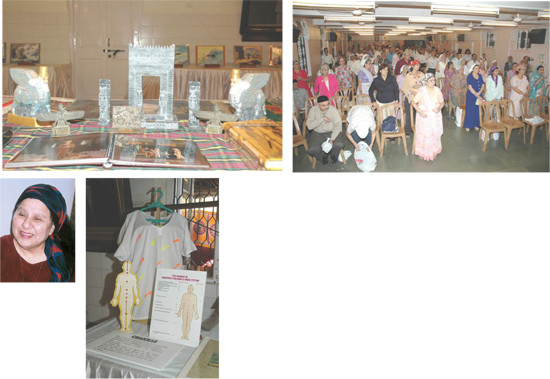
Top left: a model at the exhibition; right: the audience rose to pray. Above: An explanation of the sudreh
Mehta’s personal care included breaks from the "monotony of chello-kebabs with fish curry/rice, biryani, sali murghi, malai breakfast and more,” all cooked by her in the restaurant kitchens or open air, writes Toronto’s Ervad (Dr) Jehan Bagli adding, "We cannot imagine any tour operator going to that length for the group...You added a distinct presence of spiritual component by starting and ending the day with a short communion. Going through those ancient atash kadehs, allowing time for prayers and spiritual harmony and learning about the stories of these ancient fires added a clear flavor of pilgrimage to the land of Asho Zarathusht.”
Bombay born Mehta (née Patel) studied at the Alexandra Girls’ English Institution and later taught there for five years, shifting thereafter to the Maneckji Cooper School in Juhu. Wed to Phiroze Mehta in 1957, the couple with five children, lived long years in the Pandey Sanatorium. It was Alexandra trustee Behroze Cursetjee, granddaughter of the School’s founder and secretary to a member of the Tata family who used her influence to get her a preference flat at the Tata Colony in Bandra. Tight for funds and obliged to pay four years’ rent in advance, Mehta recalled she opted for the smallest one — a one room kitchen facility which she still calls home when she comes to Bombay.
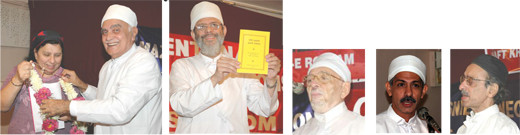
L to R: Mehta being garlanded by Kaikhusroo Dastoor; Peshotan Mirza; Meherji Meherjirana, Ramiyar Karanjia and Adi Doctor. Center: Silloo Mehta
When Parsis started going to Iran in substantial numbers in response to the Shah’s invitation in the 1970s, Mehta says her father was the first to take tours to that country. On one such tour he included her and her family. It marked a turning point. "I saw that teachers were well paid there and decided to try my luck with help from (the late) Peshotan Nargolwala.” Husband and wife took a sabbatical from their Bombay jobs, went to Iran where she started her own school, a nursery and kindergarten, in Tehran in 1974 called Shah-panah (panah meaning protection). She has a special affection for the late Shah, recalling how her husband, with a talent for magic tricks, had performed for the royal family. They lived through the Islamic revolution even though the fanatics threatened to burn her school and demanded that she change its name to Khomeini-panah. Mehta eventually changed the name to Iran-panah and succeeded in retrieving her investment ere she migrated to the US in 1980 and worked with a transport company in California for two-and-half years before she could start her own preschool and extended daycare — the first of four. The last one she says she sold to a Korean lady 10 years ago.
A scarf demurely covering her hair in traditional style, the soft, fair face radiating friendliness, the grandmother of 10 is a strange combination of mystic beliefs softly espoused and business sense. She continues to hold on to a room in Tehran which becomes her base there and, since 1998 has begun the Iran tours which have made their mark among North American Zoroastrians. To her, "The tour is not always commercial. I look at it as a chance to teach the religion.” To make up the financial slack she brings back artifacts to sell, setting up a stall at events such as the Zoroastrian congresses. Maintaining her Indian citizenship, Mehta is a US green card holder and a rare American who doesn’t drive, is reluctant to be photographed and describes herself as "a very strange person.”
◆ ◆ ◆
From the archive