
Books
Esoteric essays
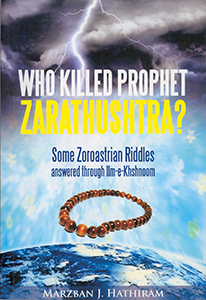
Who killed Prophet Zarathushtra? Some Zoroastrian Riddles answered through Ilm-e-Khshnoom by Marzban J. Hathiram. Published in 2013 by the author, 8/601. Behram Baug Parsi Colony, Oshiwara, Jogeshwari (W), 400102. Pp: xxiv + 229. Price: Rs 150.
Marzban Hathiram is full of beans. A chartered accountant, he gave up a lucrative job to join the newly established Ustad Saheb Behramshah Shroff Dar-e-Meher in Oshiwara, a north Bombay suburb, where he serves as the panthaki-cum-boiwalla. Being computer savvy, he has a blog site www.frashogard.com on which he posts, from time to time, essays and write-ups on religious subjects as seen in the light of Ilm-e-Khshnoom.

Ervad Marzban Hathiram: religious blogger
The book under review is a collection of his blogs posted in the last few years, some of which have already appeared in a section of the Parsi Press. The subjects have been divided into three parts. The first and largest section deals with what he calls "Troublesome riddles and their real answers,” covering 130 pages.
Many pieces in this section are worth reading, such as "What is prayer?” "Our atash padshas are not mere fire,” "Can Parsis donate organs?” "What is the importance of the varasyaji?” "How is a new varasyaji consecrated?” However, one essay that needs to be contested is "What are the alternatives to sandalwood?”
On account of the acute shortage of good quality sandalwood and the consequent and continuous rising prices, the author suggests substitutes to offer to consecrated atash padshas, mainly cedar wood and camphor. To justify his stand, he has tried to give references from Avesta scriptures, particularly the Vendidad. He takes certain words occurring in different pargards (chapters) and gives their meanings. Many of these words, in chapters 8, 14 and 18 of the Vendidad mean "sweet-scented” or "fragrant.” Some do indicate such fragrant items as sandalwood, agar and frankincense.
The author pinpoints certain trees like cedar and camphor, the wood of which he claims can be used as substitutes for sandalwood. To buttress his stand, he invokes the name of Dr Framroze Sorabji Chiniwalla, the ophthalmologist turned Kshnoomist who, in his commentary on the Vendidad, has referred to Vohu-Kereti as camphor.
Before going into that, let us make a few simple observations. Throughout the history of the Parsis in India, when they had the Vendidad text with them, Zoroastrians have been very careful and specific in mentioning the names of items such as sukhad, agar, tagar, bawal and loban (frankincense) for use as offerings for the holy consecrated fire. Of course, in those times, these items were readily available and were affordable.
The Gujarati word ‘sukhad’ refers to the wood of the chandan tree. Parsis, to this day, use the expression "Padshah ney sukhad chadhhavanu (the fire should be offered sandalwood).” Sukhad trees are found even today in Gujarat and Maharashtra, in addition to the original strongholds of Karnataka, Tamil Nadu and Kerala. It is our contention that as long as sandalwood is available, whatever be its oil content, Parsis should continue to use only this wood. Here the author’s caveat about not using cheap logs of wood as offerings to the holy fire should be adhered to.
In his commentary on chapter 8 of the Vendidad, wherein reference is made to a roadside fire that has been polluted by naso or putridity, Chiniwalla cites the various sweet-scented offerings, including camphor and cedar. All these examples of fragrant woods have nothing to do with offerings meant for the consecrated holy fires of adarans and atash behrams; nor has he stated anywhere that this should be done.
In the second section, Hathiram has given some interesting instances of what are called "miracles” performed by Parsi Zoroastrians from different walks of life.
The final section deals with short biographical sketches in the form of tributes to the likes of the Chiniwalla brothers (Dr Framroze and Jehangirji), the late Dastur Meherji Meherjirana, etc who were noted practitioners of Ilm-e-Khshnoom.
Hathiram writes in a simple, down-to-earth style, although at times didacticism creeps into some sentences. The book’s attractive cover and tough binding would have made this paperback a must keep in every Parsi household, but for the off-putting title! The author should at least have put the wrongly used word "killed” in quotation marks!
Although this edition has been reportedly completely "sold out,” the author would do well to edit his blogs if he plans to bring out another collection in book form.
◆ ◆ ◆
From the archive