
Bombay Bawas
Ancient secrets of the faith
Our religion is a veritable storehouse of occult knowledge
Circuits of protection, vibratory intonations, purification rituals, aura healing and white magic to cure illness. Some pagan religion in Polynesia? Some heathen practices in South America? No sir, we refer to the Zoroastrians of India. When our agiaries, atash behrams and dakhmas are built elaborate circuits of protection are created, according to liturgical directions, to protect their sanctity; our prayers unleash powerful vibrations when intoned correctly; mobeds and behdins undergo periods of seclusion called nahan; nirangs cleanse the aura and Avestan magical spells can cure scores of illnesses, both physical and mental. No Polynesian paganism this.
Good words, thoughts and deeds; and nothing more, assert the liberals. Priests are babblers for money, rituals have been invented to impress the gullible and magical charms are mumbo jumbo. Unlike religions which prescribe fasting (Jainism), or proscribe alcohol (Islam), or ban beef (Hinduism), or mandatorily require church attendance on Sundays (Roman Catholics), or forbid work on the Sabbath (Hebrew), Zoroastrianism hardly has any dos and don’ts. Even if you never visit an agiary or never open the Khordeh Avesta or do not wear the sudreh-kusti, you are not a lesser Zoroastrian, say the rationalists. Maybe, but you are missing out on the rich, possibly the richest, occult heritage, counter the traditionalists.
It is rather unfortunate that most knowledgeable Zoroastrian occultists are rabid sounding fundamentalists. They use jargon which only a few beyond their ilk can understand. They are violently opposed to interfaith marriages and alternative methods for disposal of the dead. Intolerant of dissent, they oppose equal rights for interfaith married women and blood and organ donation, while emphasizing racial purity. As a result, they don’t appeal to the youth and are dismissed as comical figures on the fringe. Their low credibility is compounded by poor communication skills. Some deliver dreadfully boring diatribes on abstruse topics in agiary halls before half-a-dozen geriatric listeners; most of the latter are more interested in consuming the chasni (temple offerings) served after the lecture.
Good words, thoughts and deeds; and nothing more, assert the liberals. Priests are babblers for money, rituals have been invented to impress the gullible and magical charms are mumbo jumbo. Unlike religions which prescribe fasting (Jainism), or proscribe alcohol (Islam), or ban beef (Hinduism), or mandatorily require church attendance on Sundays (Roman Catholics), or forbid work on the Sabbath (Hebrew), Zoroastrianism hardly has any dos and don’ts. Even if you never visit an agiary or never open the Khordeh Avesta or do not wear the sudreh-kusti, you are not a lesser Zoroastrian, say the rationalists. Maybe, but you are missing out on the rich, possibly the richest, occult heritage, counter the traditionalists.
It is rather unfortunate that most knowledgeable Zoroastrian occultists are rabid sounding fundamentalists. They use jargon which only a few beyond their ilk can understand. They are violently opposed to interfaith marriages and alternative methods for disposal of the dead. Intolerant of dissent, they oppose equal rights for interfaith married women and blood and organ donation, while emphasizing racial purity. As a result, they don’t appeal to the youth and are dismissed as comical figures on the fringe. Their low credibility is compounded by poor communication skills. Some deliver dreadfully boring diatribes on abstruse topics in agiary halls before half-a-dozen geriatric listeners; most of the latter are more interested in consuming the chasni (temple offerings) served after the lecture.
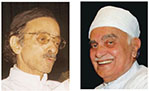
Late Adi Doctor (left) and Dastur K. N. Meherjirana
Quite a few of these speakers are Ilm-e-Khshnoomists (literally, science of ecstasy, followers of late Behramshah Shroff who claimed induction into esoteric aspects of the faith by some divine beings near the Caspian Sea) and some are Pundolites (followers of one Minocher Pundole who purportedly performed many miracles including conjuring cutlets out of empty Udvada hotel fridges). At the risk of generalizing, the former are usually knowledgeable and the latter, a bit gullible. The talks cover topics like Magav Sahebs of Demavand Koh; celestial customs of Mazdayasni din and the advantages of reciting the Moti Haptan Yasht. Parsi theosophists, followers of Madame Blavatsky, Annie Besant and C. W. Leadbeater, speak occasionally on astral travel and vegetarianism. Shroff’s followers, Pheroze Masani and Jehangir Chiniwala, published newsletters on occult teachings, titled Parsi Avaz, Dini Avaz and Parsi Pukar, some now defunct. Masani founded the Parsi Vegetarian and Temperance Society (interestingly, Pundole forbade his disciples from partaking meat but himself did so, on the basis that the atoms of his mortal coils were so finely tuned that they were immune to the polluting effects which flesh has on lesser mortals). Dastur Kaikhushru N. Dastur Meherjirana of Navsari is among the last of the knowledgeable Khshnoomists, as was the late Adi Doctor.
While some of their rabid assertions about genetic purity may repulse, it is unfair to dismiss all Zoroastrian occultists as loonies. Some of the most revered scholars believe that Zoroastrianism is a storehouse of esoteric or occult knowledge. While many may find it meaningless to recite prayers in a dead language which hardly anyone understands or find even its translation not so impressive, several will vouch for the efficacy of the vibratory intonations of some potent capsule prayers (at the end of the geh sarna, when the priests thrice utter the earthly memory severing words, Nemascha ya Armaitish izhacha; or the magical Ahunem vairim tanum paiti; or even a sonorously recited Yatha Ahu Vairyo, it does give goose pimples to the attuned). You may chortle at the awful smelling albino bull in the agiary compound or revere it as the holy varasyaji whose urine is the purifying nirang of many a sacred ritual. You may term the Vendidad prayer ceremony as an invention of post Zarathushtra clergy or find it an uplifting experience at dawn when the priest completes his all-night vigil. You may regard guardian spirits of fire temples as a hallucination of tired mobeds or trust in the collective experience of countless boywalla mobeds who have witnessed first-hand these mystical beings shrouded in all white sweeping through atash behram corridors in the early hours of the morning. You may mock those who daily invoke the protection of the Dog Star, Sirius, known as Tir Yazad in the Avesta or relish the stupendous cleansing energy it unleashes. Reputed occultists regard Zarathushtra as a great initiate and the first of the white magicians.
After the Prophet, the magician king Shah Faridoon was the greatest ever Zoroastrian occultist. He paralysed the demonic Zohak and composed miracle rendering nirangs in Pazand and Avesta which can cure many a debilitating illness of body and mind. Recited even today by the faithful, fe naame yazad, ba farmaane yazad baname nik Faridoon gaav daye, is the magical formula. King Vistaspa’s astrologer was the great Jamaasp who predicted, Nostradamus like, about the eons to come in his magnum opus, the Jamaaspi. In recent times, the much revered Dastur Jamshed Kookadaru of Kappawala Agiary performed many a miracle including turning a brick into gold to finance the stalled construction of the Anjuman Atash Behram despite knowing that he would pay a terrible price for this selfless act of alchemy in the form of losing his young son. His mantra, "Va Noor e dastagir, ya dastagir e Noor, karam kar karimaar, raham kar parvardigar, madad kar ya nabi, Zarthosht Teri Paadshahi,” is recited daily by the faithful to ward off evil and survive through difficult times.
Of course, rituals are commercialized and praying has become a business. Most mobeds are indeed ignorant of the glorious heritage of this ancient faith. And xenophobic scholars do not help the cause. Nevertheless, the fact remains that Zoroastrianism is not an elementary faith merely espousing good and simple living but an ancient knowledge system of great power whose many divine secrets will be revealed to those whose time has come to learn.
Berjis M. Desai, managing partner of J. Sagar Associates, advocates and solicitors, is a writer and community activist.
◆ ◆ ◆
From the archive