
Sports
The dawn and twilight of Parsi cricket
From being the champions of the sport, Parsis today no longer score in the game
In the last two and a half decades, Parsi cricket has slowly but steadily declined. Unfortunately, there is not a single Parsi cricketer who is knocking the door of even a Ranji Trophy team or junior team in any state of India.
The last Parsi cricketer to represent India in Test match cricket was wicket-keeper/batsman Farokh Engineer who unfortunately bagged a "pair” against the mighty West Indies team at Bombay in 1974-75. Engineer had the distinction of scoring 94 runs before lunch in a test match against the West Indies at Madras in 1966-67.
Since then no Parsi has represented the country at the test level. Rusi Jeejibhoy was selected to tour West Indies in 1970-71 as a wicket keeper, but was not fortunate enough to qualify for the final 11 during the five-Test series.
Though Noshir Mehta of Hyderabad and Zubin Bharucha of Bombay had sparkled at the national level with Bharucha scoring a century on Ranji debut and Mehta performing consistently for his team, unfortunately, their performance was not able to catch the eyes of national selectors.
Hoshedar, son of Nari Contractor, also could not fulfil the expectations. During the 2000-01 season, Rustom Shethna of Surat was also selected for the Gujarat One-day Ranji team, but was mercilessly deprived of a debut at the One-day Ranji match.
For the last few years it has also been observed that during the various All Parsi cricket tournaments, participants are not sufficiently committed to improve their standard. It is true that youngsters are loaded with studies but they prefer to use their spare time watching TV, videos and partying. Our youngsters lack the three important ‘D’s required to become a successful cricketer — discipline, dedication and determination.
Gone are the days of Parsi pioneers who could have walked into any Indian XI. Gone are the days when Dady Havewala could score 500 and odd runs at Parsi Gymkhana, Bombay. Gone are the days when Polly Umrigar became the highest run getter for India with 3,631 runs. Gone are the days when the Parsi community could provide two Parsis — Umrigar and Contractor to captain the Indian team.
Contractor had the distinction of captaining India in 12 Tests and Umrigar in eight Tests respectively. Contractor had to retire in very unfortunate circumstances after a head injury during the West Indies tour of 1961-62.
1961-1962 was the golden era of Parsi cricket, when four Parsis — Contractor (Captain), Umrigar, Rusi Surti and Engineer toured West Indies. In fact, all four played together in the first two Tests of the series!
Umrigar was the first Indian to score a double century in Test cricket — 223 vs New Zealand at Hyderabad in 1955-56. He held most of the Indian batting records at the time of his retirement.
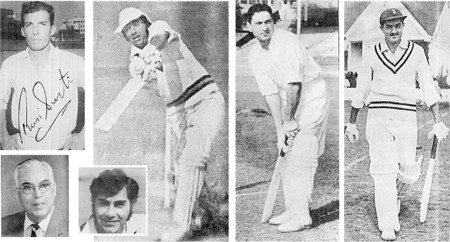
Yesteryear batsmen (from left): Surti, Engineer (also inset), Umrigar and Contractor Below left: P. E. Palia
The 11 Parsis (male) who have represented India in test matches are Phiroz Eduljee Palia (two tests, 29 runs), Sohrabji Hormusji Colah (two tests, 69 runs), Rustomji J. D. Jamshedji (one test, five runs, three wickets), Khorshedji (Kersi) Rustomji Meher-Homji (one test), Jenny Khurdadad Irani (two tests, three runs), Rusi Shehriarji Modi (10 tests, 736 runs), Keki Khorshedji Tarapore (one test, two runs), Pahlan (Polly) Ratanji Umrigar (59 tests, 3,631 runs, 35 wickets), Nariman (Nari) Jehangirji Contractor (31 tests, 1,611 runs, one wicket), Rusi Faramroz Surti (26 tests, 1,263 runs, 42 wickets) and Farokh Manekshaw Engineer (46 tests, 2,611 runs).
Ever since Indians took up the game of cricket seriously and methodically, in the latter half of the 19th century, the first community to play this game were the Parsis, who at that time were more westernized than members of other communities. The first Parsi club which came into existence was the Oriental Cricket Club in Bombay, in 1848. The Young Zoroastrian Cricket Club, Bombay was established in 1867 and has stood the test of time. It is 134 years old today and perhaps the oldest active Parsi club in the country.
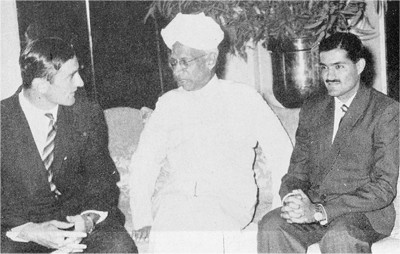
Then President of India Dr S. Radhakrishnan flanked by English team captain Dexter (far left) and Indian captain Contractor
The first ever cricket team from India to tour abroad (England) to play friendly matches was a Parsi team way back in 1886 and then in 1888. During the era of the Pentangular tournament, the Parsis won the same five times between 1906 to 1946.
Amongst the later generation of cricketers who performed creditably were J. S. Warden, H. F. Mulla, H. J. Vajifdar, H. S. Colah, R. J. D. Jamshedji, Kapadia brothers (Bahadur and Fali), Jamshed Elavia, M. P. Engineer, K. R. Meherhomji, K. D. Marshall, P. E. Palia, J. B. Khot, Dadi Havewala (of 515 runs fame), K. K. Tarapore, E. S. Aibara, J. N. Bhaya, R. S. Modi, R. S. Cooper, Col M. E. Mistry and a few others.
In 1911, the then Maharaja of Patiala led an all India team to England which included seven Parsis for an unofficial tour. They were K. M. Mistry, Dr H. D. Kanga, P. Bajena, M. D. Bulsara, R. P. Meherhomji, H. F. Mulla and J. S. Warden. The team was managed by another Parsi gentleman — J. M. Divecha.
In 1932, India was awarded test status and in the same year an all India team toured England, which included four Parsi cricketers — S. M. H. Colah, P. E. Palia, N. D. Marshall and B. E. Kapadia. In the only test played at Lord’s in 1932, Colah and Palia had the honor of representing India. In December 1933, when the MCC visited India, Colah and Jamshedji were selected to play for India, with Jamshedji creating a national record by making his Test debut at the age of 41 years and 27 days, against England at Bombay in 1933-34. This record is still unbroken.
It is true that none of the Parsi cricketers have played for India since 1974-75, but on the other hand the Parsi community can be proud of having produced a few umpires of the highest calibre since 1932.
When India started playing test cricket from 1932 onwards, Jesi Patel (nine tests), N. D. Nagarwala (five tests), Naushir Dubash and Hormusji Billimoria have served the game as umpires. Dara Pochkhanawalla of Bombay was an upcoming gold medalist in 1970, but was unfortunately deprived of getting into a higher grade of cricket. Later, he proved his mettle as a sports journalist and at present serves Asia’s oldest daily newspaper Mumbai Samachar as chief sub editor — sports.
In the "Tied” Test between India and Australia in the 1986 series in Madras was a Parsi umpire — Dara Dotiwalla of Bombay. He officiated in six test matches apart from nine One dayers. Another Parsi umpire of international calibre was Piloo Reporter from Bombay who had the distinction of becoming the first Indian umpire to be appointed for the One day World Cup tournament in 1992. He officiated at 14 Tests and 24 One dayers.
After retirement, both Dotiwalla and Reporter are still active in local tournaments in Bombay. Both are giving guidance to upcoming umpires and have extended honorary services to the Mumbai Cricket Association as well as to the Board of Control for Cricket in India (BCCI), for more than a decade.
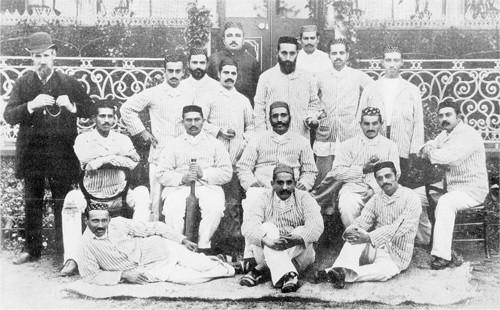
The Parsi team that toured England in 1886
At present, two Parsis are connected with the BCCI as all India panel umpires. They are Bomi Jamula (Bombay) and Shahvir Tarapore (Bangalore). Both are knocking on the doors of One day as well as Test matches. In fact, Tarapore is the second Parsi after Nagarwala to play first class cricket and also to officiate at first class matches as an umpire. His father the late Keki B. Tarapore had also played first-class cricket.
Three Parsi umpires are currently on the Ranji Trophy panel of BCCI, namely Bombay’s Jehangir Umrigar (since retired), Keki Doodhwala and Adil Palia (both of Surat). These three Ranji panel umpires are the product of the guidance and encouragement given to them by Dotiwalla and Reporter.
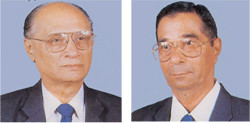
Umpires Dotiwalla (left) and Reporter
As for ladies cricket, nobody from our community has matched the achievements of Diana Eduljee of Bombay. She served the Railway team for more than a decade and is also responsible for raising the standard of Railway cricket teams (both men and women). She is the first and only cricketer to capture more than 100 wickets in Test cricket. Eduljee proved herself a useful all rounder in the true sense. She won the Arjuna Award and subsequently the prestigious Padma Shri in 2002. For the Railways she is the only lady on the men’s national selection committee. Her sister Behroze also played Tests and One-day cricket for India as a left arm medium pacer. Both sisters have played in a number of Tests and One-day matches together to create world records. During the 2001-02 season, they created another world reward by giving commentary together on a national TV channel for the Poona One-day ladies match between India and England.
In our country, it is extremely difficult to enthuse lady cricketers in view of cricket’s popularity as a man’s game. As such, the endless efforts of Alu Bamzi of Bombay should not be forgotten. She had served and encouraged lady cricketers not only in Bombay but all over India.
Among those who had played a major role in the management of cricket was the late J. M. Divecha, as the manager of the 1888 Parsi team (first ever from India) to England and then in 1911 of the all India team led by the late Maharaja of Patiala. Polly Umrigar, Keki K. Tarapore, Keki B. Tarapore and E. B. Aibara have served Indian cricket either as manager, coach, pitch curator or executive secretary. Z. R. Irani was the honorary treasurer of the BCCI from 1928 to 1946 and was the president of the BCCI from 1966 to 1969. The Irani Trophy played between the champion Ranji Trophy team and the Rest of India team is aptly named after him.
Dr H. D. Kanga was the first ever president of the Bombay Cricket Association. P. N. Polishwalla and Bapu B. Mama’s contribution towards publication of cricket related books as well as providing cricket statistics all over the world should also not be forgotten. Mama was a household name not only in India but abroad too.
No history of Parsi cricket can be complete without mentioning the name of A. F. S. Talyarkhan, popularly known as "Bobby”, whose commentaries on All India Radio were heard throughout the world when TV and video were not popular. His ball to ball comments were lively and to the point. With his untiring efforts the communal Pentan-gular matches were abolished — probably his greatest achievement!
The community, which has offered so much to Indian cricket in the past, now has nothing to offer. The Parsi youth have taken to activities other than cricket and even their numbers have unfortunately dwindled. Nevertheless, every lover of Parsi cricket hopes that a day will surely come when a Parsi cricketer, by his cricketing abilities, will set ablaze the cricket stadiums all over the world. It is only wishful thinking, nothing else!
However, with active talent scouting by our cricket conscious members, we can and we must find outstanding cricketers.
It is heartening to see the Federation of Zoroastrian Associations for Welfare and Culture (FOZAWAC) and the Parsi Gymkhana (both of Bombay), Secunderabad Club, Jamshedpur Club, Nagpur Club, Surat Parsi Panchayat and a few other clubs organizing single wicket, double wicket as well as six-a-side and full team tournaments for Parsis regularly. Yet more extraordinary efforts and action plans are badly needed to uplift the standard of young Parsi cricketers. Expert coaches should be appointed to train our young Parsi cricketers.
This article on Parsi cricket should infuse a new spirit amongst the present generation to work hard, hand in hand, for the betterment of the game.
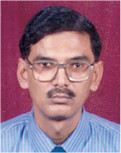
A national umpire of the Board of Control for Cricket in India since 1991 Keki D. Doodhwala has been a sports journalist for the last three decades. He has written and published several books on cricket in Gujarati.
◆ ◆ ◆
From the archive