
Books
Mandal’s magnetism
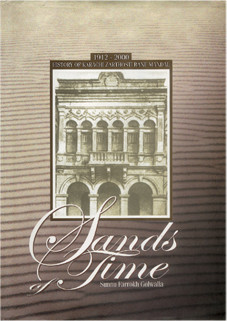
"It was exciting to find that what most people thought to be a small local charity had quietly journeyed into a wider circle of the community… It had honored the poet Rabindranath Tagore and America’s First Lady Eleanor Roosevelt when they visited Karachi. It had even published a recipe book (Manna of the Angels), a novel (Discovering Ashavan), a newsletter (What’s On) and several directories (A&T Directories, Blood Group Directory, Services Directory). There were also shortcomings, misjudgments and criticisms, but it was always an active association,” notes Sunnu Farrokh Golwalla, vice president of the Karachi Zarthosti Banu Mandal (KZBM) who felt a compulsion to record the accomplishments (upto December 2000) of "this vibrant association and the ladies who had devoted their time and energy to do impressive and meaningful work,” thereby leaving their imprints for inclusion in Sands of Time as her compilation is titled.
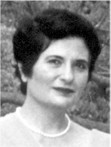
Sunnu Golwalla: record for posterity
There were three precipitating factors that led to the establishment of the Mandal: a series of articles by Shirin Dadabhoy Collector in the community newspaper Parsi Sansar Ane Loke Sevak suggesting an organization be started to teach tailoring and embroidery to indigent women who could earn a livelihood from orders placed by the well-to-do and help encourage a network of women from all walks of life; a proposal by Bhikhaiji Kabraji (who with Mithibai Ralli became the first honorary secretaries of the Mandal) that Karachi set up an association like Dinbai Patuck’s Stree Mandal in Bombay; the establishment of Young Men’s Zoroastrian Association (now Young Mazdiyasni Zoroastrian Association — YMZA) in Karachi in 1910.
Seva ané sakhavat (service and charity) were the twin objectives that led to the formation of the association on November 11, 1912. Of the 12 founder members four were men, but thereafter membership has been restricted to ladies to the dissatisfaction of some males who feeling left out have dubbed the Mandal as "bandal” (meaning nonsense). Not allowing such criticisms to impede work, the Mandal has endeavored to expand its sphere of activities from welfare disbursements, rehabilitation, medical aid, education and child welfare, literary publications and entertainment to emerge in the 21st century as a technology savvy octogenarian with its own website (www.geocities.com/banumandal), states Golwalla.
Founder president Gulbai Nusserwanjee Mehta (mother of the most respected benefactor Jamshed Mehta) died within a year of the Mandal’s formation and was succeeded by Soonamai Jijibhoy who initiated the practice of Pateti donations when Parsi families were requested to contribute for the needy on the occasion of the Shahenshahi New Year. When the Mandal declared that it would follow the Fasli New Year, the Pateti donations became the Navroz donations. Expansion of membership was Soonabai Mama’s (her husband Ardeshir founded The Mama Parsi Girls’ School) goal during her tenure as president and she also introduced the annual gahanbar festivity with dinner at her residence. Gulbai’s daughter-in-law Manijeh was the longest serving president (for 27 years) during which time the Mandal focused on literary activities. Apparently at the 16th AGM Manijeh remarked that the members did not take much interest in the Mandal’s activities but attended in large numbers the moj shok (fun) activities – the bane of most associations to this day! At the 18th AGM she appreciated the spirit of tolerance, sincerity and friendship showed by members to each other and encouraged them to speak up and settle matters rather than let differences simmer. A roster of office bearers indicates that Manijeh was succeeded by Aloo Dinshaw as president for 23 years after whom came Naju Dinshaw, Mucca Cowasjee, Mehra Minwalla, Perviz Daroga, Hutoxy Cowasjee, and the present president Dr Gool Talati who appreciated that Golwalla pored over manuscripts, minute books, newspaper articles and photo albums to create "a book that will be treasured by the Parsi community here as well as abroad.”
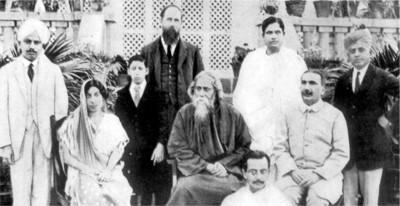
Rabindranath Tagore (seated center) with Manijeh Mehta (left) and Jamshed Mehta (right)
The silver jubilee of the Mandal was celebrated during Manijeh’s tenure with a series of activities that included sports, cooking competition, jashan, community gathering and luncheon. The chapter on "Celebrations” relates some interesting anecdotes concerning the ruby, golden, emerald, diamond, platinum, 80th anniversary functions which invariably ended as revenue generators. The golden jubilee marked the Mandal’s shift to its own premises, the Manijeh Hommie Mehta Building, presented by her son Sorab. (Hitherto they were operating from the first floor of the H. J. Rustomji Home given to them on rent for Rs 7 per month.) Among the important pieces of furniture in the main hall of the new premises is the piano donated by educationist Behram (Behli) Rustomji. The piano is of heritage value because Pakistan’s national anthem was played for the first time on this instrument. Other community organizations too rejoiced on the occasion and helped to raise funds like the Bai Virbaiji Soparivala Parsi High School boys who played the Cowasjee Variawa Band in all Parsi localities on Navroz and contributed their earnings of Rs 1,600 to the Mandal.
When Parsi women’s education started in 1862 it was considered sufficient if they could write a dhobi’s (washerman) account or keep a note of the utensils given to a kalaigar (one who tin-plates utensils). "But today (100 years later, coinciding with the Mandal’s golden jubilee) you have ladies of the Mandal who have multifaceted skills and knowledge,” remarked then secretary of the Karachi Parsi Anjuman, Peshotan Wania.
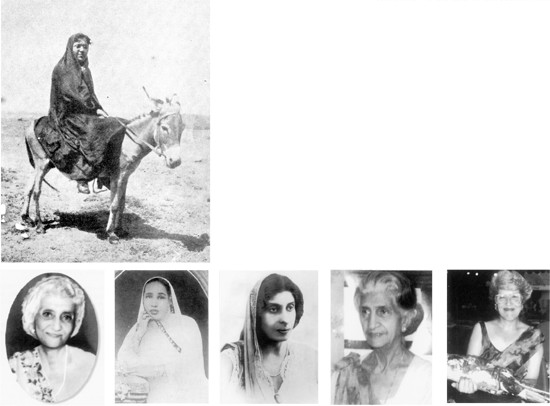
Above: Founder vice president Cooverbai Dhalla during her Iran Anay Iraq Ni Musafari; Bottom From left: Aloo Dinshaw, Gulbai Mehta, Manijeh Mehta, Goola Kabraji and Toxy Cowasjee
At the diamond jubilee celebration a flyer announcing an exhibition on the Mandal ladies in business and profession read, "One lady exports parrots,/Another makes iron grills/Some bottle pickled carrots,/Some fly for thrills,/We have to make confessions,/The other 50 professions,/Cannot all be told,/So come and behold!” The credit for this show was given to then new committee member Toxy (Hutoxy) Cowasjee (later to become the dynamic president of the Mandal) who had painstakingly displayed 61 professions through posters with names of Zarathushti ladies pursuing them. The Parsi ladies were told to enlist their names in the business directory proposed by Parsi Sansar. The directory though materialized only in 1998 under Cowasjee’s stewardship.
A large cake in the shape of KZBM’s crest, made by Metropole Hotel, made a grand entry in the middle of the 80th anniversary function with the steward carrying it through the crowd. This may have looked intentional but it was actually rushed over when the Hotel was reminded about its delivery! writes Golwalla. At the turn of the century the Mandal had invited the ISK Millennium Jazz Band who caught the organizers by surprise when young children (although very well trained) came up on stage to entertain the guests.
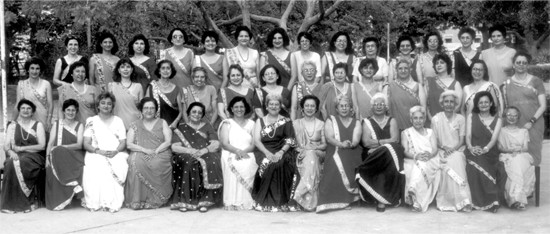
Mandal’s managing committee and subcommittees’ members at the turn of the century
"Several institutions come and go: Some are active and vibrant at the start but within years fall into inactivity. KZBM is unique in its exemplary service to the community for 50 years. It has never been mired in Parsi politics. In fact the history of Banu Mandal is the Karachi Parsi community’s proud heritage because all Parsi institutions are directly or indirectly served by the Mandal,” noted a write-up in the Parsi Sansar of October 24, 1962, adding, "The Mandal started with tremendous blessings in the shape of its first president who was the mother of revered Jamshed Mehta, and later his sister-in-law Manijeh. The Mandal’s lifeline, the like of whom no one has ever seen, are her committee and subcommittee members who work with total dedication and selflessness.”
There have been criticisms too against the organization which have been candidly reported in the book: "The munificence of the Mandal is disappearing with working women (who have now joined the Mandal’s working committees) trying to import check-and-balance style of the corporate world.” "The Mandal’s committee members today…may be more efficient and may be giving out more goodies but genuine concern and involvement with an aggrieved is not there today (as compared to earlier when) a beneficiary would bask in the warmth of these ladies’ care when they came visiting.” A perusal of the minutes indicated to Golwalla the respect accorded to every beneficiary whose name would invariably be prefixed with either behen (sister) or bhai (brother) or beta (son) or beti (daughter). "With improving economic condition of the community and better education facilities, there may be a time when practically no one will seek or need assistance for welfare. At that point the Mandal will have to find new channels to utilize available funds.”
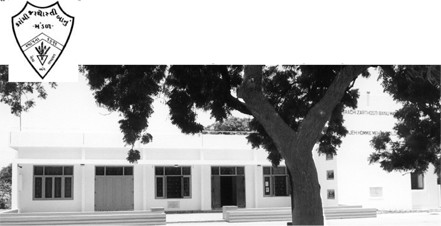
Crest of the Mandal and its present premises
According to the 1995 census of Zarathushtis in Pakistan by KZBM, there are 2,824 Zoroastrians of whom 990 (35 percent) are aged over 60. The Zarathushti community in Pakistan is an aging one with younger persons emigrating to more promising countries. This will place greater demand on funds for medical assistance. A Vision 2000 workshop suggested that KZBM ought to have a more balanced representation, age and income wise, so that the community would feel more comfortable to come to Banu Mandal. It was further recommended that the Mandal should have a flexible work style permitting service from persons not attending meetings or on the subcommittees.
"We are on the eve of the new millennium and cannot sit back and bask in our achievements for we will stagnate and be left behind,” declared then president Cowasjee at the AGM in October 1999. Her efforts resulted in placing Banu Mandal in cyber space, setting up a book society, microfilming of old records (until 1990 the minutes were recorded in Gujarati), organizing workshops where a special one for the committee members sought to ‘wake and shake.’
Parinaz M. Gandhi
◆ ◆ ◆
From the archive