
Media
Covering the community
Three high-powered women journalists edit community publications across the globe
Many Zarathushtis living in the diaspora receive three different magazines: Hamazor, published by the World Zoroastrian Organisation (WZO), Parsiana, published by Jehangir Patel in Bombay and FEZANA Journal published by the Federation of Zoroastrian Associations of North America (FEZANA).
If you are like me, you will go through each of the issues from cover to cover, to see what interesting and exciting articles they contain and make a mental note to go back and read them again, and if you are like me then you will collect each of the issues as archival material for they always contain information on varied subjects which you want to keep as a reference.
Over the past decades there have been some outstanding Zarathushti journalists and publishers, men and women who have left their mark on the communities they live in. But today I pay special tribute to three women, high achievers whom I admire immensely, three women who have devoted a good part of their lives to provide the community with quality and well researched material and who in their own way have raised the awareness of the community towards some of the burning and pertinent issues of our day. They have given us well-researched articles on our past heritage and shaped the views of the Zarathushti reader over the decades. They are none other than Toxy Cowasjee, editor of Hamazor, Arnavaz Mama, managing editor of Parsiana and Roshan Rivetna, editor-in-chief of FEZANA Journal.
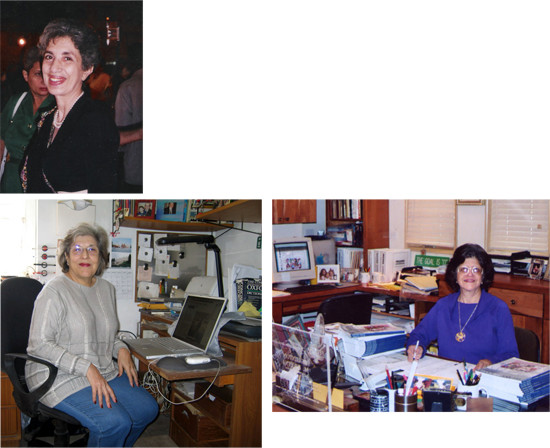
(Left) Toxy Cowasjee, (above) Roshan Rivetna and (top) Arnavaz Mama
Cowasjee, Mama and Rivetna are distinct personalities and yet they have one thing in common — their desire to serve the community and to make a difference. Women with a mission and a vision of keeping the community connected.
Cowasjee was born in Karachi to Villie and Noshirwan Cowasjee and did her early schooling at the Karachi Grammar School before going to Roedean, a boarding school in England where she was subjected to the "highest form of discipline and regimentation” that "molded her character to face storms which would prepare her in life for whatever was in store.” The love of the arts and all things artistic was cultivated in the boarding school. Reluctantly abandoning her first desire to become an interior designer, she settled on working for her father as a professional secretary. On returning to Karachi she fell in love with her cousin Cyrus Cowasjee and married him in 1962. They have two children, and four grandchildren.
In 1971 being challenged by a friend to contribute to the welfare of the community, she immersed herself in working tirelessly for the Karachi Zarthosti Banu Mandal (KZBM) established in 1912, and she has never looked back. In 1981 she was elected joint honorary secretary and in 1995 president, a post she held till end 2001. Ever ready to accept new challenges to satisfy her creative juices she produced, compiled and edited Manna of the Angels, a coffee table book on traditional Parsi cooking. Two thousand copies have been sold with all proceeds given to KZBM.
Once Cowasjee realized what her artistic talents were capable of creating she gave birth to the monthly newsletter of KZBM — What’s on. She then went on to edit and compile the 100-year history of the Karachi Parsi Institute (KPI) and abook on the life of Dr Maneck Pithawala, the principal of Karachi’s Bai Virbaiji Sopariwala Parsi High School.
Cowasjee was heavily involved in the conceptualization, production and coordination of the "Daughters of Mashyani” event for the Seventh World Zoroastrian Congress (WZC 2000). Her penchant for perfectionism added pizzazz to the Congress. And now she has added the same to the production of the proceedings of WZC 2000.
But her biggest challenge came in 2001 when Rumi Sethna, former WZO chairman, requested her to take on the editorship of Hamazor, a quarterly publication of WZO. Apart from help by a professional graphic designer Tannaz Minwalla, for the design of the cover, and for printing and mailing, the complete issue of Hamazor is produced by Cowasjee single-handedly. From conceptualization to layout, to proof reading, to getting it camera ready on a CD, to sending it to the printer with a dummy. This whole process from start to finish takes about 10 weeks. The printing and distribution is done worldwide from Pakistan. The mailing within India is done from Bombay. And once the 4,500 copies are out of the way, the process starts all over again. She is grateful to people who feed her information which could be developed into newsworthy stories.
To date she has produced 12 issues and each one gives her jitters wondering whether she will be able to deliver what is expected. "I can happily say my life is full, with never a dull moment,” she says.
Cowasjee continues to serve on two committees of KZBM, is a board member of WZO as well as the representative for WZO in Pakistan. And in the 110-year-old history of the KPI, she has been the only lady president.
Mama was born in Bombay to Homai and Sorabji Marshall, and being the youngest of three siblings she spent most of her time reading. She schooled at the Alexandra Girls’ English Institution and later at St Xavier’s College, graduating with an honors degree in English and French. She had ambitions to be in the Indian Administrative Service (IAS) but joined the Onlooker magazine instead. During the seven years she was at Onlooker she worked on an annual economic journal which whetted her appetite for economics. She resigned her position, went back to school to obtain a second degree in economics but got married to Sam Mama just before her final exams. For the next 10 years she raised her three daughters before joining Parsiana as a journalist.
Mama’s involvement in community journalism was purely accidental, but now that she is in it, she enjoys covering events which are political and controversial, and being in the profession for a fairly long time she feels a kind of déjà vu of controversies repeating themselves. She tries to understand the subject before writing about it, tries to present the whole story with a balanced perspective. Her goal is to write simply without journalistic jargon to ensure that the message is delivered and understood. Even though Parsiana has a firm policy of not editorializing in its reports, both the magazine and she have taken a stand on several issues, e.g. the Roxan Shah episode, the decision to publish data on interfaith marriages, the data on births, marriages and deaths being published since 1987. These are issues which the community has a right to know to decide if any action has to be initiated but at the time they caused a lot of grief to the publisher Jehangir Patel, by way of cancelled subscriptions, cancelled advertisements, and irate letters to the editor. As a journalist she has traveled extensively in India and abroad covering different events and meetings, and interviewing people. She enjoys meeting high achievers and reflecting their success stories. She travelled to Houston to cover the Seventh World Zoroastrian Congress.
Rivetna was born in Bombay to Jaloo and Khurshed Patel and educated at Queen Mary High School. She graduated from Elphinstone College with a BSc in Physics and Math, and a Masters in Nuclear Physics from the University of Pittsburgh. She then worked at Bombay’s Atomic Energy Establishment and the Tata Institute of Fundamental Research, before joining Argonne National Laboratories, Chicago and AT&T Bell Laboratories (Lucent Tech), retiring in 2001.
Her background as a nuclear physicist is a far cry from being editor-in-chief of the premier community journal of North America. Growing up in Bom-bay in a very comfortable, secure, traditional Zarathushti family, she says, "I had no interest or thought of what ‘Zarathushti community work’ was.”
She came to USA in January 1966, a week after she got married to Rohinton Rivetna. Feeling the necessity to connect with other Zarathushtis in North America, and fearing the lack of a Zarathushti environment, the Rivetnas plunged into community work, first with the Zoroastrian Association of Chicago, then with the building of the Chicago Darbe Mehr and finally with FEZANA. In the early days of FEZANA, a small Journal was being published with Ervad (Dr) Jehan Bagli as editor. In 1991 Roshan was appointed editor of the Journal and in 1996 editor-in-chief by then FEZANA president Dolly Dastoor, a title she has carried most admirably with a great sense of responsibility.
Rivetna, a mother of three, works with a passion, devoting over 15 hours a day to the Journal. From conceptualizing the theme of each issue, to gathering all the materials, to design, layout and production, to mailing and distribution, takes her all of three months, full-time. "Mailing day is the fun part,” says Rivetna, when 20-30 friends, many seniors, show up at their house on a Sunday, to do inserting (manually taping in letters/forms, etc), sorting, labeling, and bundling of the packages. The men-folk mostly put the bundles of 1,600 copies into mailing bags, labeled for each destination and load them into the Rivetnas’ two station-wagons for delivery to the post office the next day. "Besides working, we have a lot of chai (tea) and food and fun all day. Each time someone does a demo of making a Parsi dish like sooterfani, mehsoor, dodhi-halva,” she mentions, "and of course we catch up on the gossip.”
She hopes that the Journal provides a forum for networking between our dispersed people in the diaspora and the homelands, and also serves as a vehicle for perpetuating our culture, customs and traditions among our future generations and for posterity. FEZANA Journal is unique in that besides community news, each edition covers in depth a specific topic related to Zarathushti history, religion, traditions, the community, etc. Rivetna is driven by the goal of making the whole series of the Journal a compendium and an archive of the Zarathushti religion and community. She would like the whole archival set to be placed as reference material on the web, and in Zarathushti and University libraries. The book Legacy of Zarathushtra edited by Rivetna is invaluable for showcasing our religion and community and is being used as a text in several schools/universities.
The Journal is the voice of FEZANA and it prides itself on being a forum for all diverse opinions and ideologies. The creditability of the Journal is in large measure due to the Journal team’s vigilance and integrity to maintain a balanced perspective. However when Rivetna has strong opinions on certain issues, she expresses herself in an editorial like the well-worded one in the Winter 2004 issue on the flurry of attacks against the birth of the world body. Sometimes her editorials evoke nasty and unjustified accusations which she sleeps over and responds to later in more sober moments with a short and courteous response.
Cowasjee, Mama and Rivetna have lives outside the magazines they devote so much time to. Cowasjee and Rivetna are both avid photographers, devoted grandmothers, and involved in several community projects. Mama enjoys cooking, getting her hands dirty with potted plants, walking her pets, and reading authors like Neale Donald Walsch and Paulo Coelho.
So the next time you pick up the Hamazor or the FEZANA Journal or the Parsiana think of the hours of toil these women have put in willingly, think of their creativity and their energy to keep us connected, well informed and present us with issues at hand that need to be addressed. The community owes a huge debt of gratitude to them.
The women appear in alphabetical order.
Dolly Dastoor served as president of the Federation of Zoroastrian Associations of North America (FEZANA) 1994-98, co-chair of the Seventh World Zoroastrian Congress 2000 and chair of the FEZANA ad hoc committee for the 3,000th anniversary celebrations of Zoroastrian culture. She is a clinical psychologist and assistant professor in psychiatry, McGill University, Montreal, Canada. She was the founder president of the Alzheimer Society of Montreal.
◆ ◆ ◆
From the archive