
Roots
Zoroastrian ethos of Karachi
Living largely within the community, Parsis absorbed Zoroastrian values which are changing with the times
For most of my life I had not been aware of any distinct characteristics of Zoroastrians and, if these were mentioned, I did not pay particular attention.
However, when I was about to retire my boss requested me to find a Parsi lady to fill my post. "I can understand that you require a lady for a human resource department, but why a Parsi?” I asked. He responded, "Oh, come on Sunnu, you know why.” I did not quite know so he explained, "Well, unquestioned integrity; peaceful nature: will not have any quarrels; and, conscientious: she will not leave till the work is done or will take it home to complete. What more can an employer want?”
This is not an isolated comment: our community is generally viewed thus, not just in the corporate world in Karachi, where I live, but also by people who interact closely with us. My boss’s comment stayed with me and I have often reflected on its merit and validity.
I grew up among Parsi neighbors, went to a Parsi girls’ school which had a majority of Parsi students. In addition, for the first 10-12 years of my working life I was employed in companies where there were a fair number of Parsis with whom I interacted. This insular life left me unaware of the advantages of being a Parsi among a majority which has none of the facilities we enjoy thanks to our benevolent and farsighted forefathers. They created facilities for the community in Karachi that served people from the cradle to the grave. There is a downside to this: while it did uplift the community and made it into an educated middle class one, it resulted in many people becoming laid back and lacking in initiative. If the facilities and finances are to be taken forward or even sustained, some effort and participation from our people is required.
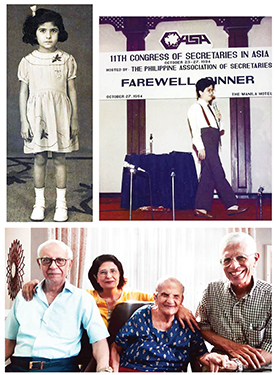
Top row: Sunnu Golwalla with silver medal for scholastic
achievement pinned on dress; playing the boss in a farce;
2nd row, from l: Farrokh and Sunnu Golwalla, mother Dina Sethna
and brother Godrej on her mother’s 105th birthday
Along with most of my childhood friends I acquired Zoroastrian values by living largely within the community and absorbing its way of life, values and characteristics. Some of these are being eroded with the changing times. A generation ago, people lived within the community from childhood to adulthood. Today few Parsi children in Karachi go to Zoroastrian schools perhaps because the standard of education in other schools is higher, the networking opportunities are greater and, with double income parents, the significantly higher fees are affordable.
Zoroastrian characteristics such as discipline, punctuality, responding promptly to letters and messages are not imbibed and sometimes even poor values and characteristics are absorbed. Vigilant parents do try to impart Zoroastrian values but some parents remain unaware of the need for this. Children today also feel alienated and therefore do not participate in celebrating community events, thereby missing out on our cultural life which was more vibrant a generation ago.
When I joined the leading social welfare organization, the Karachi Zarthosti Banu Mandal (KZBM), I worked closely with a cross-section of the community and developed greater understanding and connection. This has been a fulfilling part of my life. It has also helped me reflect on many aspects of our community, how things are changing and what we need to work toward preserving and rectifying.
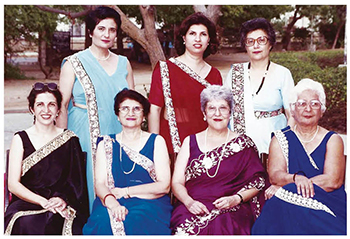
Sunnu, standing ext l, with education subcommittee of the Karachi Zarthosti Banu Mandal
We need to encourage initiative and sense of responsibility. Because many are beneficiaries of our forefathers’ largesse, they feel entitled to avail of the funds and facilities. Should any restrictions be implemented, there is resentment and sometimes even hostility. Some facilities can be made conditional, by way of monetary contribution or service in order to avail of, so that they are valued. Also, when we see an initiative being taken by a community member — younger or older — we need to appreciate it and work with the person to develop it further.
Our associations and institutes continue to play a beneficial role with committed volunteers and generous donors.
Health needs are cared for by group health insurance, gratis and at-home flu vaccines for the elderly and at cost for others. During Covid, the myriad needs of elderly Parsis were catered to. We also have a free Parsi clinic to which all community members have access.
To entertain and bring the community together, enjoyable events are held at subsidized rates and sometimes even free, to attract the maximum number of people. This is done with the support of silent and generous donors.
On his appointment as honorary consul for Canada, then chairman of the Karachi Parsi Anjuman Trust Fund, the late Byram Dinshaw Avari used his goodwill and contacts to facilitate immigration to Canada for 25 families. This is a testimony of his love for the community.
I love our community and value all that our forefathers in Karachi have done for us, and the role our institutes and associations continue to play. As one of our community members said, "I feel so lucky to be born a Zoroastrian in Karachi.”
◆ ◆ ◆
From the archive