
Religion
Balancing the books
With interest rates declining and costs increasing, making ends meet is a daunting task
Fire temples and worshipping in them is the focus of our religion. All aspects of our religion are being assailed by a motley range of criticisms and views — orthodox, conservative, reformist, etc and it is an appropriate moment for Parsiana to take stock of the situation.
Regrettably, our religion does not have the equivalent of a Pope who could be looked up to during times of crises for advice and guidance instead of leaving the trustees of the relevant institution to the vagaries of public opinion which could be brutal and cruel. It is a problem that the trustees face. To give just one instance, the orthodox feel that it is incorrect for a woman who is a practicing Zoroastrian to worship at our fire temple if she is married to a non-Zoroastrian who himself may have no objection to her doing so. The trustees are at times put in an embarrassing position and are often accused of succumbing to pressure.
Rituals, as introduced into our religion from time to time, do play an important part in our private lives and during our visits to the fire temples. Some lay great stress on them; others feel that rituals are only an extraneous part of religion and it is not necessary that all rituals should be observed. Any deviation practiced at the fire temple draws an immediate comment from an orthodox observer.
There are five trustees of the Dadysett Charity Trust who are responsible for the maintenance and proper functioning of both the Dadysett Atash Behram and Agiary.
The Dadysett Atash Behram at Fanaswadi was the first Atash Behram to be established in Bombay, being consecrated by Mulla Kaus Rustam Jalal on roz Srosh, mah Farvardin, 1153 AY, September 29, 1783 AC. The Dadysett Agiary commenced a little later on September 25, 1803. The Atash Behram was the first home to the present atash padshah whilst the Agiary, though built anew, took in a fire which was earlier housed in an adjacent premise for 18 years. Both the Atash Behram and the Agiary are of the Kadmi sect. The Atash Behram remains one of our community’s most revered and holy places of worship.
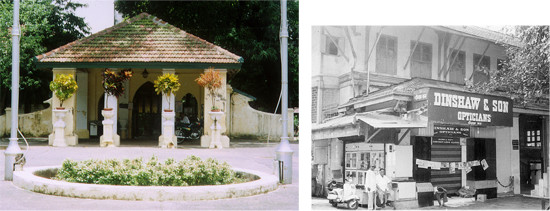
The Dady-sett Atash Behram at Fanaswadi (far left) and the Dadysett Agiary at Fountain
The main and chief difficulty in running a fire temple is the effort to balance the books. Our corpus is not large enough to allow the luxury of being able to live off the interest earned. About 15 years ago when the interest rate was 15 percent and expenses were comparatively low, it was possible to run the trust with just a little ‘topping up’ if required, from donations. Today, the interest rate on permissible investments is just six percent and with expenses on salaries, maintenance, electricity and the purchase of kathi all shooting up, it is well nigh impossible to run the Trust. As a rule, we do not solicit donations.
The second difficulty is the availability of suitable mobeds; though currently we have no problems as we have four mobeds at the Atash Behram (including four boewallas) and six mobeds at the Agiary (including two boewallas).
Our Trust does have a panthaky system, but of an informal type whereby the trustees have themselves not appointed any panthaky, but some of the mobeds have their own captive ‘clients’ who they minister to. Chasniwallas are not too difficult to come by but they are more difficult to keep.
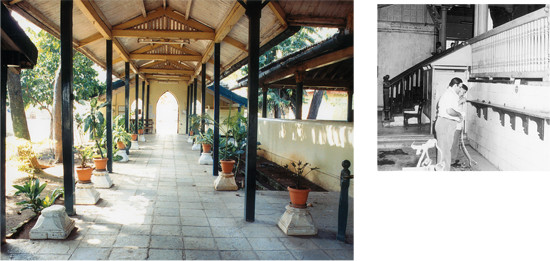
Inner portals of the Dadysett Atash Behram (left) and Agiary (above) Photos: Homyar Mistry, Homz Prints
The third difficulty is the constant maintenance required of our old structures but because of the quality of construction built so many years ago, we are able to get by with little maintenance expenditure. We are currently in the process of undertaking major repairs to our Atash Behram.
A large recurring expenditure is the regular purchase of kathi from M/s H. Sidhwa for both our fires. Donations towards kathi expenses given by the devout help to reduce expenses but nonetheless it is difficult to keep pace with the ever rising cost of kathi.
On a rough average about 75 devotees visit the Atash Behram each day and about 50 visit the agiary. About 60 tables are booked each for Shahenshahi and Kadmi muktads at the Atash Behram and Agiary each year. There are three atash behrams and more than a couple of agiaries in the vicinity of our Atash Behram, whilst there are about five other agiaries in the vicinity of our Agiary.
As the years roll on and our community decreases in number, the number of young mobeds entering the ranks of priesthood shrivel; and as more and more Zoroastrians emigrate/intermarry, where will our agiaries and atash behrams look to for their mobeds and devotees? How will they remain solvent and buoyant? All attempts to augment their incomes by hiring out surplus lands attract frequent accusations, mostly by ill informed members of our community that trustees plan to dispose of property belonging to the Trust and quite often the accusation goes on to add personal gain to the trustees as the reason.
Most of the fire temple trusts will face great difficulties in the years to come. What can be done?
Ratan Lalkaka is the managing trustee of the Dadysett Charity Trust.
◆ ◆ ◆
From the archive