
Zoroastrians Abroad
"A rose by any other name..."
Harsh criticism from a section of the community compels Peter Schipperheyn to rename his nude bronze sculpture
The Parsis have won the latest round of the Peloponnesian War. This one was conducted on the internet and in Melbourne, Australia instead of the plains of Greece or Iran. What the great Achemenians were unable to do in the heyday of empire — trounce the Greeks — the miniscule Parsi community achieved by well-worded missiles against the most Grecian of all arts — nude sculpture. A monumental bronze statue in the classical Greek mold, four meters in height, meant to depict the anguish of human existence according to the artist, raised the ire of the community, because the sculptor named it Zarathustra after his inspiration. Perhaps because our Prophet was mortal, unlike Zeus, Aphrodite and the entire Greek pantheon of gods and goddesses, the community insisted he be clothed or renamed.
"It would be sufficient to say you were inspired by his teaching but giving the sculpture his name is both disrespectful and blasphemous. In the name of decency and respect Peter, please cover up the offensive parts of the sculpture, rename it,” wrote A. Nariman of Sydney in the course of a long letter to sculptor Peter Schipperheyn whose work had been commissioned by The Elisabeth Murdoch Sculpture Foundation, at the behest of Dame Elisabeth, for permanent display at Melbourne’s McClelland Gallery and Sculpture Park.
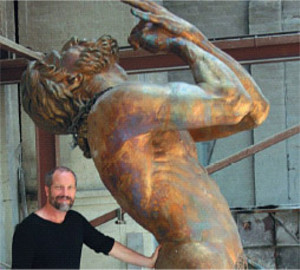
Schipperheyn with his creation
"Your plan to unveil a four-meter high bronze nude figure of Asho Zarathushtra Saheb has left a profound effect on the minds of Zoroastrians all over the globe. It will not be out of place to state the true status of Asho Zarathushtra Saheb, termed as Prophet of prophets. He was the first true Prophet who emerged out of super natural and to reproduce his structure in such a low profile is indeed highly deplorable… We are mere human beings who cannot by our whims and fancies indulge in such acts!” wrote Farrokh Magra.
World Alliance of Parsi Irani Zarthoshtis (WAPIZ) supporter and convener of the Fourth World Zoroastrian Youth Congress Shirin Mistry had a more worldly approach: "A word of explanation from my viewpoint may help you to understand where we stand. Lord Byron may have said, ‘We are all Greek’ but the people he meant are his own. We Ancient Persians are not Greek in that sense at all! Nude sculptures of their Greek Gods, fine pieces of art may indeed glorify the human body and so it should for it is indeed God’s finest creation and we Zoroastrians are cultured enough to admire any such pieces but had you tried to extend your knowledge of Zoroastrianism just that little bit more you would have realized that we do not recommend anyone even go barefooted in this world and specially at prayer we would never be bareheaded! - so where’s the question of ‘going naked in the world?’ Das Spake Zarathushtra (Thus spake Zarathushtra) makes a mockery of Zoroastrian tenets and traditions and it is always a bone of contention amongst us and those who cite it as a source of their knowledge of Zoroastrianism. We have always dismissed FN (Frederick Nietzsche) as a lunatic who had latched on to a bit of exotica floating around in his times and then gone on to twist and turn it to suit his own demented brain.” (Frederick Wilhelm Nietzsche was a renowned German existentialist philosopher of the 19th century.)
"It is disgusting to make a nude sculpture of any prophet in the name of art. I am sure our Zarathushti brethren in Australia and across the world are already in action to stop this grave insult to our beloved Zarathushtra. If it were any other race, there would have been mayhem by now,” noted Goolcher Navdar.
"We need to write to our MPs and even the Indian Prime Minister to stop Peter Schippenheyn from going ahead with this project on April 1, 2006,” panicked Farokh Sorab of London.
"The idea [gesture of the open hand and the clenched fist] for the monumental bronze male nude figure that I created and originally called Zarathustra then Thus Spake Zarathustra and now I don’t know what to call him, came to me in a dream. Upon awaking I pounced upon the already fading vision and sketched it in my journal,” unburdened a hard pressed Schipperheyn to Rustom Engineer of Huston.
"This dream was followed by a serendipitous event. Michael, a friend who I had originally met in Rome... wanted to pay a visit... Sure, I said, but you will have to model for a sculpture! (Michael had exactly the physique I imagined for my sculpture, Bondi surfie, muscles shaped by waves of the sea) So in the space of several weeks I made in clay (a) one meter tall version of this sculpture now in discussion... At the time I remember thinking I was very satisfied with the gesture of the hands and the overall posture of the body but the ‘character’ of his head was not right. Nonetheless, I cast the work in bronze and in a short time I sold 12 copies of him which was very unusual. These unexpected sales enabled me to buy a place to live for my wife and young child!
"From the outset... I wanted to make a monumental version of this work. Well I had to wait 20 years for the opportunity to recreate him at monumental proportions! And this opportunity was given me by the very gracious 95-year-old Dame Elisabeth Murdoch AC DBE who is the patron of the McClelland Gallery and Sculpture Park. Dame Elisabeth visited me at my studio as I had invited her to view a Mother and Child sculpture that I had carved in Carrara Marble. After tea and scones, and what seemed to me out of the blue, she turned to the small bronze version in a corner of my studio and asked if it would be possible to make a large version of this work for the island down at the McClelland Gallery as the Balzac by Rodin that was on loan had been returned and the Gallery wanted something to replace it,” Schipperheyn related how the sculpture had taken on a life of its own.
"At the time I had used different titles for this work I returned to the what for me was the unresolved aspect of this sculpture — his head. I thought initially of the sculpture of Ancient Greece (who... portrayed their Gods nude), I began thinking I will give him a noble Greek head, a beard and curly hair. I imagined a warrior/philosopher; the Promethean myth at one stage seemed to fit…. Bit by bit the ‘character’ began to form in my mind. Yet to me this figure expressed dualism, a push and pull, an inner struggle. He is modern (in an existentialist sense) but ancient. Good, I thought. That (is) what I want him to be — a timeless figure. But I still did not have a name for him. And he did not seem fully Greek to me anyway. At some point I thought of Thus Spake Zarathustra. I started to reread this book and it made sense to me (I believe Nietzsche is unduly maligned). The book starts ‘When Zarathustra was 30 years old, he left his home and the lake of his home, and went into the mountains…’
"I decided to call my sculpture Zarathustra. This all happened quickly, and as far as the commissioner was concerned I was making a sculpture with a strange sounding name derived from a book by a mad German philosopher that no one really understood,” Schipperheyn related the trend of ideas. "However the sheer poetry of this beautiful sounding name totally obsessed me. In my heart a mystique was enveloping the sculpture I was to make. As my understanding grew of this book and as I researched more and more the meaning of Nietzsche’s book I began to get more and more interested in (who) Zarathustra was and then began to research (his history). When I read about the concept of dualism, of the eternal struggle between the forces of light and dark, between good and evil, (that) ‘He was wise enough to recognize that all the motives of human beings are based on action and reaction,’ I thought, that is it: I have found the spiritual meaning of the clenched fist and the open hand gesture that I had dreamed all those years ago. It meshed entirely in my mind with what I was trying to express. The more I researched the more excited I became, to learn of an individual who lived so long ago, whose teachings have been woven so tightly into subsequent spiritual traditions including my own (I was raised a as Christian) and yet whose presence has faded from contemporary knowledge. In general, I have found most people (in the West) know next to nothing of who Zarathustra was, let alone the history of their own traditions. I am often saying to people now, ‘You know the three Magi in the Bible? You realize they were Zoroastrian priests.’
"From this research I began to fathom that Nietzsche had a far more complex relationship to the real Zarathustra, it was not just that he chose on a whimsy the name of some obscure Persian who lived in ancient times whose name sounded suitably exotic. It took me a year and a half to model the clay sculpture... As this large figure grew I saw him more and more as embodying the ‘Prophetic Voice.’ Sometimes I imagined him as the young Zarathustra from an ancient land, standing before time and before all of creation, powerful yet vulnerable, in this beautiful mystery that we experience as life. I am sorry that the Zoroastrian community cannot embrace him as such. I should add I received many e-mails from Zoroastrians who (were) really intrigued, interested and supportive that someone from Australia would even make a sculpture with a Zarathustrian connection.”
Mistry wrote to Schipperheyn when the decision to change the name was announced: "I applaud your hard taken decision and even if it has been ultimately forced upon you by the Gallery, I am personally grateful that you have done so, even if with a very heavy heart! I realize that as an artist you are indeed very saddened to have to remove a name from your own work! It would be like having to rename a child to suit the world instead of being allowed to make your own personal choice for your own personal creation!... A most grateful Zoroastrian community will ever remember the magnanimity of your decision and the grace with which you have conceded to it!”
Saluting the prompt action of both, FEZANA Journal editor-in-chief Dolly Dastoor congratulated Mistry. "Thank you for your initiative in reaching out to Peter Schipperheyn and his subsequent consent to withdraw the label of ‘Zarathushtra’ attached to his piece of art. Open, rational and direct communication, appealing to the artist’s sensibilities is more powerful in achieving results than all the insults and innuendos hurled from behind. The community is indeed grateful that you chose the first route, and to Peter Schippenheyn for seeing the rationality of the request of the community.”
Not all Zoroastrians took Mistry’s tack. Wrote Natalie Wania, "I like the statue. I think it’s a beautiful expression of a beautiful figure, a beautiful human body… Why is every e-mail I am getting about the statute assuming something awful about it? It is wonderful and politicizing my aesthetics is not wonderful. Thanks if I can please enjoy Art for Art’s sake!” Added Ardeshir Yeganegi, "Vania has addressed an important point in her e-mail, and that is the freedom of expression. It is important that as a community we stand united and try to preserve our faith, heritage and dignity. But we must also remember the Zoroastrian faith is based on the freedom of choice. Don’t we use that freedom through our wisdom (good thoughts) to choose and exercise good words and good deeds? "How is naming an art Zarathustra any different (from) naming a son, or a peak in the Grand Canyon or other numerous objects after our Prophet?
"We have seen how in the past few months the Muslim communities around the world have risen in anger because journalists exercised their right of the freedom of expression of ideas and thoughts (I am not saying they used their freedom wisely, but in a free and democratic society they have the right to express themselves). By protesting to an artist who named an object of art after our Prophet aren’t we delivering a message that our faith is similar to others by being intolerant to (the) right of the freedom to choose (right or wrong, it doesn’t matter)?”
One wonders how Zarathushtra himself would have reacted, with his followers involving themselves with politics, peripherals and prejudice while derailing his own message of universal brotherhood. In the meanwhile Schipperheyn might take a little solace from an analogy. As the bard said, "What’s in a name? A rose by any other name smells as sweet…”
◆ ◆ ◆
From the archive