
Iran Focus
"Constructive engagement"
Improving the lot of the Zoroastrians in Iran will require an ongoing dialogue between the Zoroastrians and the government
Iran’s Islamic Revolution of 1979 foreboded a disaster for non-Muslims similar to the seventh century Arab invasion of Iran. Under Islam, non-Muslims have an inferior status to Muslims. The Infidels (non-Muslims or Kafer) are divided into two groups: (1) the Harbi, who must either embrace Islam or be annihilated; and (2) the Zimmi, who will be tolerated if they accept complete subordination to Muslim authority, observe Muslim public policy, pay Jazia (personal tax) and suffer the social and religious restrictions forced upon them.
The catchword of Ayatollah Khomeini, the leader of the Islamic Revolution, was "Islam,” not "nation” or "Iran.” On every occasion he reaffirmed that the aim of revolutionary Islam was the protection and promotion of religion. His first objective was Islamization of Iranian life and polity. The constitution of 1979 of the Islamic Republic is aiming at that and as such no expectation of improvement in the lot of non-Muslims would be realistic. The manifesto of the Islamic Republic that Khomeini founded had no place for concepts such as nationalism, democracy and human rights since these concepts were regarded as alien to Islam. Economic development and modernization were no longer a priority for the new Islamic government of Iran. This was in some ways not surprising. In his pronouncements back in 1961, Ayatollah Khomeini asked, "What is meant by equality of rights among all citizens?” He answered the question by concluding that "equality of rights of all citizens is directly opposed to several fundamental imperatives of the (Islamic holy book) Quran.” In the same pronouncements, Khomeini explained that, in Islam, women have no right to participate in elections. Elaborating on this concept, in another context, Khomeini attacked the practice of allowing non-Muslims’ representatives in parliament to take oath on their respective holy books; he argued that such a practice gives the Zoroastrian Avesta, the Christian Bible and other "blasphemous books” the same value and respect as the Quran. Khomeini argued that all representatives of parliament should give their solemn pledge in the presence of the Quran.
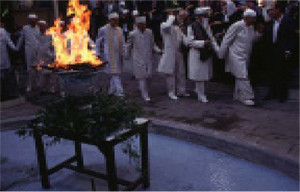
Priests at a religious ceremony in Yazd
Photo: Kaveh Kazemi
The establishment of the Islamic republic resulted in a migration of Zoroastrians from Iran. This was not unlike the migration of Iranians to India after the Arab invasion of the seventh century, except that this time, the migration was to the West. Zoroastrians migrated to democratic countries that promised them the right to practice their religions freely without fear of persecution. These societies were based on the principle that all members of the society were to be treated equally before the law, regardless of their religious affiliation. Secular in philosophy, they advocated equal opportunities for members of all religious affiliations in all professions, including politics and the judiciary.
In this short period of time, Iranian Zoroastrians have established themselves in their adopted countries and worked to improve the lives of fellow-Zoroastrians who have immigrated there. Iranian Zoroastrians have made noticeable contributions in the area of education and commerce in their adopted countries and been involved in significant charitable works. The majority of funds for the establishment of Zoroastrian centers and places of worship in various states in the United States, Canada, Australia, and England came from Irani philanthropists: Arbab Rustam and Morvarid Guiv, Mobed Mehraban and Mobed Ferydoon Zartoshty, Mehraban and Goli Farhangi, and the Farhangi brothers. In the West, Iranian philanthropy has surpassed that of our Parsi co-religionists, long been admired for their philanthropic reputation. With collaboration of their Parsi co-religionists, Iranian Zoroastrians have successfully placed the name of the Zoroastrian community and Zoroastrian religion on the map of the world. They have done this by establishing internet websites, creating seats at universities and colleges [eg, School of Oriental and African Studies (SOAS) at the University of London, Claremont Graduate College at the University of Southern California], publishing articles and books and by organizing numerous seminars and lectures on the religion. All these activities are a source of pride to all Zoroastrians, irrespective of their native country.
Zoroastrians of Iran are and have been the true guardians of Persian culture. The history of ancient Iran and the history of Zoroastrianism are inseparable and indeed the same. They consist of seven centuries of glorious written history of dynasties such as the Medes, the Achemenians, the Parthians and the Sassanids. Iran is the cradle of Zoroastrianism. In this respect, Iran is for Zoroastrians, as Mecca is for Muslims and as Jerusalem is for Jews, Christians and Muslims. I, therefore, salute my fellow Iranian Zoroastrians, who despite all difficulties, choose to remain in Iran and in doing so preserve our identity, culture and history in Iran.
Contemporary Zoroastrian Status
The Islamic constitution is a religious oligarchy in which the clerics are supreme. The institution of "Velayat-e Fagih,” which is an innovation, guarantees the absolute dominance of the clergy. Accordingly, the Velayat Fagih can veto the legislation, judiciary decisions and executive ordinances. The Guardianship Council is another institution that ensures the theocratic autocracy. The Guardianship Council repeals laws enacted by the Islamic parliament of Iran known as the Majlis Showra-ye Islami (Majlis) which are in their view contrary to Islam and the Constitution. It also examines the competence of those who have been nominated to stand for presidency and for the Majlis and other important elective posts. Since the criminal and civil laws are those of Quran and Islamic law or "Sharia,” they are administered by the clergy and Muslim jurists.
Religious minorities don’t have any political clout in Iran. Zoroastrians have one representative in the Majlis. Like Muslim representatives, in theory, the representatives of religious minorities are considered representatives of all Iranians; however, their main task is to bring the complaints of members of their respective communities to the attention of the parliament and the high executives. Unfortunately, little attention is given to their statements. For instance, concerns expressed by the Zoroastrian, Christian and Jewish representatives about the amendment to Article 882 of the Civil Code (see below) were largely ignored. So also the complaint by the Christian representative that religious minorities were not given the same opportunity as Muslims for employment in government offices as well as the companies and foundations run by the state. In addition, members of religious minorities cannot hold ministerial or high government offices, ambassadorial jobs or indeed jobs in any foreign mission in Iran. Religious minorities are also excluded from high military positions. They are, thus, treated like second class citizens.
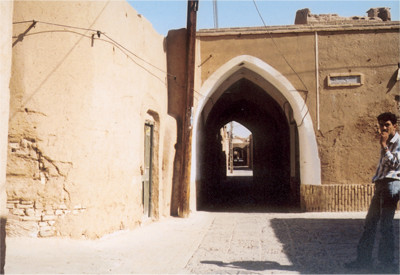
Ancient gateway to town
Photo: Namrita Rustamjee
Religious minorities are similarly excluded from positions in the judiciary. This is not entirely different from the past. In pre-revolutionary Iran, non-Muslims were deprived from holding judiciary positions. Some progress in this area had been made however. Three years before the revolution, non-Muslims were allowed to become justices of the peace in the equity tribunals, a right they no longer enjoy.
Religious minorities can practice their own religious customs and prayers at home or in their places of worship. However, religious minorities are not permitted to construct new houses of worship; they are only allowed to remodel or repair already existing temples.
With regard to the personal law, marriage, divorce, burial and inheritance, religious minorities are subject to their own laws. In each case, this law should be proved as "a matter of fact” by their respective religious authority in the court of law. Although a court can consider the religious custom or practice, it does not carry the same weight as a "matter of law” in the analysis of the given circumstances.
Unfortunately, Iranian Zoroastrians are subject to discriminatory laws that have been passed since the revolution. In 1991, Section 881 of the Iranian Civil Code was passed. Under this law, a Muslim who married a religious minority, or a non-Muslim who embraces Islam could inherit the entire inheritance of his or her spouse’s family. The Muslim member of the family enjoys this right regardless of whether his or her relation to the deceased is by consanguinity or by affinity and regardless of the degree of the relationship. This law is unjust and discriminatory to the religious minorities of Iran. And as far as I have researched, there is no basis for this law, either in the Quran or in the Sunna. In fact, according to universally accepted practice, it is always the personal law of the deceased that governs inheritance. This law provides a financial incentive for non-Muslims to convert to Islam. It is no different from other financial gains that had been offered in the past as an incentive for attracting people to Islam.
Another discriminatory law is that related to "Dieh” or blood money. Under current law, Muslims who are killed by homicide or manslaughter receive Dieh from the assets of the criminal but, in the case of Zimmis or religious minorities, no Dieh is paid.
In June 1996, my wife and I visited Iran at the invitation of Iran’s Minister of Culture and Islamic Guidance to participate in the Sixth World Zoroastrian Congress. During that visit, an Iranian alerted me to this law. Fortunately, I was able to raise this issue during a one-day conference that was organized by an office within the International Studies and Research Center of the Organization of the Islamic Culture and Relations. The conference consisted of a religious discussion among Muslim and Zoroastrian scholars. On the Islamic side, the participants included Ayatollah Taskhiri, Ayatollah Seyed Mohammad Khamenei, Hojat-ol-Islam Dr Hojati Kermani and Gholamreza A’avani, a professor at Tehran University and chairman of the academy of philosophy. On the Zoroastrian side, the participants included Dastur Rustam Shahzadi, Mobed (Dr) Oshidari, Dr Mahyar Ardeshiri, Dr Parviz Ravani, Dr Dabestani, Dr Rostam Vahidi, my wife Parichehr and I. During that conference, I raised my objection to the new law concerning inheritance as well as the discriminatory laws relating to Dieh or blood money. The Muslim scholars at the conference were unable to provide a religious basis for these discriminatory laws. A debate followed short of a conclusion but the question had been raised. The Islamic scholars asked Professor A’avani to investigate the matter and report the result to them.
I raised these issues again with then President Khatami on three different occasions when he visited the United States to address the United Nations General Assembly. I mentioned that in the government job vacancy advertisements, only Muslims can apply and this is another unjust treatment of Zimmis in Iranian civil society. President Khatami expressed his regret and promised to take action on those matters once he was back in Tehran.
Fortunately, as a result of that discussion some progress was made. In January 2002, Mohammad Reza Aref, the first vice president to President Khatami issued a circular to all ministries, government organizations and institutions, the Islamic foundations and governor-generals to apply their utmost care and supervision to ensure the rights of religious minorities — Zoroastrians, Christians and Jews — in areas including employment and engagement in various professions.
In addition, the representatives of Zoroastrians, Jews and Christians in the Majlis pursued the matter relating to Dieh. In addition, in February 2002, the judiciary authorities drafted an amendment to Article 30 of the Islamic criminal code, thereby extending the blood money (Dieh) payable to the Muslim victims of homicide, manslaughter and other bodily harm to the victims of the same crimes if they be members of the recognized religious minorities. Unfortunately, so far, nothing has been done to remove the discriminatory law relating to inheritance. I hope that Iranian Zoroastrians will continue to pursue these issues vigorously.
Generally speaking the relationship between the Muslim populace and Zoroastrans is an amicable one, based on trust and mutual respect. The Shah’s interest in the glorious history of ancient Iran, as demonstrated in the 2,500 year anniversary celebration of the monarchy, was a subject of harsh criticism by Ayatollah Khomeini. Two years prior to the revolution, several fanatical Muslim hairdressers in Yazd posted notices outside the door of their shops announcing that they would not offer their services to non-Muslims. On that occasion, the Tehran Zoroastrian Anjuman tried to resolve this unpleasant anomaly without success. At present, few such instances of disharmony between the followers of the two religions have come to my attention. It appears that Muslims and Iranian Zoroastrians generally live in full harmony and have friendly relations.
Lastly I should make a brief remark about individuals who presently conduct community business in Anjumans and represent Zoroastrians in the Iranian parliament. Before the Islamic Revolution, those elected to administer various activities of the community were from the elder elite. The elders were unwilling to let the young people be elected or hold a majority in the Anjuman. In 1966, the situation changed, and the youth, who had become active in the community and formed youth groups, took a majority position in the Anjuman. Consequently, only six members of the previous Anjuman were re-elected that year and the rest were newcomers. I was fortunate in being elected the president of the Anjuman that year. Contrary to the belief of our predecessors, the new Anjuman was as effective, as trustworthy as the previous Anjumans. In fact, the new Anjuman was more innovative and creative in resolving challenges and initiating projects than its predecessors.
After the revolution, some elderly leaders approached me to find some device to secure the funds of the Anjuman and prevent the entry of some politically leftist individuals in the Anjuman. I declined to advise the elders, noting that I believed in the competence of the youth and trusted the process. The new members, after all, had been chosen from the grass roots and had deep loyalty to the cause of religion and welfare of the community. Fortunately, time has proved me right. Those very individuals have served the community with dedication and courage. I salute all of them and wish them success in their future services to our community.
For a small religious community like the Zoroastrian community in Iran, the most effective policy for the removal of discrimination is constructive engagement. I hope that the future leaders of our community devote themselves to improving the lives of their fellow Zoroastrians both in Iran and abroad.
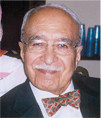
Professor Emeritus of International Relations at Boston University, Dr Farhang Mehr led the Tehran Zartoshty Anjuman for 12 years. He was Iran’s Vice Prime Minister, Minister of Finance and Chancellor of Shiraz University.
◆ ◆ ◆
From the archive