
Awards
Champions all
Five top performers were given the Federation's annual awards for excellence
" Find purpose and the means will follow. The world colludes with the man or woman of purpose and everybody is the big strong force behind you,” entrepreneur-builder Boman Irani suggested to the full house on the rooftop of the West End Hotel in Bombay where the community had gathered on September 3, 2005 to applaud him and four sports persons on whom the Federation of Parsi Zoroastrian Anjumans of India bestowed its awards for excellence.
A popular side feature of the biannual Federation meets, the awards had been instituted in 1988 at the suggestion of then vice president the late Homi Bod-hanwala who had laid the groundwork for assessment of individual achievements and their due recognition by the community, Federation honorary secretary Keki Gandhi reminded the gathering.
Declared Yachtsman of the Year four times over (in 1986, 1991, 1994 and 2002), Farokh Framroze Tarapore was awarded the Peshotan D. Nargolwala Memorial Award for 2002, the year when he became the first and only Indian to win a world championship in two different classes of boats at the 420 World Championship in Portugal, as notes the citation. The first world championship he had earned was in 1991 in the Enterprise class. In 2004 he became the only Indian to win 12 medals in six different classes at the Asian Championships in Bombay, it further notes.
A science graduate from Jawaharlal Nehru University in New Delhi and a graduate of the National Defence Academy, the 45-year-old yachtsman has represented India in yachting since 1971. In 1988 he was credited with training the team that achieved world championship. From 1995 to 1998 he was the chief national coach for India. The citation credits Tarapore with 25 national titles, four Asian Games medals and eight Asian Championship medals including four gold, four silver and four bronze. In 1994, at the XII Asian Games in Hiroshima, Japan, he became the only Indian to win four consecutive Asian Games medals for India in sailing, adds the citation. A former naval officer, Tarapore earned the Indian Navy’s Vishist Sena Medal as well as the Arjuna Award, India’s highest sports award, in 1982. In 1985 he received the Chatrapati Shivaji Award.
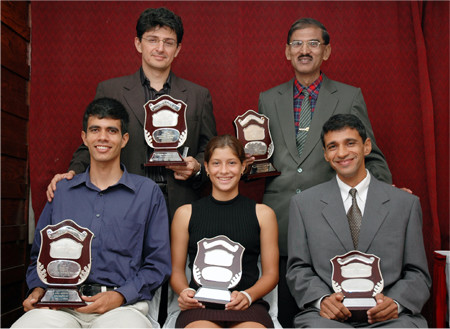
L to R: (Standing) Irani and Doodhwala, (Seated) Banajee, Shroff and Tarapore
Proud of being a Parsi though "not in the heart of community (affairs),” Tarapore identifies Xerxes Bamboat of Rustom Baug and the Heerjee family as upcoming yachtspeople to watch. "They are active at the junior level. In years to come they will produce good performances,” feels Tarapore, adding, "Certain things one can’t foresee…40 years ago people would not have imagined I could do it!” Surveying the sports scene today he told Parsiana on the sidelines of the awards function, "The younger generation faces great challenges in terms of sponsorships and the money needed to excel in sports,” adding a word of advise to the freshers: "Believe in yourself. That’s the most important. Train like you’ve never trained before. Set goals. Never work without a goal. The difference between working without and with a goal is that you will reach there. Practice every day, have a mentor, somebody you fully have faith in. Plan your strategy.”
Running a business that helps others set up their businesses, Tarapore says his income stems from royalties they generate. Married to Anahita ("a very sporting person”) the couple enjoys all kinds of sports. Two weeks before the Federation awards he had been in France. Tarapore is all set to try for the Asian Games in 2006. After that, "if we do get selected from India,” it will be the Olympics.
"The only driver to have reached the Go-Karting finals five times, to win a National Karting Championship twice and to win races in five different national level championships,” Rayomand Dadabhoy Banajee received the Jiji D. Irani Memorial Award for 2004. The year marked his participation in the highest number of Go-Karting and Formula Racing podiums in India as well as being member of the Indian team along with Narain Kirthikeyan and five others in the 25 Hour Endurance Race in Dubai. The Indian team finished fourth among 22 contestants at its first participation in an endurance race. Banajee "did India proud by winning the 25 lap Rotax Max Seniors Race, the showpiece of the Asian Zone Karting event” when Kirthikeyan pulled out midway due to engine trouble, notes the citation. Banajee also won the Rotax Max Challenge – Indian Series in October that year with four wins and a second place from a total participation in five races.
Banajee, who says he became enthused just watching Formula One racing on television, started with Kart racing in 1999 when he was all of 19 years old. "After training, testing and winning most Kart races, he started with formula racing and was the highest placed newcomer in the National Formula Racing Championship 2001, runner-up in 2002 and in the same year won the MMSC Cup (Formula India),” records the citation. He went on to win the Fourth J. K. Tyre National Karting Championship in 2003 "undaunted by the mishaps during the final stages in three preceding years due to an accident, a broken petrol tank and a snapped accelerator cable.” His prize, as notes the citation, included a fully sponsored drive in the J. K. Tyre National Formula Racing Championship 2004 as well as a brand new Opel Corsa Sail.
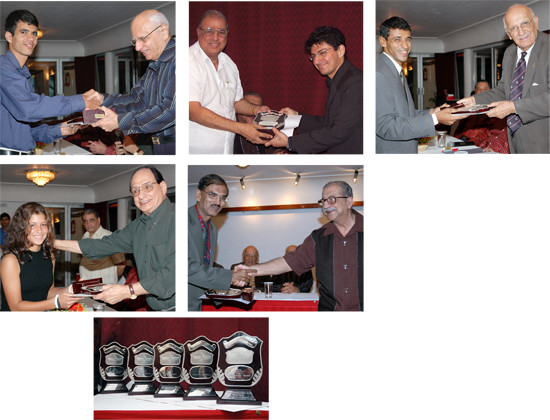
L to R: Receiving the awards (top) Banajee from Minoo Shroff; Irani from Nariman Mogrelia; Tarapore from Adi Sethna (alongside) Shroff from Engineer and Doodhwala from Khambatta Photos courtesy Sarosh Daruwalla, Mazda Audio and Video Labs
In a brief acknowledgement Banajee made it a point to publicly thank his benefactors: "(Bombay Parsi Punchayet trustee) Dinshaw Tamboly who introduced me to Mr Farokh Kavarana in Tatas” and karate specialist Vispy Kapadia. Noting that "a sportsman does not need money once; he needs it year after year,” Banajee announced that the next step in his racing career would require an investment of 1.2 crore rupees, adding, "It is not fair (to seek help from) charitable institutions. It is better if people in the corporate world are gently pressured to help us with sponsorship… Only then can we go ahead.”
"To a certain extent” Parsi youths do take it easy, Banajee admitted to Parsiana during a chat after the award ceremony. This was partly due to the fact that "in every field we have guys at the top.” But he strongly felt that parents need to give kids "a free hand and support.” His own parents, he said, "were not too happy (with his choice of activity) but they didn’t stop me and were always there when I needed support. (If) you decide that you want to get somewhere, do something. The determination and will has to be there to put in hard work.” Banajee also explained why he needed such a large sum of money: "I don’t own the car; it’s hired. You need money to cover the cost of the racing machine, the maintenance is very high. A set of tyres costs Rs 30,000 and they will not last more than 40 laps. You go through four such sets in a racing weekend plus the fuel, the service of race engineers and mechanics at the national level…”
Banajee explains that the corporate sponsor reaps advertising mileage when the race is covered on TV: "The car is seen for 10 minutes of the 30-minute program 30 to 40 times in the season. It is the best advertising proposition for companies but you need contacts in the corporate world. Parsi (sportsmen) are suffering because they are not known to people at the right level.” Banajee’s dream is to go on to Formula BMW-Asia, Formula Three, Formula Two and, ultimately, Formula One racing. "But at every stage the costs go up…”
Fresh from Delhi with the under-14 national doubles title and the Nike Super Series Finals, the sparse, tawny athlete and budding tennis star Kyra Firdaus Shroff received the Federation’s Late Dhunjishaw Manekji Jall Award for 2004.
Starting at the age of eight, Shroff has been coached by Krishna Bhupathi at the Nike Bhupathi Tennis Village in Bangalore, notes the citation. Participating in different level tournaments in Ahmedabad, Bangalore, Mysore, Tumkur, Calcutta, Bombay and Poona, she had won four singles titles in 2003, three in the under-12 age group and one in under-14 and was a runner-up in three tournaments. In 2004 she became the Bombay Inter-School Tennis Champion in the under-12 age group. Participating in the All India AITA Ranking Open Tournaments that year, she won nine titles, five in singles and four in doubles. Three of these were in the under-18 age group and six in the under-14, notes the citation. 2005 saw her garner six titles earlier, five of them in doubles matches.
A month away from her 13th birthday, this all-rounder from Bombay’s St Anne’s High School has participated in state and district level athletic meets in sprints and long jumps, represented her school in handball, throw ball, football, cricket and badminton tournaments and won a gold medal in the under-10 national level Karate Championship apart from academic achievement, elocution competitions and dramatics.
After two and a half years’ training in Bangalore, Shroff went on to train under Paul Dale in Thailand for one and a half months to acquire some international experience, she told Parsiana in a brief chat. "It was a very different way of teaching; the game is very differently played,” she learnt. With such absences, how does she manage at school? we ask. "St Annes’s is very accommodating. Our principal had played national basketball so she understands.” Currently in standard VIII, Shroff says she makes sure to be back two months before the exam and finds the final month of study a bit stressful but enjoyable. Math is Shroff’s favorite subject because it doesn’t require "mugging.” Her aim is to take tennis professionally along with basic education up to graduation though "great tennis players reach their peak at the age of 15/16/17 and have not graduated because they’ve been playing tennis,” she tells us. She knows because she has been watching tennis on television, especially Wimbledon.Having shared a room with India’s tennis icon Sania Mirza during her stint in Bangalore, Shroff says, "It’s a big boost that there’s an Indian girl out there.” Happy that her parents Gulshan and Firdaus are very sports oriented – he is a former junior Maharashtra champion in badminton who has played county cricket in England, she says her young brother Porus, nine, who attends Campion School, has also won badminton tournaments. Younger sister Maya, seven, is the odd man out. Not interested in sports, she wants to be a model, says Kyra.
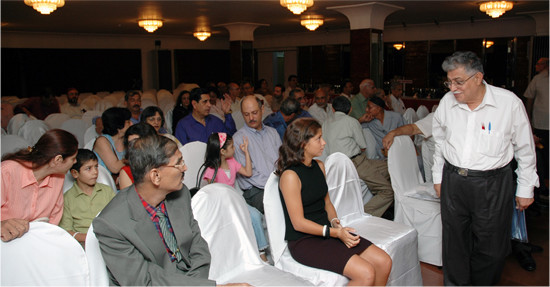
Well earned praise (R to L) Gandhi to Shroff and Doodhwala
The Aloo Noshirwan Cama Award for 2003 went to cricket umpire and freelance sports journalist Keki Darabshah Doodhwala. The Navsari born, Surat educated Doodhwala has been on the panel of the Cricket Control Board of India as a Ranji Trophy umpire for the past 15 years during which he has umpired over 100 Ranji Trophy and over 500 district level matches, notes the citation. He umpired the India-New Zealand Women’s Test Match at Vapi in November 2003 as well as two one-day international cricket matches between India and Australia in Surat and Vadodara. He was appointed umpire cum assistant manager for the Vintage India Cricket Team’s tour of Australia to participate in the World Vintage Cricket Carnival in Perth.
A life member of the Indian Cricket Umpires Association and the Legends Club, Doodhwala was a joint winner of the All India Cricket Quiz Competition organized by the magazine Cricket World. He is also said to have participated in several seminars and workshops organized by the Association of Cricket Statisticians and Scorers. Recipient of the C. K. Panthaki Sports Journalist Award for 2002 for lifetime excellence in journalism from the Surat Shaher Patrakar Kalyan Nidhi, Doodhwala received the Vocational Service Award from the Rotary Club of Surat Roundtown District 3060 in March 2004 for his dedicated service to cricket umpiring.
Voicing his thanks for the award, Dood-hwala said, "This kind of award will not only encourage youngsters but their parents to encourage their children to enter the field of sports.” He mentioned to Parsiana in the course of the socializing and dinner which followed the awards ceremony how he had played cricket in school and college – he is a commerce and law graduate – and loved the game but had little chance of getting into a recognized team. Wanting to be associated with the game, Doodhwala credits cricket umpires Pilloo Reporter and Dara Dotiwala with inspiring, encouraging and guiding him. Sitting for the two-day BCCI (Board of Control for Cricket in India) exam in Calcutta Doodhwala says he was the only one selected from Gujarat’s 20 candidates on the basis of the last two years’ performance at the national level. He has earned additional status as a commentator on All India Radio and local TV stations prior to and during test matches and on the birthdays of celebrity cricketers.
The Navsari born umpire, a senior clerk at the Baroda Rayon Corporation married to Maharukh, is a son of the late Darabshah and Hillamai who had a milk business and no interest in cricket. Neither he nor his elder brother Homi, a professor of surgery who is medical superintendent and director of medical education and research at the Surat Municipal Institute of Medical Education and Research, were interested in promoting the dairy business.
BPP trustee and noted solicitor Dadi Engineer, always ready to provide a laugh, recalled annual cricket matches between solicitors and advocates in the time when then Indian Prime Minister Indira Gandhi was demanding a ‘committed’ judiciary (meaning judges amenable to the government’s way of thinking). Describing himself as "only an armchair cricketer,” Engineer claimed he had tried to introduce a system of ‘committed’ umpires. Making a snide reference to the stormy session of the Federation that morning, Engineer rued, "(Unfortunately) Doodhwala is not a ‘committed’ umpire. Areez (Khambatta) is so vociferous at the Federation meeting, we need an umpire to say ‘out!’ Areez, did you ever play cricket?” he asked and got a one word response from the generally verbose Khambatta: "Everything.”
The Federation conferred the Rusi Noshirwan Cama Memorial Award for 2002 on first generation entrepreneur and real estate developer Boman Irani. Saluting the chairman and managing director of the Keystone Group, "one of the first Indian real estate development companies to get the ISO 9001-2000 certificate in August 2001,” the citation notes that the company "executed and delivered projects of more than two million square feet at multiple locations in (Bombay) consisting of premium townships spanning the western suburbs of Dahisar, Malad, Goregaon, Andheri, Juhu, Bandra, Matunga and Dadar.” It further notes that "‘Rustomjee Acres’ was judged the Project of the Year 2001-2002" by Accommodation Times. At the Property Exposition in January 2002 Keystone sold the highest number of flats from among the 183 participants and was adjudged the ‘most customer friendly developer’ at the MCHI Exhibition in 2002, records the citation.
An inspiring team leader and a socially concerned individual, Irani’s "unrelenting desire, philosophy and vision to prioritize education has led the Rustomjee International School to achieve an enviable reputation in a short span of time” with student achievements at the state, national and international levels, adds the citation.
Irani, who had been invited to address the executive council of the Federation on the subject of entrepreneurship the following day (see "Achievers’ advice,” Parsiana, December 7, 2005), provided a preview of his thoughts in the course of his acknowledgement of the award he had just received: "Ideas are nobody’s domain. Gone are the days when only the rich could stay rich.” Congratulating his fellow awardees, Irani said, "Every award brings the responsibility to go out and propagate (your ideas).” With a passing reference to the awards available to the teachers of the 4,500 students of his Rustomjee School, with particular emphasis on sports, Irani responded to Banajee’s appeal: "I can’t fund 1.2 crore rupees but I would like to institute awards for young athletes under 12 and under 15 for the next 10 years.” Referring to the movie Pay It Forward based on the philosophy of aid not being returned but forwarded to others in need, Irani noted that his offer was essentially just a way of continuing the community’s philosophy of proferring a helping hand.
"(It is) my belief that adversity or problems bring out the best in people. You will fall, but don’t give up.” Using the analogy of a rider thrown by his horse, he emphasized that the best way to get over the fall is to get back into the saddle and continue the ride. He urged parents to push their children harder to do what they can do: "Osho said we take our children and make them what they aren’t. Please be more attentive and let the children grow in the direction in which they want to grow.” He also spoke of a project in his company for mentoring — a sort of apprenticeship that provides personal attention.
Engineer referred to two successful entrepreneurs of the community – audio-visual recording artist Sarosh Daruwala and Khambatta’s son Piruz who has expanded his father’s Rasna empire.
Engineer’s wont to recall quotations and anecdotes he has used before in his long innings as president of the Federation’s awards functions in Bombay (a well worn favorite is an Oliver Goldsmith poem on the virtue of excelling at every level — "If I shall be a tinker, the best tinker I shall be...”) led Gandhi to quip, "For the first time we are recording the awards function so that next time he’ll remember not to talk of tinkers and cobblers.” Touché!
◆ ◆ ◆
From the archive