
Sports
From pole to podium
Rayomand Banajee’s successes in karting and national formula championships fuel aspirations for international car racing
Keeping his cool on the race track, 22-year-old Rayomand Banajee won both the 10-lap and 15-lap races in the second round of the National Formula Racing Championship in Madras in October 2002. In pole position (first in qualifying), Banajee drove the fastest lap in each of the two races as well, notes an e-mail from the over six-foot-tall Poona lad.
"I was always attracted to fast cars. After I started watching Formula 1 in 1993-94 on television, I felt that what the racers were doing was literally superhuman! I’m confident of beating anybody. I know what my capabilities are as also my oppo-nents’. It’s not merely speed that makes a good racing driver. What is needed is also a high level of commitment, concentration and fitness, the will to win, to go up to 300 km per hour and be perfect to the inch!” Banajee explains.
Banajee started with kart racing in the year 1999. Untrained and 19 years old then, he was one of the first drivers to enter this new sport in the country conducted by First Track Go-karting at Poona. "I wasn’t very serious at that time. I was recovering from a scooter accident in which I had broken my right hand fingers. I was pretty happy when I stood second.” He kept in touch with different circuit owners who’d inform him about the races. Banajee trained with the Gaekwad Racing Team at karting tracks in Bombay in September 2000: "The selection was done after I broke the track record at the Hakone Go-karting circuit at Hiranandani Gardens, Powai. The rigorous physical training and daily go-karting practice with a team of five drivers helped improve my kart racing skills.”
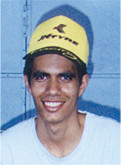
He qualified for the JK Tyre National Karting Championship held in New Delhi in 2000. In 2001 no qualifying round was held in Poona, so Banajee qualified from the Bangalore region and became the Bangalore Champion for 2001-2002. His several podium finishes (first, second or third position) through the course of two national championships and the others he has raced in has led him to hold the maximum number of podium finishes in karting championships in the country — about 25 kart racing trophies and 88.8 percent podium finishes in his racing career so far, he reports.
During December 2001 and January 2002, the KNK Championships (Indian car manufacturer, Karts and Karting) were held. Explains Banajee: "It was about drivers going to different centers to compete. Whoever had the most points after four cities bagged the championship. I entered the championship and won by a huge margin. In the process I won a kart, which is built specifically for racing and can’t be used on a daily basis.”
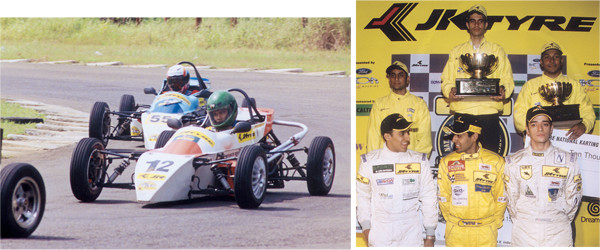
Banajee (center, holding trophy) at the JK Tyre National Karting Championship and (left) enjoying the thrill of racing
In August 2001 he was selected for a five-day intensive course on race driving by Akbar Ebrahim, the great Indian racer who has raced abroad and holds a Formula 1 superlicence. Ebrahim trained Banajee at his new Circuit Racing School at the Sriperumbudur Racing Track near Madras. Asserts Banajee: "I started by learning on the Esteem, followed by a two-seater Formula car and, finally, the Formula India. This training was necessary since I wanted to take part in the National Formula Racing Champion-ship.”
A month later, ADCA (Advanced Driving and Corporate Academy founded by Ebrahim and Indian racing champion Karun Chandhok), held a scholarship test for all their drivers, akin to qualifiers. Thrilled by his performance during the tests, Ebrahim ensured that Banajee drove the full Formula India season. What Banajee won was exactly what he was looking for — a one-year full sponsorship for Formula India.
Ready to take part in Formula India in the single seater Maruti engine category of the MMSC (Madras Motor Sports Club) Cup Championship, Banajee drove for Team ADCA. According to the Pune Times of August 23, 2002: "In the first race, Rayomand qualified third overall on a grid of 18 cars. In the 10-lap race, Rayo maintained his third position at the start. However a lap later, due to lack of engine power, he was overtaken. Rayo fought back within a lap, finishing second. In the longer 12-lap race, Rayo made a good start and coming out of the last corner pressurized polesitter Naveen Kumar and the two diced all the way to the finish. Rayo won the battle and after that, it was easy going for Rayo. Maintaining the lead, Rayo won his first Formula India race in a time of 15:12.903.” Till date, Banajee’s fastest time in the Formula India races on a 2.1 km track has been 1:13.1 seconds, that’s an average speed of 106 km per hour.
Although the winning streak continues sponsors are hard to get. Each and every pie he wins goes back into the next race. Eventually, he lands up spending at least Rs 40,000 for every event. The practice itself costs about Rs 100 for four minutes. Additionally he spends on entry fees, traveling, accommodation, gear, racing suit, car maintenance, tune-up and accident insurance. "Last year I was lucky to have Jotun Paints as my sponsor for the National Formula Racing Championship. The two federations that organize car races, MAI (Motorsports Association of India) and FMSCI (Federation of Motor Sports Clubs of India), can achieve much more if they pool their resources and work together... I’m fond of other adventure sports such as windsurfing, paragliding, etc. But since all that I earn goes into car racing, I don’t waste money on anything else!” he declares.
Though Banajee’s dream is to take part in Formula 1 (a level no Indian has yet reached), his next step is to qualify for Formula Asia, Formula 3-A, Formula Nippon and, finally, Formula 1. The two main factors that differentiate these races are advancement in technology (by light years) and increase in racing time. Whereas a Formula 1 race lasts for almost two hours, Formula India lasts for barely 15 minutes.
Having had three to four car crashes in his racing career thus far and luckily escaping injury, Banajee quips: "If you’re aiming to reach a certain level, do you expect to get there without a couple of bad moments? However, to set the record straight, car racing has become extremely safe over the years with several technological advances.”
Banajee believes in God and the power of Zoroastrian prayers. He always prays three Yatha Ahu Vairyos and one Ashem Vohu before and after each race. He is concerned about the dakhmenashini controversy dogging the Parsi community: "I prefer to follow the tradition although I’m not opposed to new things. It’s not that birds are wiped off from the face of the earth. It’s possible, that can be rectified.” Banajee believes that Parsis should marry within the community "so that our dwindling community prospers.”
With parents Armaity, a general physician, and Dadabhoy, a printer of identity cards, shifting from Dubai to Poona when Rayomand was three, Banajee’s base is Bombay where he takes part in most of the karting races and stays with his maternal grandparents. His younger sister, Huzannah, plans to take up equestrian studies. Like Banajee, there are quite a few young Parsis into the sport for whom he has a message: "Don’t get affected by everybody’s opinions. If you want to do something, go out and do it. But when you do it don’t leave it half way; give it all you have. And, believe in yourself.” That’s exactly what has made Banajee an achiever.
◆ ◆ ◆
From the archive