
Institutions
Tried and trusted
Over the last 75 years Sir Ratan Tata Institute has remained committed to its objective of promoting self dependence
Reputation, Trust and Industry could well be the attributes that characterize the 75-year-old RTI (Sir Ratan Tata Institute) known to the community for its food outlets serving the perennial Parsi favorites and its garments and sari departments proferring well tailored and painstakingly created garas and other embroidered beauties. Referring to the bygone era when it offered "the best food and cakes in town” Simone Tata, chairperson of Sir Ratan Tata Trust states, "RTI has been quite an institution in Bombay.”
Dotting the city today are "umpteen cake shops and food stalls which means very high competition for RTI,” points out the chairperson and additionally, "with the number of Parsis dwindling, this has created a shortage of customers,” the impact of which is felt particularly on the food department which continues to remain Parsi oriented. Bambino and Hers, the clothes stores for children and ladies respectively, being more cosmopolitan "are surviving quite well in spite of competition thanks to our faithful clientele.” Their biannual sales are quite popular but the profits they may earn at that time are not sufficient to wipe out the losses which makes it "difficult to survive. We have been getting donations and assistance to see us through but there is a real shortage of funds,” impresses Tata.

Having spent two crores of rupees on renovating and refurbishing the building, Tata notes, "We can’t expect only the Sir Ratan Tata Trust to support it. In the platinum jubilee year, we hope to raise enough funds with the help of many people.” RTI is the joint responsibility of Tata and her co-trustees Noel Tata and Dinshaw Tamboly who along with her represent Sir Ratan Tata Trust, and the three representatives of Stri Zarthosti Mandal — president Keti Mehta, vice president Banoo Cama and honorary treasurer Silloo Kavarana. A special platinum jubilee celebrations committee has been set up under the chairmanship of Cama which hopes to raise funds to meet the Institute’s rising costs of electricity, gas, raw materials, food bills… A fax machine as also computerization of their administrative chores could enhance their productivity, they realize. "Our arms are always open to gratefully receive any donation and then we thank them with closed hands,” mentions Dhanoo Khusrokhan who is assisting with fund raising.
On November 19 and 20, 2005 as part of their platinum jubilee year they have organized two shows of Shiamak Davar and his dance troupe for "music and dance are the manifestations of all celebrations.” Soliciting advertisements for the souvenir to be published on the occasion their appeal reads, "In terms of numbers employed or the turnover of sales and returns we may not be counted amongst the creators of wealth…But we can honestly say that within the means available to us, and the restraint one faces in such ventures, our intentions and our commitments to the well-being of our less fortunate brothers and sisters have been tried and tested for over 75 years. On this momentous occasion we are confident that you will extend your support to enable us to further upgrade and enhance our infrastructure and programs and make life a little easier for those who are willing to work and not be a burden on society.”
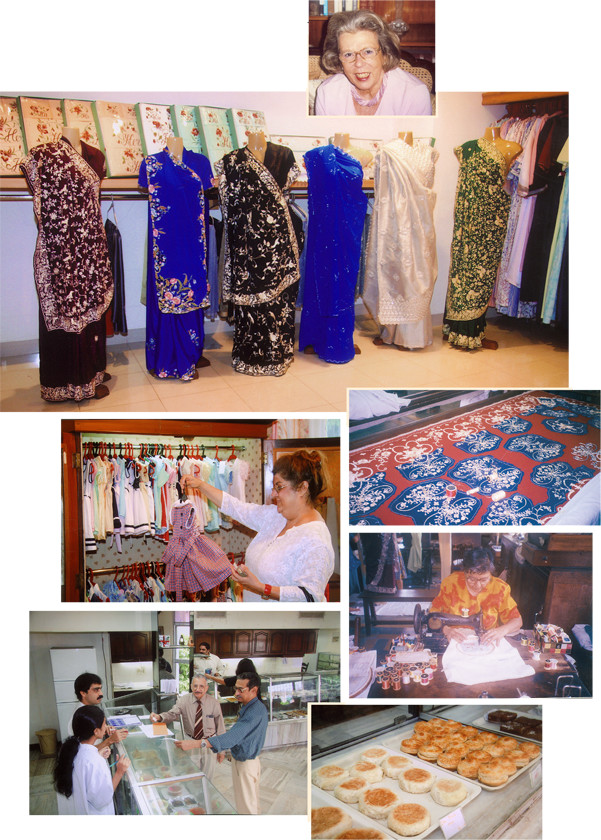
Simone Tata with RTI’s many creations Photos of garments and food on sale by Nazneen Vajifdar; of work getting readied by Hilla Guzder
[Donations favoring "Sir Ratan Tata Institute (Platinum Jubilee Account)” may be forwarded to the Institute at 35, N. S. Patkar Marg, Bombay 400007, Tel: 23802781/82/4363].
Since its inauguration on January 20, 1929 the birth anniversary of Sir Ratan Tata (younger son of Jamsetji Tata, the founder of the Tata enterprise) who had died in 1918 at the age of 48, RTI has helped the disadvantaged by offering them a means of living when they are ill equipped to find employment in competitive fields. A life of dignity which is not dependent on charity is what they seek to promote. Of the 154 employees presently in service, around 33 percent are Parsis. In the cookery section, Parsiana had chance encounters with old-timer, 77-year-old Perin Vatcha who has been making chocolates for the last 32 years, godown supervisor Ruby Engineer who has been working at RTI for over two decades, Rati Patva who has been cooking for them for over a decade just as Arzin Avasia been weighing and packing for the last 10 years. In the Annexe building across the road which houses the clothes section, Pervin Captain is in charge of the embroidery department. She has been working here for the last 25 years and has eight other Parsis working with her too, specializing in cutwork and garas. While Khorshed Panthaky is given the responsibility of Bambino the laundry department is in charge of Burzin Tarapore.
"With an average pay scale of Rs 2,500-3,000, some Parsis do not find it lucrative, others do not find such jobs interesting and respectful, those highly skilled do not think it worthwhile,” mentions Shernaz Acharia, the administrator of the Institute since the last six years. "We also give a chance to handicapped people,” she adds.
"We want Parsi workers but not many are forthcoming,” regrets Kamal Pandole who oversees the functioning of the embroidery department in the course of her weekly visits to RTI, just as Simone Tata monitors the progress of Bambino. "Those who want to work are more educated and aspire for different jobs. Not many Parsi women are being recruited at RTI. If they come, they don’t want to do enough hard work,” was Tata’s observation who has found that even at office, "the young want to get jobs near their homes and don’t want to travel. Today many jobs have moved uptown. The initiative and urge to develop oneself is not there. It’s unfortunate.”
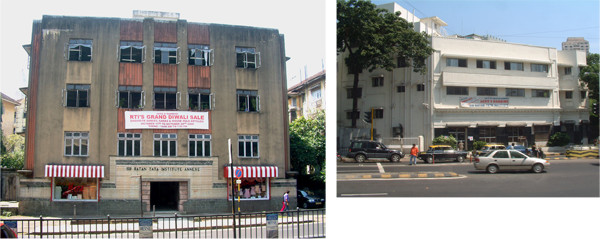
The centrally located premises of Sir Ratan Tata Institute Photos: Chereg Mevawala
RTI’s main premises continue to be at the Hughes Road/Babulnath intersection. The food outlet is housed in the building next to the Vachaghandhy Agiary and across the road is the Annexe where they create and restore clothes. As we are taken on a guided tour round the property we learn that by 10 a.m. the meals for the day have already been cooked and left the central premises for their stores from Hampton Court in south Bombay to Tata Blocks, Bandra in north Bombay. In fact by 8 a.m. the first van leaves with breakfast items for their outlet at the B. D. Petit Parsee General Hospital. They also supply snacks to the Cathedral School and lunch to the Sir J. J. School. With the reintroduction of their bhonu (meal) services (Rs 1,500 for vegetarian and Rs 3,000 for non-vegetarian) they hope to win back their loyal patrons. The storage facilities on the different floors of the RTI building are clearly demarcated with separate rooms for paper, provisions, non-vegetarian items and a cold walk-in where items are stored below room temperature but not at freezing point as required for confectionery dishes. The aroma of bhakras being fried, of tray loads of soya toffees being cooled… they seem to be a safe repository of Parsi culinary delights. The top floor of the building houses the women’s hostel. Four women share the spacious dormitory facilities here.
The Annexe houses the shops for readymade garments for children sold under the name of Bambino and embroidered saris, salwar suits and lingerie which are marketed as Hers. Known for their quality garments, their patrons may tire of wearing the same dress but even after years the fabric endures and so do the stitches, it is reiterated. Among saris they specialize in cutwork and garas, with hand embroidered garas available in the range of Rs 35,000-50,000 and the machine embroidered ones for under Rs 10,000. When old, beautifully embroidered heirlooms develop a tear, the laborious task of transferring the old creations onto new fabrics is undertaken here. Depending on the time involved, two or three months, a client may have to pay Rs 25,000-40,000. Kor polishing is also undertaken here which may take eight to 10 days. At the laundry department the prized borders and garas are respectfully cleaned with the care they deserve for which they charge Rs 300-500. These different activities are undertaken on different floors of the Annexe. Further, one section is reserved for the nine-month international teacher training course in early childhood education that they have introduced. Concession in fees is given to Parsis, states Zarin Malva.
Having conceived Bambino, for the last nearly five decades that Simone Tata has been associated with RTI she has nurtured this readymade garments department into a self supporting proposition. "This was my first business venture in India,” she fondly recalls. In 1957 when her son was born she found that well stitched "children’s clothes were not easily available in Bombay.” Her husband Naval Tata who was then the chairman of RTI told her to make a beginning at RTI and "I found that job quite interesting,” she reveals.
"Younger and newer blood is needed at RTI,” maintains Tata, convinced that "the style of functioning could be improved. The Institute has to be much more proactive and modern in its outlook and try to reach a more cosmopolitan clientele.” Admiring the community "for what it stands for, its integrity…its charitable attitude over the centuries which is still very much in place” she was appreciative of the overseas community support "which has been a great help to us… It’s a sort of chicken and egg story. Unless we get support we can’t improve and unless we improve, we can’t get support. My only vision is to see the Institute carry on for another 75 years.”
◆ ◆ ◆
From the archive