
Politics and Policy
“Don’t think you are doing anyone a favor”
Recipients need to be thanked for giving us opportunities to serve, believes social worker and trusteeship candidate Arnavaz Mistry
One circular posted at the entrance of each building at Godrej Baug intimated the residents of independent candidate Arnavaz Jal Mistry’s meeting on Monday, September 15, 2008. No door-to-door handbills were distributed for Mistry believes in personally trudging up and down different buildings in Parsi colonies to introduce herself and her work to prospective voters for the Bombay Parsi Punchayet (BPP) trusteeship elections. The venue chosen was the basement of B Block as against the prior campaign meetings of other trustee-hopefuls in the Agiary compound or the Eco Park.
A compact group of around 100 friends, supporters, and those who knew of her or wanted to learn more about her chose to attend the evening meeting which started 10 minutes after the scheduled start at 7 p.m. and ended within an hour.
After devoting herself to her family and the family enterprise of Mistry Transport and Logistics for the first four decades of her life, she has for the last 22 years committed herself to walking in the footsteps of her mentor, the late Silloo Kavarana, also a trustee of the BPP. When Mistry first started visiting the Parsi Ward at the J. J. Hospital it comprised four rooms and was "in a dilapidated condition,” infested with rats. With their meticulous and loving care of the bedridden inmates they gradually won over different deans of the Hospital so that they were entrusted more space and "now the entire bungalow in the complex is ours.”
Previously the geriatric ward was viewed as a death trap, "marvu hoi tau taa jaav (go there if you want to die).” Presently there are 45 invalids who enjoy the comforts offered and many more are in queue as it is the only community institution which accepts invalids, some of whom are kept absolutely free and others who can afford pay a nominal monthly sum. "Kaaré mot aavsé (when will death free us)?” was the constant refrain earlier whilst now they show a willingness to live, pointed out Mistry, inviting the audience "to come and see the change” at the Parsi Ward which to her is a second home. Nearly seven lakh rupees a month are spent on food and medicine for these patients while the government subsidizes the salary of some of the staff members on duty. The Jal Mistry Memorial Trust that she formed with Noshir Dadrawala’s assistance two years ago in memory of her late husband is primarily meant to channelize donations towards the corpus fund of the J. J. Ward so that the good work for the inmates will not stop even in Arnavaz’s absence.
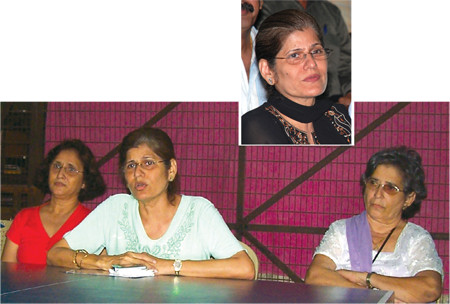
Arnavaz Mistry (inset) and addressing the gathering (center)
She also makes time to visit those ailing and suffering in the general wards at the B. D. Petit Parsee General Hospital and the Masina Hospital, those fearing an operation in the absence of relatives, those who feel consoled in her presence. Vouching for Mistry’s "love and affection…an angel in disguise who wants to see our happiness,” young Maharukh Kalianiwala remembered the time when she was critically ill with bronchal asthma and on a strong dose of steroids. Mistry would regularly come visiting, give massage, bringing help in cash and kind, said Kalianiwala as she gratefully touched the social worker’s feet as a mark of respect. "If you vote for her you will get blessings from above,” she told the audience.
On the ladies’ committee of the F. S. Parukh Dharamshalla at Hughes Road run by the BPP she and other volunteers help look after the 100 residents, 60 of whom are taken in free. Besides arranging entertainment programs they take the residents to atash behrams and on other outings occasionally. Her connections with the Stree Zarthosti Mandal and the Pattuck Trust enable her to assist non-academically inclined boys and girls interested in pursuing other financially rewarding careers in tailoring, hairdressing, beauty, art… One of the "borderline” youngsters from Godrej Baug she had helped secure a job at the Ratan Tata Institute was present with his father at the meeting to express his solidarity.
A regular visitor to the Jai Vakeel School for children in need of special care at Sewree which is presently being managed by Tehmina Shroff she teaches prayers to the 15 Parsi children and takes them to the Lalbaug Agiary. "Some may be 50-60 years old but because they have the mental development of a 10-year-old, they are referred to as children,” she explains. Since relatives sometimes distance themselves from such differently abled individuals, she tries to establish contacts on behalf of the School. Some of the other institutes to benefit from Mistry’s presence are the Kamla Mehta School for the blind which she visits every week and the Don Bosco Shelter for street children.
Formerly president and presently joint secretary of Young Rathestars, they regularly visit the interior villages of Gujarat and from the donations they receive from well-wishers and philanthropists in India and abroad they disburse grains and other essentials to the needy. They will also be extending aid to certain Irani families in Poona after confirming their worthiness. Bonny baby contests, Christmas parties, gahanbars are some of the other ways in which they spread joy in the community.
Just as Mistry has come to be known as "Silloomai’s successor” among the Parsis, at the Ackworth Leprosy Home, the inmates knew her as "Bawaji ni béti (Bawaji’s daughter).” Until the death of Gustadji Sidhwa, a leprosy patient who had been there for 35 years, Mistry would regularly visit him for he was "like God to me...Don’t think you are doing anyone a favor if you are serving them. Instead we should thank them ké séva aapvaano mauko aapoch (for giving us an opportunity to serve them).” There is much to be learnt from such recipients too, she stated, citing the instance of Sidhwa who from his monthly stipend of Rs 30 would help in looking after two fellow mentally challenged inmates. When she would broach the subject of shifting him to some institute for Zoroastrians, he would decline saying "aaee ghaataa ghariya jé mané maan aapéch té aapraa kaum vaala nahi aapsé (the respect I am accorded by these Maharashtrians here I will not get from my own community).”
As a member of the Doongerwadi Upkeep Committee she feels obliged to go to Doongerwadi once or twice a week so that the khandhias and nassessalars "dil thi kaam karé (feel motivated to give their best service).” Just because they may have TVs and mobiles it does not mean they are not deserving, she pointed out. "We should respect them,” she believes.
When the J. N. Petit Library in Dadar needed a fresh lease of life, she brought in donations, new books that could face the competition from computers. As attested community activist and Congress party worker from Dadar Mehernosh Fitter, "We need people like her in the Punchayet.”
"I know what sacrifice you have to give in terms of studies and medicine” when there is limited income, she told the audience. If elected trustee she would spend an entire day eack week listening to the grievances of the community and subsequently bring up issues at the board meeting. People should be able to voice their grievances even on the website, she notes. Her prime endeavor would be to bring about unity in the board, she says: "I am very flexible, I am willing to say sorry to anybody. At the same time when work needs to be done I can be firm. I am a very good administrator…”
When she married, the family business had two tankers, she revealed. As a young bride she would help out with the administration and accounts work. She recalled doing calculations in those days without the instant facility of a calculator and her father-in-law insisting that additions be done three places to the right of the decimal point and accurately rounded off to the nearest paisa! Presently their business has expanded to 45 tankers and is being capably handled by her elder daughter Yasmin, leaving the mother free time to devote to community and welfare issues, to dwell on providing financial aid to academically bright students, to pursue transparency in housing allotments, bringing together the youth for matrimony, guiding those shy of approaching the fertility clinic...
Not lured by fine dining or entertainment in the 60th year of her life, invitations from the family she gently declines on grounds of being tired. A standing joke in the family is: "Chaalo aapré koi hospital jaiyé, tamuné taakaat aavee jasé (come let us go to a hospital where you want to serve; you will replenish your energy stock).” The session with the audience ended on a note of apology: "Sorry I am not giving you any refreshments like the other candidates. I think it’s against the code of conduct.”
◆ ◆ ◆
From the archive