
Science
Gen(e) next
For her genetic study of the Parsi/Irani community Dr Villoo Morawala-Patell’s Avestagenome Project intends to collect 15,000 blood samples by 2008
"At 32, I found a vacuum in my life. I wanted to change the world… to do something more.” Twenty years later Dr Villoo Morawala-Patell’s cup is overflowing: The Rs 125 crore endeavor, The Avestagenome Project that she initiated to compile a genetic, genealogical and medical database of the community, has rolled out. Avestha Gengraine Technologies Private Limited, the company that she founded a decade ago has, effective January 1, 2008, become Avesthagen Limited, a leading Indian biotechnology company, in preparation for the mega IPO (initial public offering) of Rs 1,200 crore. The knowledge-based life sciences company hopes to announce the issue by the end of the year.
When Parsiana interviewed the go-getter on her visit to Bombay on January 19, 2008, already 1,119 Zoroastrians from Hyderabad-Secunderabad and Navsari had participated in The Avestagenome Project, giving blood samples, getting themselves photographed and filling out the extensive 30-page questionnaire. By February they hoped to cover 2,000 Zoroastrians and by the end of the year, 15,000. With Zoroastrians known to be an aging community, she believes, "we need to get the (elderly) in fast before it is too late.”
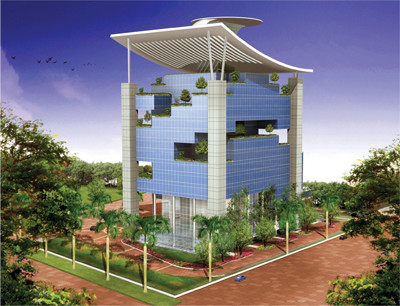
A model of Avesthagen’s new premises in Bangalore
While the educated strata came in willingly to participate in this Avestagenome study, people from the colonies "had to be coaxed out,” was their observation. Having spent several years of her life in the twin cities — her paternal grandfather Dinshawji Morawala had come from Surat to Bidar to work in the Nizam territory as a tax collector, her father Dara Morawala eventually settled there after his early years in Bina, Madhya Pradesh and around 40 years in Nizamabad, and husband Zareer Patell resides there — helped Patell’s team from Bangalore gain easier acceptance. In fact, in Navsari where her mother Daulat’s (née Kasad) family is based, "there was a deluge” with almost 100 volunteering to participate in the study each day despite the team being equipped to handle barely 30. Confidentiality of names and data was assured to each participant with a bar code maintained.
A total of 50 ml of blood per person is collected in nine small aliquota in vials and immediately treated to process and preserve for posterity the DNA (Deoxyribonucleic Acid — the molecular basis of heredity), RNA (Ribonucleic Acid — the expressing gene) and proteins. One of the tubes is set aside for extraction of haematopoetic stem cells. Earlier it was believed that only stem cells obtained from the umbilical cord served this purpose. "Each blood sample is unique and we have to set up both individual and multiple technology and systems biology platforms,” maintains the creator of this Project. She believes the need for significant "bio-computing powers have been put into place but much more will be needed and collaborating with partners will be important,” realizing that a lot of unique lines will be generated. To ensure that "we don’t run short on technology,” they are collaborating with Sun Microsystems and Affymetrix who will provide the tools and instruments for experimental and computing power.
Photographs of some participants in the study were clicked — the face as also the hands. It is through the hands that creativity is expressed, points out Patell. The excitement generated by this Project prompted NDTV to cover this activity in Navsari, interview Patell and give them the much needed exposure in their Urban Planet program.
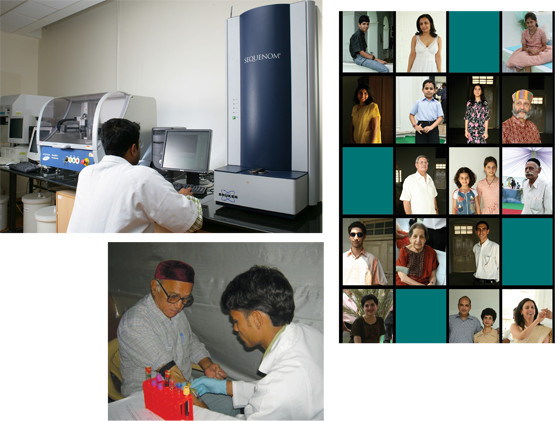
Laboratory organizing data from the blood samples of individuals (far right and center) participating in The Avestagenome Project
Presently there is "a lot of positivity,” says Patell who is overwhelmed with comments like "Tamé bau mottu kaam karoch (You are doing gargantuan work)… People are writing to me from many parts of India enquiring ‘When are you coming here?’” Patell realizes though that when the Avestagenome team goes to Bombay the response of the community members in the city which has the largest concentration of Zoroastrians "will be the crucial test” to determine the acceptance of this Project. Blood was collected from individuals even if only one parent was known to be Zoroastrian for it would help form a control group.
The appeal of the Zoroastrian religion, she believes, lies in its "fundamental simplicity… so easy to follow with its basic tenets of good thoughts, words and deeds… reference to the elements of fire, water, earth and air…how to keep the life force intact.” She considers the religion’s premises to be "scientifically acceptable” and is of the view that customs were introduced in India to keep the religion intact and ensure that it doesn’t get diluted; not because the religion or Prophet so prescribed them. In matters of dress and lifestyle habits the early migrants were willing to compromise, to gain acceptance in the Indian milieu.
"The women in the community should have the courage to question and to stand up,” asserts Patell. Though she may appear to be reformist and challenge Dastur Nadirshah Unvalla’s supremacy in Bangalore, Patell is equally emphatic about her preference for the dakhmenashini system.
The value of land the lady well understands, recalling the time at the turn of the century when she had to plead with the Indian Institute of Science in Bangalore (the National Centre for Biological Sciences being located there) to grant her space enough for two bench spots from where she and an assistant could commence operations. Fortunately for her soon followed a monthly funding from The Rockefeller Foundation for over four years. Besides the financial grants that she earned from the French and Belgium governments she was also fortunate to find research guides like Prof Jacques Henry Weil of France and Prof Marc Van Montague of Belgium, early giants in the field of biotechnology.

Avesthagen’s presence in biopharmaceuticals and bionutritionals
Considering that she chose to uproot herself and her family when her daughters Farah and Sanaya were just eight and six years, respectively, Villoo remembers her mother-in-law Rashida (who was one of the first PhDs in physical chemistry from the Nizam region and who retired as professor of chemistry from Osmania University and Women’s College, Hyderabad) urging her to "reach the top of the top of the tree.” A calling in chemistry was initially ordained for Zareer too who later opted for a mid-career switch to become a physical trainer and jazz pianist. Whilst actively pursuing her commitments at Avesthagen, Villoo makes time to serve as a key member of the Task Force and Vision Group for Biotechnology instituted by the State Government of Karnataka and as founder member of the Association of Biotechnology Led Enterprises (ABLE).
Married at the age of 22, for 10 years Villoo had worked at the International Crop Research Institute for Semi-Arid Tropics before she opted for higher qualifications. She had led a closeted life in India — schooling as a boarder at St Anne’s, Secunderabad. Her Dassera and Christmas holidays then were invariably spent in Nizamabad and summer holidays in Navsari. She completed her science graduation from St Francis College and postgraduation in medical biochemistry from Bombay’s Sophia College. She had a "tough time” in France when she went to do her doctorate in plant molecular biology from the University of Louis Pasteur, Strasbourg. Referring to the three-and-a-half grueling years in France in the early 1990s she says, "I had gone through fire.” On her return to India she found that "I was a totally different person.” Then came the realization, "I didn’t fit into Hyderabad of the mid 90s” and subsequent decision to relocate to Bangalore.
She had initially conceived of a public-private business proposal which could bring together the government and venture capitalists but when the model was rejected by both, she proceeded on her own steam. Her intention to launch a company under the name of Gengraine did not earn the approval of the registrar of companies who suggested that she prefix Gengraine with a name from the Hindu pantheon of Gods. But rather than do that she gave directions over the phone to use Avesta as a prefix and thus came into being Avestha Gengraine Technologies Private Limited. The company aimed at providing solutions to agriculture and health disorders such as degenerative and metabolic diseases and infections. After developing draught tolerant rice and engineering many other varieties as well, Avesthagen has over the years earned 160 patents of all kinds, 25 of these being core patents and the rest non-core, notes Patell. Besides agribiotech and science and innovation, Avesthagen has established strategic business units in biopharma-ceuticals and bionutritionals. The firm has collaborated with appropriate partners for access to and exchange of technology and overall commercial expertise.
"The name change (to Avesthagen Limited) is a key milestone in our growth, to broaden our corporate legal status and bring in stringent corporate governance. It also brings transparency in all our operations and the opportunity for future public participation in wealth creation as well,” Patell was quoted on the company website.
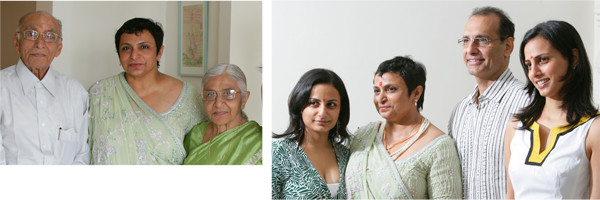
Dr Villoo Morawala-Patell (center) flanked by her parents Dara and Daulat Morawala, and with husband Zareer and daughters Sanaya (left) and Farah
Reportedly the largest venture funded biotech startup company in India with about $ 42-44 million being raised from entities like Fidelity Funds (Mauritius) Limited, New York Life Investment Management India Fund and a group of strategic investors like bioMerieux SA, Vilmorin and Cie, and Daninvest.com SA (Group Danone), Avesthagen has received support from Indian corporates too like Godrej, Meditab (Cipla Group), the Tata Group and ICICI Venture Funds. The company which has always given priority to integrity, quality services and transparency in business operations plans to use the proceeds from the IPO to scale up operations, global branding, manufacturing and setting up marketing offices abroad. As founder-promoter, Patell’s stake will continue at 31 percent, notifies the website.
Besides Villoo, elder daughter Farah Morawala Patell-Socha who is in her final year of doctorate studies on the subject of plant cell biology from Cambridge and younger daughter Sanaya who is now all set to do her doctorate in molecular biology from Cambridge University also serve as directors on the board of Avesthagen. The mother, who as chairperson and managing director holds together a team of 610 personnel globally, believes that her daughters are as entrepreneurial as her. The other directors are vice chairman Darius E. Udwadia, Prof Marc Van Montague Emmanuel Rougier, Jochen Ebert, Nadir Godrej, Aluri Srinivasa Rao and Koen Wentink.
A 15-storey building designed by Hafeez Contractor at Bangalore’s International Technology Park will soon be the new corporate headquarters for Avesthagen. "The path to accelerate product building is to make… acquisitions that shorten the time to market,” states Patell. "To sit on every shelf globally” is their dream. But the present challenge before Avesthagen is to "assure returns to the investor year after year,” declares the founder who has learnt, "To be at the cutting-edge of science you cannot compromise.”
◆ ◆ ◆
From the archive