
Books
Dadabhai's talks
The Parsee Religion and The Manners and Customs of the Parsees by Dr Dadabhai Naoroji. Reprinted in 2005 by The K. R. Cama Oriental Institute, 136, Bombay Samachar Marg, Bombay 400023. Pp: 71. Price: Rs 100.
The Liverpool Literary and Philosophical Society, UK had invited Dr Dadabhai Naoroji to deliver two lectures on the above subjects. The one on "The Parsee Religion” was delivered on March 18, 1861. After stating that priesthood is hereditary, Naoroji clarifies, "As a body, the priests are not only ignorant of the duties and objects of their own profession, but are entirely uneducated, except that they are able to read and write, and that, also, often very imperfectly... they say a prayer for anybody who chooses to give a half penny, and to depend upon charities distributed on various joyous or mournful occasions. They do not understand a single word of these prayers.” Naoroji’s non-complimentary observations about the priestly class prior to 1861 are not incorrect. But, since 1861, education has spread, some four athornan madressas have started training our athornan youths and the mobeds today are well educated, understand the Avesta and our holy scriptures, some have developed into reputed oriental scholars, give public discourses and write authentic papers and books on our ancient religion. Today, the community is proud of them.
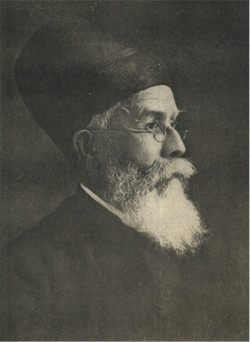
Naoroji: mores and morality
Naoroji then proceeds to give a series of extracts from the Yazashne as they give a faithful notion of the doctrines and morality of the Zoroastrian religion. I reproduce below some of the extracts:
Good conscience, high piety, love of excellence, high and perfect thought
I accept and am glad to do deeds of virtue
With highly good thoughts, highly good words and highly good deeds, I pray for freedom and ease to the community of holy men
The righteous are immortal
He who knows God through His works reaches Him
All the days of the holy man are with thoughts of truth, words of truth and deeds of truth.
What is the high religion? That which promotes holiness and truth with good thought, word and deed
The religion is for all, and not for any particular nation or people
On the day of reckoning, all the wicked shall be annihilated
Naoroji also states that "many ceremonies and notions have been introduced and the reformers of the day contend that all these ceremonies and notions that have no authority in the original Zend Avesta ought to be abolished and disavowed. Of course the old orthodox Parsis and the priests do not like this at all.”
Reading through the lecture, we feel that Naoroji has been frank, forthright, direct, to the point and has not desisted from criticism, where it is called for.
Concluding, Naoroji states that "At the commencement, I gave some account of the present imperfect knowledge of the Parsis about their own religion. I do not however mean to blame them much for it. A handful of persecuted exiles living in a foreign land, surrounded for 1,200 years by idolatry, and persecuted at times by religious fanaticism, it is rather a matter of surprise, as with the Jews, that the Parsis have preserved their national type and character, and their original worship. Though they have not altogether escaped contamination, and have adapted many superstitious ceremonies and notions of the Hindus, they have always recoiled from degenerating to the worship of idols, and have tenaciously clung to the idea that they were worshippers of the invisible Hormuzd.”
Much water has flown down the Thames since Naoroji delivered his talk in 1861. Today, with progress in education, the Parsis are a forward looking, dynamic community, leading in all the major fields and in the comity of nations. We may pray that they reach higher international standards following the great teachings of the holy Prophet Zarathushtra.
Naoroji delivered the discourse "The Manners and Customs of the Parsees” on March 13, 1861. He states, "the English education of the last 20 years has worked a great change... The change is not general, nor is it looked upon with satisfaction and approval by one portion (of the Parsis).” He refers to the great gap between the orthodox and those who have taken kindly to reforms and modernization on the English pattern. As an example, he refers to those dining on tables, with forks, knives, etc and those perfectly happy with the primitive good old mode of squatting on a piece of mat, with a large brass or copper plate, containing all the dishes of his dinner... using his fingers for knives and forks! He, therefore, prefers to give distinct accounts of the two extreme classes: the ‘old class’ of staunch, orthodox, unchanged Parsis and the ‘young class’ of educational reformers.
Naoroji then proceeds to give a description of the kusti prayers and explains the use of nirang; the sudreh, with its garian, etc. Many women of the priestly families make a livelihood or substantially add to their income by weaving kustis. Nirang is the urine of the cow, ox, or she-goat and the rubbing of it over the face and hands is the second thing a Parsi does after getting out of bed.
Naoroji asserts that the kusti prayers play an important part in daily religious observances — a Parsi "says it four times before he ends his morning ablutions... All meals must begin and end with kusti prayer, in addition to grace prayers... Before going to bed, the work of the day is closed by kusti prayers. Needless to say that today no Parsis — not even the members of the priestly class — fully observe the practices so meticulously explained by Naoroji. In those days, the ladies did not join the gents at meals. From a sense of duty, they preferred to ensure the gratification of the lord of the house. Noble ideas indeed.
Naoroji then proceeds to give some idea of the customs on births, marriages and deaths. On the 40th day of the confinement, the lady "undergoes the purifying ablution, consisting of rubbing the body with nirang, drinking a little of it too, and a good deal of washing, both of herself, of her clothes and of everything belonging to her bed. The bedstead is always of iron.” When the child is seven years old, it is invested with the sudreh and kusti, the badge of Zoroastrianism and representing admission to its duties and privileges. Naoroji adds that "by the age of seven (maybe even in its infancy) the child is betrothed by the parents.” The celebration of the wedding is described at some length. For a better appreciation of the simple and dignified marriage ceremony of today, the reader would do well to read in toto Naoroji’s description: "What with presents of dress and ornaments, with feasting and ceremonies, the poorest man hardly celebrates his son’s marriage under £ 80. The rich often spend large sums indeed.” Even today, the Parsis believe in competing with the Joneses and spend fortunes on wedding and navjote ceremonies. In all humility, I would strongly advocate spending the barest minimum amount on festivities and give the sums thus saved to the wedded couples for setting up their new homes and ensuring for their future conjugal bliss. Naoroji clarifies, "There is neither bigamy or polygamy amongst the Parsis. They are simple monogamists.”
The death and the obsequial ceremonies and the procedure at the dakhma are described. Naoroji described the "muktads” for the departed souls, the baj-rojgars and the gahambars. Naoroji has just stated things as they are and has not given his personal opinion. This talk objectively describes the customs of the Parsis. Naoroji deserves our praise for faithfully preserving for the benefit of posterity, the details of the manners and customs of the Parsis in 1861 and the preceding decades.
◆ ◆ ◆
From the archive