
In Memoriam
Theadmirableaviator
"Old soldiers never die, but must just fade away,” Air Marshal Aspy Merwan Engineer, former chief of the air staff, Indian Air Force (IAF), had specified in his will. Respecting his wishes that there should be no fly pass or gun salute at his funeral, the family bade him their final farewell on May 1, 2002 at Bombay’s Doongerwadi. Even the air force was informed a few days after his demise.
"It is indeed an irreparable loss...for the Indian Air Force as a whole,” wrote the present chief of the air staff, Air Chief Marshal S. Krishnaswamy. On Jamshedi Navroz, March 21, 2002, 89-year-old Engineer had specially penned a message for the Indian Air Force: "You shall not rest/You shall not pause/You shall not relent/You shall pursue mercilessly/You shall never waver/You shall not spare yourself/You will achieve your goal/Then without pause — you shall/Set out again to pursue the next/You shall never falter/You shall never fear/We will prevail!” Describing this message as "very, very profound and pithy,” Krishnaswamy added, "I, on my part, plan to ensure that it finds its way to and touches the heart and mind of each IAF air warrior today and tomorrow! It will serve them well both in peace and in war.”
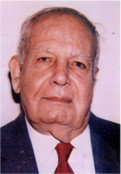
Engineer: "never fear”
When Engineer took over command of the IAF in 1960 shortly before his 48th birthday his address to his comrades was reported in The Hindustan Times of December 2, 1960, "The task of building up the IAF to its full stature is yet to be completed and a period of consolidation lies ahead of us. I take this opportunity to call upon all ranks to carry on with the same zeal and devotion to duty. As a united force, we must march ahead without ever faltering and with the fullest confidence in our destiny. I know I can fully rely upon each and everyone of you to do this.” Within the four years he spent as chief he reorganized the national air defence system, the command structure of the IAF and tactical air centers, and organized the induction of air-to-air and ground-to-air missiles into the air force. For a year he had also been appointed chairman of the chiefs of staff committee until he retired in 1964.
Prior to this prestigious appointment he was managing director of Hindustan Aircraft Limited (HAL) at Bangalore. Having transformed it into a purposeful organization and being the seniormost air force officer then, he was chosen to succeed Air Marshal Subroto Mukerjee who had died in harness. During his years at HAL, Engineer had initiated several new aircraft manufacturing programs for a supersonic fighter bomber, Vampires and Gnats, Pushpak and Krishak aircrafts, as mentioned in his biographical sketch.
Since his commissioning in the IAF in 1933 Engineer had served different stations, had occasion to lead several goodwill and aircraft purchasing missions, and had represented the IAF on the air force partition committee (1947), the armed forces reorganization committee, and the original committee set up for the establishment of the National Cadet Corps in India. He has been given credit for initiating the training of air force pilots and mechanics of countries like Indonesia, Egypt, Afghanistan and Iraq. During World War II, he was awarded the Distinguished Flying Cross (DFC) in 1942 for gallantry and leadership. Since his brothers Minoo and Rointon had also been conferred the DFC during Word War II it was considered a rare accomplishment for the family.
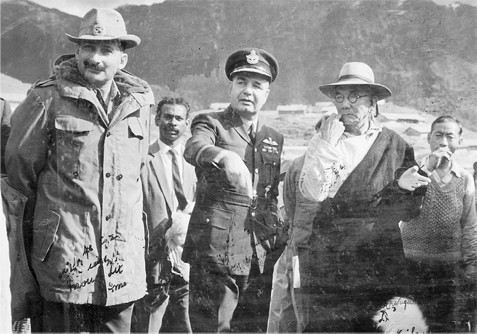
Field Marshal Sam Manekshaw (left) and Engineer (center) at the world’s highest air field, Leh
"Dad was married to his Indian Air Force... The family came second,” recalls son Cyrus clarifying, "This does not mean he didn’t care for his family. Whenever any of us were sick, he was the first to be there and always took charge of operations. As soon as things were in control, he was off to his air force...He would be away at work from 7 a.m. to 7 p.m. His habits were frugal... up at 5.30 a.m. every morning all his life. He would gulp down two boiled eggs with toast and rush to office by 7 a.m. in his 1947 Mercury car, which he always drove to office himself, refusing to use his staff car although he was entitled to it. He held on to his Mercury car till 1980...”
By 1950 the family had relocated to 6, King George’s Avenue, Delhi. At 4, King George’s Avenue was their legendary neighbor General Cariappa whose son Nanda and Cyrus became close friends. One day when invited to a party at Nanda’s house at age 14, Cyrus came back at 2 a.m. and found "Dad waiting for me with a lecture and reprimand. A young man had to have rules,” he remembers being told.
The practice of rising before dawn has remained with Cyrus too who acknowledges the strength derived from starting the day early. Above all, "he taught me ‘never to fear,’” adds Cyrus. The reticent man of few words had once told his son, "I never had any fear of dying but at the same time I was never foolhardy and planned everything I did. If there were any risks or a gamble was taken, it was only after fully understanding the consequences and planning for it.”
"Dad could face the bullets flying around him in Waziristan, and later on in the ‘War on Kashmir’ or meet the fierce warriors of the Nawab of Ippi in the Northwest Frontier province with a smile and get his way with them. Men of honor recognize each other. But in ‘court craft’ he was sadly lacking,” observed Cyrus. "His survival was simply due to his great honesty, sincerity and the fact that all things had to be done in the right way and that there were no shortcuts... Simple in his thinking... Dad was always ‘a man of his word.’ Once he gave it, no arguments could ever sway him. His word was final and had to be honored... His only failure therefore was the implicit trust he held in all human beings.”
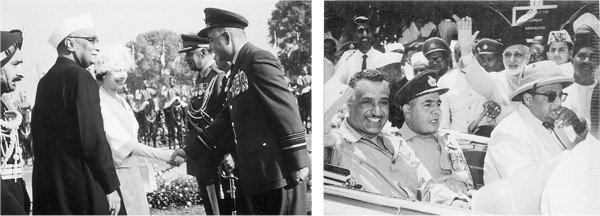
Far left: Queen Elizabeth shaking hands with Engineer as Rajendra Prasad and the other Service chiefs look on. Alongside: Engineer accompanying President Nasser in 1960
The eldest of the Engineer brothers, the skies beckoned to Aspy since his school days at Panchgani. When he was barely 17 he became the first Indian to fly solo from London to India in his Gipsy Moth (bought by his father Merwan) within 17 days winning the Aga Khan Prize of £ 500 in 1930. Earlier he had flown with Ram Nath Chawla from Karachi in the Gipsy Moth, landing at Croydon, UK, 17 days later. Competing with the likes of Manmohan Singh and J. R. D. Tata, the young lad put his training to good use to emerge as the winner over a route where few airfields and practically no communications existed. Cruising at an air speed of 80 mph in his Moth aircraft which has a limited range of 550 miles under no wind condition Engineer told The Sind Observer of May 12, "I flew as circumstances permitted, sometimes six hours at a stretch in a day and sometimes four hours...My longest flight was from Rome to Catania which lasted for about seven to eight hours without refuelling the machine...” As commented The Sind Observer when Engineer landed in Karachi, "To fly over three continents exposed to the inclemencies and treacheries of the weather, to cross mountain, sea and desert, plain and prairie with no more than a chart to guide him required physical and spiritual qualities of which heroes are made...We congratulate his parents especially for encouraging him, even at the risk of their dear son’s life, to dare and to achieve.” As a tribute to his ac-complishment, there stands at the Croydon Museum a statue of Engineer at the Lifetimes Gallery which was inaugurated in 1995.
"An Indian has been chosen as the best all-round pilot and awarded a special prize at the Royal Air Force (RAF) College at Cranwell. He is Flight Cadet A. M. Engineer,” reported a 1933 news item from London. "It has been decided that he has shown the greatest flying ability among the cadets of the senior term and he, therefore, receives the R. M. Groves Memorial Prize, the coveted distinction of all cadet officers in the RAF,” added the news item. After passing the 16th Army Co-operation Course at Old Sarum, Engineer joined the Royal Indian Air Force. After more than a decade he returned to the UK to graduate from the RAF Staff College, Bracknell in 1946 and the Imperial Defence College, London in 1951. The next year he was made deputy chief of air staff, India, mentions his curriculum vitae.
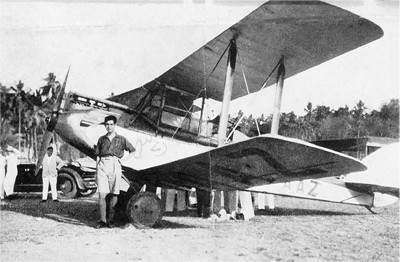
Engineer with his Gipsy Moth in 1930 Above: as chief of air staff
"In the latter years of his life his concern for his immediate family far outweighed all the neglect of the air force years. In 1966 when I desperately needed funds for my fledgling business, Dad, without a thought, advanced me half the proceeds from his Provident Fund when he could ill afford to. In his will he had written, ‘I leave all my wealth and assets to my son Cyrus...if he can find any.’ There were none because whatever little he had, he had given away to us, his family, over the years,” observed Cyrus. The premature death of his son Kersi in 1981, had left him heart broken. His wife Ruby had predeceased him by three years.
"Dad was a clairvoyant like his mother (Maneck) and his premonitions were uncanny,” states Cyrus. "He predicted that the Shah would fall almost two and a half years before the Shah of Iran abdicated.” He had many occasions to interact with the Shah during his ambassadorship to Iran from 1965-67. In fact, Engineer had conveyed to Jawaharlal Nehru that he had a vision of bringing Iran and India closer with a view to do good for Zoroastrians in India and Iran. A religious minded and staunch Zoroastrian, Engineer had studied ancient history and visited Persepolis many times. After completing his tenure as Ambassador, Engineer served as head, organization affairs of Iranian Marine International Oil Company in Tehran till end 1969 and he was concurrently resident representative of Hydrocarbons India Private Limited in Tehran. After he left Iran, Engineer spent equal time in Bombay and abroad. "Whenever possible he visited our fire-temples and met prominent Zoroastrians and gave talks not as an intellectual but as one who had a passionate love for his religion. He had an open mind and his sole fear was that one day the Parsis would become an extinct race,” conveys Cyrus.
Although he had expressed his preference for cremation, the ever thoughtful Engineer had specified that ultimately his son could choose the more convenient mode of disposal. Cyrus opted to consign his father at Doongerwadi "because I sincerely believe that the peace and tranquility and the power of our prayers at Doongerwadi far outweigh all other considerations.”
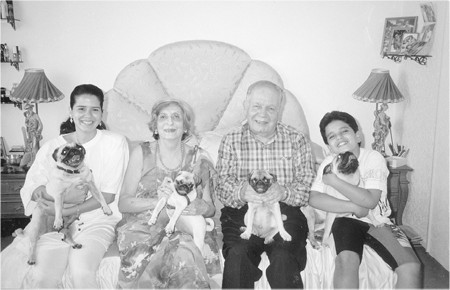
Aspy and Ruby Engineer with grandchildren Tayunaz Merchant, Rohnish Engineer and the pups
Until the end he sustained his interest in cricket and national events. Although once an active shikari, he gave up hunting and opted to pursue fishing in later life, teaching his family much about the splendors of nature and wilderness. Attempts to chronicle his life remained unsuccessful. In the last month when he realized that his physical health was failing and his legs could not support him he almost "masterminded his demise” announcing to his family, "Now my time to go has come and I’m a burden.” He was very close to his brother Homi in Canada, who was a year younger to him. "He phoned him and prepared him and then after calling for his great-grandchildren and meeting them, he left us,” notes Cyrus.
"I have no hesitation to say that I have inherited an air force which can be considered professional by any standards. The credit for this essentially lies with you,” one of his successors had addressed Engineer stating, "I have just assumed command of the air force and could not think of anything better than to seek your guidance and blessings.”
The air marshal is survived by his son Cyrus and brother Homi.
◆ ◆ ◆
From the archive