
Business
Parsi profit
Around 23 Parsi established or managed companies are among India's top 500 corporates
In good company at ET 500 (The Economic Times survey of India’s top 500 corporates) are several Parsi owned/promoted/established/managed companies. Nusli Wadia’s Britannia Industries (ranked No. 61) and The Bombay Dyeing and Manufacturing Company Limited (No. 113) are high on the list; the Godrej group’s Godrej Consumer Products is listed at No. 82, while Godrej Industries is at No. 237. Poona-based Thermax, put on the path to growth by the late Rohinton Aga, ranks No. 150. Originally pioneered by the Sidhwas of Bharat Tiles, Grindwell Norton is at No. 363 while Shapoorji Pallonji group company Forbes Gokak stands at 369.
Sixteen Tata companies, probably the largest number from a single group, are in the top 500. Interestingly, India’s leading IT company, Tata Consultancy Services, which would have ranked in the top league, is not included as it went public last year and one year of listed history was not available. Poised at the peak were Infosys Technologies and Wipro, at number one and two respectively.
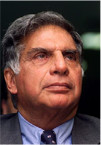
Ratan Tata:Forbes Asian Businessman of the year
Published in June 2005, the survey this year reflects the changing face of Indian industry by using a new methodology – it uses eight parameters to rank companies in terms of size, stability, current and future performances, and not just on market capitalization (cap), sales or assets as was done in earlier years.
Tata Steel, the bastion and old favorite of Parsi investors, put in a shining performance, steeling itself at No. 7 on the list, one notch above giant SAIL (Steel Authority of India Limited) which, however, posted higher profits than Tata Steel. ONGC (Oil and Natural Gas Commission) and Reliance were the two largest companies by market cap.
With India being, according to ET 500, the fifth largest commercial vehicle manufacturer in the world and the fourth largest car market in Asia, Tata Motors found its place at No. 53.
In a surprise announcement in June 2005, the board of Tata Sons, the holding company of the Tata group, raised the retirement age for non-executive directors to 75 (from the present 70). Non-executive chairman Ratan Tata can now, if he chooses, remain at the helm of Tata affairs till 2012, when he will turn 75. Named Forbes Asian Businessman of the Year (2004), Ratan has been widely credited with having spent the past decade (since he took over from J. R. D. Tata) transforming the Tata group from a lumbering giant into a modern, global player, aggressively focusing on expanding business into China, South-East Asia, Iran, Bangladesh, South Africa, Australia and the US, while pursuing his dream of a one-lakh rupee car in India which will be, as he told Rajeev Dubey of Businessworld (January 24, 2005) "bigger… and cheaper than the Maruti 800 and will take market away from two-wheelers.” The board’s decision also affects non-executive directors like Noshir Soonawalla, who would have retired in June, but can now carry on for the next five years. There is no change in retirement age for executive/whole time directors who will continue to step down on reaching the age of 65.
In the FMCG (fast moving consumer goods) sector, ET 500 names Godrej Consumer Products and Dabur as companies "to watch out for” in future. Incidentally, the promise of Dabur was greatly enhanced by the acquisition at the beginning of this year of Balsara Home Products and other brands of the Bombay-based Balsara group. With toothpastes like Promise, Babool and Meswak and household products like Odopic, Odonil, Odomos and Sanifresh getting added to the Dabur kitty, the group is reported to have acquired three Balsara companies "lock, stock and barrel for Rs 143 crore in an all-cash deal,” according to The Economic Times of January 28, 2005. It was, according to the paper, one of the largest FMCG deals in recent times.
The Wadia group’s food company, Britannia Industries with Nusli Wadia as chairman, is third in the FMCG sector behind giant ITC (at No. 4) and Dabur India (No. 42). Textile major and Wadia flagship, Bombay Dyeing, which had somewhat lost its way in recent years, ranks surprisingly high, standing second in the textile sector behind Pantaloon Retail (No. 84), though denim heavyweight Arvind Mills leads by market cap in this sector. With the dismantling from this year of the quota system for garment exports, Bombay Dyeing hopes to regain some of its lost ground, with a high profile media blitz launching its Ebony and Irony, a premium bed and bath collection in black and white, revamping of shops and making its presence felt in the mall manias currently sweeping Indian cities!

Top: Tata Steel mill, Trent’s Westside poster, Grindwell Norton’s products; Forbes Gokak shop floor, Godrej’s Entranza Doors, Godrej Properties’ Sherwood building, Wadia group’s Bombay Dyeing products and Go Air logo
With the recent Supreme Court judgment permitting development of mill lands in central Bombay, Bombay Dyeing is in a position, after complying with legal issues, to capitalize on its surplus land available at its two textile units in Bombay — Spring Mills at Dadar and Textile Mills at Worli. The two "young Turks” of the Wadia group, Nusli’s sons Ness and Jeh, both of whom are in their 30s, are increasingly making their presence felt. Ness, who has been deputy managing director of Bombay Dyeing since 2001 and heads their property division, is reported to have said at the Realty Summit 2005 organized by the Confederation of Indian Industry: "Real estate is the fastest growing sector in India.” The recent government decision to permit FDI (foreign direct investment) in real estate will bring in better financing opportunities, professionalism and transparency in this sector, Ness believes. "We need to think global, while being Indian,” Ness was quoted by www.business-standard.com, in a dispatch dated April 30, 2005.
The Wadia family is fueling its new aviation venture, Go Air, with a reported infusion of over Rs 100 crore. In charge of getting Go Air off the ground is Ness’ younger sibling Jeh who is positioning Go Air as a low-cost airline. "Aviation has been a premium sector, limited to just a certain section of people. Our responsibility is to commoditize it,” Jeh said in an interview with Reuters correspondent Rina Chandran in June. Jeh is modeling Go Air on Ireland’s Ryanair, Europe’s big discount carrier. "Unfortunately India lacks the secondary airports that Ryanair uses to cut landing and parking fees,” Jeh said. Set to take off in October, Go Air will face a clutch of competitors taking to the skies as well, despite the turbulence of poor airport infrastructure, shortage of pilots, ATC’s (air traffic controllers), runways and myriad other spanners in the works.

Pirojsha Godrej: real estate development
In the Godrej group too, a young generation of family members is presenting its calling card and credentials. Chairman Adi and Parmeshwar’s daughter Tanya Dubash is executive director and president (marketing), Godrej Industries. Also being groomed within the group is daughter Nisaba Godrej, who is manager, corporate development, Godrej Industries and newest entrant Pirojsha, manager (corporate development) who joined Godrej Properties Limited in September 2004. With development projects ongoing in Bombay, Poona and Bangalore, Godrej Properties was the first Indian real estate development company to get an ISO 9000 certification.
Opening a new door to business is the tie-up between the Godrej Security Equipment Division and Masonite of Canada, reputed among the world’s leading door makers, manufacturing 45 million doors per year! Launched in April 2005, the doors will be sold under the brand name Godrej Entranza, with outside and interior doors suitable for homes, offices and institutions. Present at the launch, among the several VIPs, was D. E. Byramjee, vice president and business head, Security Equipment Division, with Neville Bachana, general manager, marketing, making a presentation on the marketing plans. Made of fiberglass, steel and high density fiber, Godrej Entranza doors are ready- to-fit and will be available at exclusive Godrej showrooms and home outlets.

Thermax chairperson Pudumjee
Meher Pudumjee is the new non-executive chairperson of Thermax, an energy and environment major which, after having gone through a trough, has emerged with revitalized energy. Pudumjee took over from her mother Anu Aga who retired last October, but who continues to be on the board of directors. Pudumjee, who is in her late 30s, is not just an inheritor, having played an active role in the turnaround of Thermax’s fortunes, divesting it of non-core activities and restructuring business portfolios. Also on the board is Meher’s husband Pheroz, who had earlier managed Thermax’s venture in the UK. Pheroz became a director in 1997.
With family ventures increasingly professionalized, gen next has many a technical and managerial qualification from prestigious institutions like Wharton or Imperial College of Science and Technology, London tucked into their young belts.
◆ ◆ ◆
From the archive