
In Memoriam
Dhatigara’s daring
Died: Air Marshal Edul Jehangir Dhati-gara, 87, former Vice Chief of the Indian Air Force, on October 4, 2010 in Poona following kidney failure.
A farewell with full military honors, a flag ceremony and a gun salute were accorded to Dhatigara with wreaths offered on behalf of the Chief of the Air Staff Pradeep Naik, Air Officer Commanding-in-Chief (AOC-in-C) of the Western Air Command and the Air Officer Commanding No. 2 Wing of the Air Force in Poona.
During his 37 years of association with the Indian Air Force, Dhatigara, or Dhati as he was popularly known in the military circles, had served the nation with dedication: fighting during World War II as also the Indo-Pakistan wars of 1965 and 1971; participating in operations in the North West Frontier Provinces, Jammu and Kashmir, and several other regions for which he had been decorated with the Kirti Chakra as also the Param Vishisht Seva Medal (PVSM). Prior to his retirement as Vice Chief of the Air Staff in 1979 Dhatigara had served as AOC-in-C of the Western Air Command.
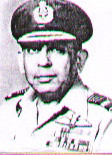
When assigned the command of an Air Force Station in the eastern sector in 1956, he had planned and executed counter insurgency operations and had undertaken a very hazardous supply-dropping mission when his aircraft received many bullet hits from ground fire, notes his life profile. This act of courage and leadership earned him the Kirti Chakra. The PVSM for distinguished peacetime service followed 18 years later.
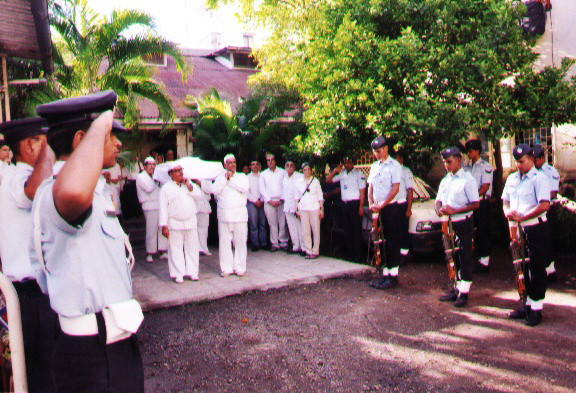
A military farewell being accorded to Air Marshal Edul Dhatigara (above)
The intervening years saw many eventful developments. His wife Maperviz remembers the time in 1959 when he was sent to the UK to test the Gnat aircraft. Due to failure of brakes the aircraft crashlanded leaving Dhati-gara’s spine seriously injured. He had to be rushed to the military hospital and when filling in the details he was asked his religion to which he replied "Parsi” but they misunderstood it as RC (Roman Catholic). A week later he was visited by a Catholic priest enquiring if he would like to confess. Being in considerable discomfort, Dhatigara responded, "I’ve been writhing in pain. What can I confess?” When the priest enquired whether he was a Roman Catholic, Dhatigara explained his religious leanings after which the padre left.
With members of the Christian faith Dhatigara had another memorable experience in 1962 during his six-day stint in Goa when he was entrusted the task of clearing Dabolim airport of unexploded bombs and repairing the damaged airfield. That was the year when Goa was annexed to the union territory and Dhatigara’s services were requisitioned for the Goa operations. Whilst there, a drunk soldier threw a grenade into a pub owner’s house when refused an extra drink. Dhatigara ensured that the soldier was duly punished for his misdemeanor. Some nights later he saw a posse with candlelights heading towards his dwellings. Wondering whether they had come to lynch him Dhatigara was pleasantly surprised to be told that in appreciation of his efforts they had come to reward him with an invitation to a special viewing of the body of St Francis Xavier which is permitted only on rare occasions. He was taken to the church and shown the body. When asked what he had prayed for, Dhatigara responded, "I wished for the betterment of my Air Force!”
Early in his career as a flight commander of a transport squadron Dhatigara had organized relief operations during the earthquake and flood catastrophe that had struck Assam in 1950. Active in both the Indo-Pakistan wars, in 1965 Dhatigara was assigned the command of an operational wing in the eastern sector where he was responsible for the successful operations carried out by fighters and transport aircraft. In 1971 he was commanding an operational wing in the western sector leading the fighter and bomber squadrons. The next year when he was appointed Assistant Chief of the Air Staff (operations) at the air headquarters he was able to establish satisfactory rapport with his counterparts in the army and naval headquarters.
To Air Marshal (retired) Bharat Kumar, Dhatigara was "an outstanding officer. I had the privilege of serving under him when he was AOC Air Force Station Chandigarh. A man full of resolve and still very humane, his sense of humor and of course the famous and now eternal ‘Dhatigara Bhujia’ will be missed…” Known to be fond of good food and a chef par excellence, it is to his credit that every Air Force mess serves Dhatigara Bhujia (as the Parsi akoori came to be known) today. He lived in the operations office when the 1971 Indo-Pakistan war was in progress. Maperviz remembers a harassed cook from the office who came to their house asking her to show him how to prepare a Parsi omelette since "Saab (Sir) won’t eat my preparations.”

.jpg)
(Left): Maperviz, Nariman and Edul Dhatigara; (right) Edul (in suit) with his younger siblings
After retirement, Dhatigara chose to initially stay back in Delhi to work as a consultant for firms like Alitalia and Lockheed to advise them on aircraft purchase. Subsequently the family relocated to Poona. After the untimely demise of his son Nariman in a road accident, Dhatigara preferred to restrict his social engagements but every Sunday morning he would visit the Shivaji Market in Poona to purchase his favorite fish and prawns. Even the beggars outside Shivaji Market knew him for he believed in quietly helping those in need in true Zoroastrian spirit although he may not have visited the agiary regularly.
Dhatigara’s formative years were spent in Karachi, studying at the Bai Virbaiji Soparivala Parsi High School. Keen to be a fighter pilot, at the age of 18 he had joined the Royal Airforce so that his income could help his mother Piroja raise his younger siblings. Before partition, the family had shifted to Calcutta where resided his maternal grandparents.
"It is not an exaggeration but an obvious truism to say that your pleasing attitude and humane behavior has won the hearts of one and all,” noted a farewell citation from the airmen of the No. 14 Wing of the Indian Airforce on the eve of Dhatigara’s transfer in 1966. The citation further commended "the pains you have undertaken to establish the welfare of your subordinates… You have proved beyond doubt that humanity and discipline can go hand in hand.”
The commendable commander is survived by his wife Maperviz and sisters Bachi Dastur, Aloo Gazdar and Silloo Bhattacharjee.
◆ ◆ ◆
From the archive