
Professions
The flamboyant flier
Tata Airlines’ first full-time pilot Homi Bharucha was a bon vivant who loved flying, family, fashion and food
It is a well-known fact that J. R. D. Tata launched Tata Airlines in 1932 with the help of Nevill Vintcent, an Englishman, who became chief pilot and manager. The airline, which started as a mail service, went on to become Air India. What is perhaps not so well known is that Tata Airlines’ first pilot was a colorful personality named Homi Bharucha who was born in Bombay but who earned his wings in England. When the young Tata and his associate Vintcent wanted to start an airmail service they needed a full-time pilot, and the flamboyant 24-four-year-old Hormusji "Homi” Bharucha was the first to join. The historic first flight on October 15, 1932 is too well known to bear repetition here, but in the months and years to come Homi would fly from Bombay’s Juhu airport to Ahmedabad, and then to Karachi where the Imperial Airways flying boat would take the mail bag to London.
He loved to dress the part of the pilot. Cyrus, Homi’s son, who went on to become a film director in the US, directing Zubin Mehta in On Wings of Fire, a docudrama on Zoroastrianism, recalls Tata telling him, "He wore jodhpurs, boots and a leather helmet with goggles attached. He liked to look the part.” Homi was well loved in Bombay society: his profession made him unique and he was also much in demand as a raconteur.
He loved to dress the part of the pilot. Cyrus, Homi’s son, who went on to become a film director in the US, directing Zubin Mehta in On Wings of Fire, a docudrama on Zoroastrianism, recalls Tata telling him, "He wore jodhpurs, boots and a leather helmet with goggles attached. He liked to look the part.” Homi was well loved in Bombay society: his profession made him unique and he was also much in demand as a raconteur.
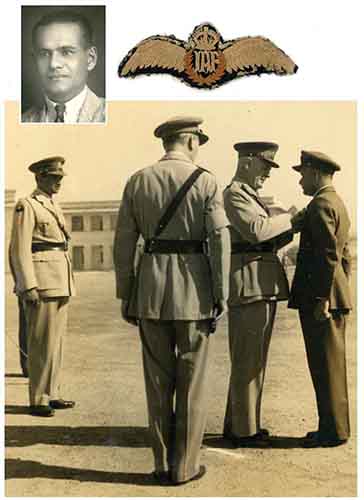
Above: Viceroy Lord Archibald Wavell pinning the Air Force Cross on
Homi Bharucha (inset) as Maharaja Sawai Man Singh of Jaipur (l) looks on;
top Bharucha’s Air Force Wings
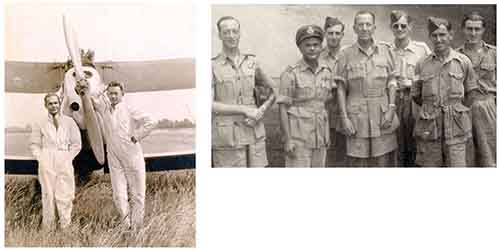
L: Bharucha in flying kit with a Chinese pilot who had flown with him during World War II;
r: Homi (2nd from l) withentertainer Sir NoelCoward (center) and flight crew
Born on March 16, 1908 in Bombay to Dhunjishaw and Jaiji Bharucha, Homi grew up in a westernized Parsi home with a love for all things British. Dhunjishaw, his father, was a lawyer with a very lucrative practice. Homi was educated in Bombay and was an alumnus of St Xavier’s College. Orphaned as a teenager when his parents died within months of each other, he came under the guardianship of Sir Phiroze Sethna, a close friend of his father (and perhaps also his client). Homi didn’t excel at studies but had a great passion for flying aeroplanes. Sethna, realizing that he could never make a scholar of Homi, sent him to England to the flying school and club in Brooklands near Weybridge, Surrey where he trained for two years from 1928 to 1930.
Homi returned to India in January 1930 having qualified as a class B pilot and a mechanic in all classes from A to D. This made him eligible to fly any plane at the time. He first worked as a freelance pilot for the aristocracy and once flew an English peer across the Sahara. When the plane stalled, he landed at an oasis, repaired the engine and flew back to Cairo. Homi also worked briefly for the textile magnate Ambalal Sarabhai (father of the famous nuclear scientist Vikram Sarabhai). His job was to ferry cotton samples from Ahmedabad to Cairo, the flying time in those days in a Tiger Moth being two days. This revolutionized the cotton trade. Samples in those days went by sailing boats (dhows) and took up to 10 days depending on the headwind. Flying the cotton to the Egyptian market in just two days enabled industrialists like Sarabhai to get the best price. Homi flew with a compass and the stars, but no radio. In the monsoon months he was stationed in Poona and would fly from there to places like Madras, Bangalore, Delhi and finally Karachi. During this time, Tata also pitched in as part-time pilot.
Homi married Khorshed "Kitty” Virjee of Panchgani in 1936 in Bombay. The couple had two children, Cyrus who was born in 1941, and Gita who arrived in 1947. (Gita owes her name to Geeta Bali, Cyrus’s favorite film star. He says that he had never seen a film of hers but liked her from the posters! His parents must have liked her too since they decided to name their daughter after her.) Cyrus recalls having being told that Homi and Kitty’s wedding was attended by many who would qualify as Page 3 people today, since Homi was well known among the socialites of Bombay at the time. Homi was very much a "Brown Sahib” who liked the good life: his suits were cut to the fashion of the day and he bought silk smoking jackets from Peter Robinson on Oxford Street (which his son wore for years), and wool hunting jackets from Burberry on Regent Street. Sharkskin suits were a favorite and he owned many. The family resided in Bandra so that he could be could close to Juhu airport. He drove a Lancia and Cyrus remembers sitting on the dickie seat with his ayah. There was a Siddi called Sambo who was Homi’s Jeeves. Sambo not only ran the house but also serviced the car.
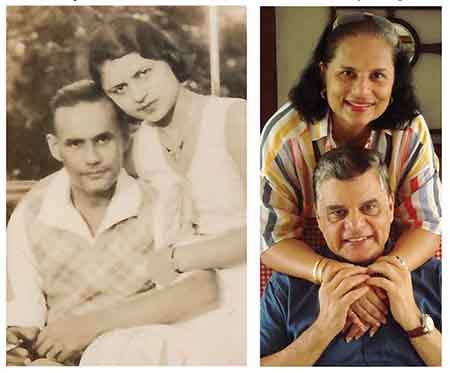
L: Homi and Kitty, while courting; r: Gita Choksi and Cyrus Bharucha
Years later when one of Homi’s old trunks was unpacked, the family found bolts of white sharkskin from which Cyrus made a suit. Wool and corduroy also found favor for jackets and suits. Kitty was a creature of fashion too, and for many years she would get her monthly copies of Vogue and other fashion magazines and have clothes made for herself and Gita (who was a friend of Freddie Mercury when he schooled in Panchgani). Kitty’s photo in the Illustrated Weekly won a prize and she was called "The Bergman of Bombay” after the famous movie star Ingrid Bergman.
Tata was once again the source of an invaluable nugget about Homi. He narrated an amusing anecdote to Cyrus and Gita. "Your father was a very naughty boy; he used to try to impress your mother by diverting the flight to Panchgani and flying over the house and doing sommersaults and flybys. I found out because I got letters from a Mr Batha who owned a school next door saying he was frightening the young girls and that the chickens didn’t lay eggs on the day he flew over the school! I didn’t stop him as I too am a romantic and thought it was a very chivalrous gesture.” Homi was a cause of further irritation to Batha. A narrow lane leading to Maidstone, Kitty’s home in Panchgani, served as a short cut. Notwithstanding its narrowness, Homi insisted on driving down the lane much to the annoyance of Batha. Having made up his mind that he would put a stop to this rashness, Batha had two poles placed in the lane effectively barring Homi entry! They stood there until the 1980s when the lane was paved into a road. Ironically, today motorbike riders roar down it.
As the airline grew more pilots were hired with Captain Rao and Captain Vishvanath being some of the earliest to join. Rao, sadly, was killed in a crash but Vishy (as he was called) went on to fly Boeing 707s into the 1960s and flew Cyrus from London to Bombay on a couple of occasions. Cyrus recalls him telling his co-pilots, "His father was in the left hand seat when I joined Tata.” But by 1940 Homi had a falling out with the management over safety issues and resigned. At the time he was making Rs 800 a month, a princely salary in those days.
After the stint with Tata Airlines ended, he cast around for another job and soon found employment with royalty. In those days all the major maharajas had their own aeroplanes and aerodromes. Homi secured a contract with Maharaja Sawai Man Singh II of Jaipur who was married to the beautiful Gayatri Devi, princess of Cooch Behar. Homi secured a contract with the Maharaja on very generous terms: a salary of Rs 1,200, expenses, a jeep and a house with servants. It was considered a very major contract in those days. For many years visitors to Maidstone could see a signed photograph which the Maharani had presented to Kitty. When Gita met the Maharani over tea in the early 1990s, she recalled both Homi and Kitty very fondly.
In Jaipur, the young couple kept open house. There were visits from the princes of the royal family; Brigadier Charlton who was in charge of the Maharaja’s army was also a frequent visitor. Jaipur has always been known for its strong polo team and Cyrus recalls going to many matches as a young child. The couple became part of Jaipur’s high society and the first European dance in that city was held at their home at 6, Civil Lines. It was a large house with a first floor and the family was served by four servants, including a Muslim khansama who Cyrus says made the best cream meringues he has ever eaten.
Like most Parsis, Homi loved his food. The ducks he bagged on his shikar found their way to the Bharucha table, as did peahen (which was illegal). Cyrus recalls the surreptitious manner in which he and the faithful servants would bury the feathers — evidence of the illegal repast — in their backyard. Homi was a heavy smoker and also loved his scotch and brandy. The Maharaja too was a gourmet and loved the biryani made by the Coronation Restaurant on Bombay’s Grant Road. Homi would fly into Bombay with two huge copper tapelas (vessels), fill them with the object of desire, and fly back to Jaipur in time for dinner.
The World War II had started in September 1939 and following the Japanese attack on Pearl Harbor on December 7, 1941 America formally entered that world conflict the next day. Pilots were in short supply and the Royal Indian Air Force requested the Maharaja of Jaipur to lend Homi to them for the war effort. Thus it was that Pilot Officer Bharucha found himself flying Bomber Squadron 31 in the Assam sector and over the "Hump” in the Himalayas. These flights had never been attempted before and Homi flew Mosquitos and B25s and in one year alone, from June 1943 to June 1944, he accumulated 1,510 hours which earned him a mention in dispatches and recognition in the form of the Air Force Cross.
Commenting on Homi’s role, the commanding officer of 353 Squadron noted, "No higher standard of a pilot’s ability and determination to succeed could be set. He is confidently recommended for recognition.” By this time Homi had been promoted to Flight Lieutenant. (In 1965, Cyrus, then working as a cameraman for the British Broadcasting Corporation, went to Anglesey in Wales to film Royal Air Force pilots doing their mountain training. On asking about his father, the commandant produced a ledger with the name, Homi Bharucha — 1929. Cyrus recalls how thrilled and proud he felt.)
After the War ended, Homi returned to Jaipur and was awarded the Air Force Cross at a glittering ceremony in 1946 at which the Viceroy of India, Lord Archibald Wavell, did the honors, in the presence of the Maharaja and the Rajput regiment. Of course, Kitty and Cyrus were present and Cyrus, who though only five at the time, vividly recalls this very memorable day in his young life. After the War Homi was given the honorary title of Wing Commander by what was then the Royal Indian Air Force. He returned to his duties as state pilot for Jaipur on an increased salary of Rs 3,000 a month, a huge pay packet by any standards in those days.
Cyrus recalls that on his mother’s birthday in 1946 Homi took them on a surprise flight to an unknown destination. He kept it a secret till the end in spite of her pestering. Then, when they finally broke through the clouds, his mother screamed in surprise and joy, for in the light of a full moon stood the Taj Mahal. They approached it from many angles and then flew back to Jaipur. Kitty said that was the most romantic thing Homi had ever done for her.
But the idyllic existence in Jaipur didn’t last long. Homi’s health was deteriorating and he was worried that his flying days were numbered. He took a long leave of absence in 1948 and went to England for treatment. He had a serious kidney ailment and given the state of medicine at the time, his case was declared as hopeless. He also started losing his vision and it soon became obvious that he had only a few months left to live. The flamboyant pilot finally left for his home in the sky on August 22, 1948. He was only 40 years old. There was a Tata connection even in the afterlife: Homi is buried in Brookwood cemetery in Surrey, UK, near the tombs of Sir Ratan and Sir Dorab Tata.
◆ ◆ ◆
From the archive