
Zoroastrians Abroad
The Parsi Lodge
She is a science graduate from Bombay’s Jai Hind College who works full time as a registered medical scientist; he’s a commerce graduate from Bombay’s H. R. College with a three-year course in catering and management from the Auckland University of Technology who arranges sight-seeing tours for visitors. Together they run the Parsiana Lodge in Auckland, New Zealand (no connection with the magazine Parsiana). Meet Daulat and Aspi Shahlori, a lively duo with the lady as main spokesperson.
With a capacity for 48 guests in accommodation ranging from fully furnished self-service apartments to shared facilities for singles, the Lodge is open to all migrants and needs to be booked three months in advance, say the Shahloris.
Though a lot of Parsis provide "homestay,” the Parsiana Lodge is registered with the City Council (akin to the Bombay Municipal Corporation) and is listed in the official ethnic communities’ directory, notes Daulat. "When people come, they are like our family,” she says.
The normal 15-day stay begins with a free pickup from the airport. They then help to settle the migrant with an introduction to the bank to open an account, acquire the IRD (Inland Revenue Department) number, look for housing, find the right school, buy a car, shop, etc.
Availability of residential accommodation varies seasonally, depending on the influx of immigrants. Sometimes four or five newcomers arrive in the course of a week. "We then put them into a buddy system so that they provide support to each other, go job hunting together.”
A lady of Chinese origin from the Ethnic and Cultural Affairs Office visits the Lodge to provide moral support to the newcomers. Another white woman helps in writing curriculum vitae for a fee ("we do it free”) and largely caters to white immigrants from South Africa. The Zoroastrian guests, who range in age from 16 to 60, settle at the Shahloris’ big dining table where 12 to 15 people can sit together and discuss and join the hosts in the Mushkil Asan prayers on Friday nights, Daulat informs us. On Saturday nights people socialize with drinks, dancing, etc. Ninety percent of the Zoroastrian immigrants are from India, although expatriates from the UAE also choose to settle in this Tasman Sea paradise. A family from Canada and an individual from the UK have also used the Lodge until they settled.
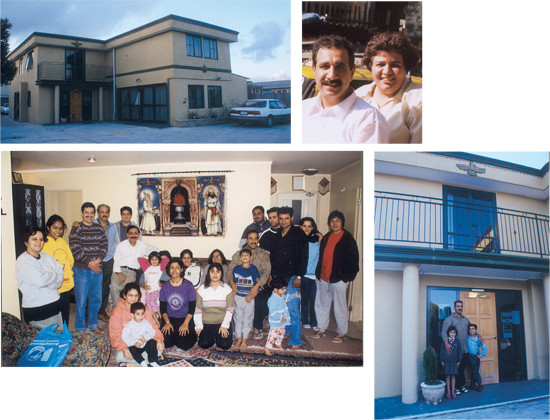
Clockwise from far left: The Parsiana Lodge; Aspi Shahlori with Daulat; with Zeeba and Darian; inmates passing through Photographs by Perzon Zend
The Lodge started by providing homestay in 1999 when an elderly lady "came and said she’d like to stay with us,” recounts Daulat. That was the time when there was "a major push for New Zealand.” The immigration is temporarily closed but will start again. Presently the policy favors blue collar workers like mechanics, carpenters, etc, she notes. Earlier New Zealand had focused on graduates with two years’ work experience preferably in the 25-35 age group. It is likely that the policy may change again. In between 48,000 applications had lapsed, said Daulat. "People had been taken for a ride by consultants.”
Though not mandatory, Daulat took a one-year course with an exam to qualify to be a member of the NZAMI (New Zealand Association for Migration and Investment) in order to provide her patrons with good service. She is a member of the New Zealand Council and is a counsellor at the Citizens’ Advice Bureau.
The Shahloris enjoy helping new immigrants to settle in Auckland. But they also cater to students and tourists, specifically elderly visitors who wish to avail of the health benefits of sulphur pools near the city. One gentleman from Bombay comes regularly and stays for two weeks. Aspi organizes tours for him to the North Islands. While another New Zealand based Zoroastrian takes tours to the South Islands, they tend to be expensive. Aspi’s tour begins early on day one and ends late on day two and costs NZ$ 375 per person inclusive of food as against NZ $ 680 per person without food charged by others, Daulat informs us.
Both husband and wife are children of Irani Zoroastrians born and bred in India. Aspi migrated in 1989. Daulat followed in 1991. Their twin children Darian, a boy, and Zeeba, a girl, had just been navjoted at the Iranshah. They were homeward bound when Parsiana met them in end December 2003.
Aspi calls himself a "professional chef.” He says he loves cooking and unhesitatingly recommends his biryanis, butter chicken and sali boti. He says he learnt to cook at his dad’s cafés Milan and Café Shapoor in Bombay’s Crawford Market area. He has also taken short diploma courses in business administration and is a certified, licensed real estate agent.
Daulat’s is a sci-fi job at the Cord Banking Clinic. An offshoot of IVF (in vitro fertilization) technology, the baby’s cord must be processed and banked within 72 hours of birth. It can be stored in liquid nitrogen for 30 years and the stem cells can be used for transplants when required. It costs NZ $ 3,000 to bank the blood, NZ$ 150 per year to maintain the storage and between NZ$ 30,000-50,000 for each transplant, Daulat tells us. "Only two Parsis have banked their babies’ blood so far,” says she, adding, "Ours is the only clinic that does it in New Zealand.” Their website www.cordbank.co.nz is linked with various important websites which can be accessed for information through it.
Members of both New Zealand Zoroastrian organizations — the Zoroastrian Association of New Zealand and the Traditional Mazdayasni Zarathustree Anjuman of New Zealand — the Shahloris, who "basically believe in good thoughts, words and deeds,” have been trying to bring them together. Aspi was on the Zoroastrian Association of New Zealand’s managing committee for five and a half years before he resigned.
They are currently working on a prayer room on the Lodge premises and have placed an order for an afargan. The facility is aimed at the religious education of children of Parsi fathers, born in New Zealand.
◆ ◆ ◆
From the archive