
Zoroastrians Abroad
Foroud Shahlori Dar be Mehr
Aspy and Daulat Shahlori of the Parsiana Lodge in Auckland, New Zealand, welcomed all Zarathushtis to the Foroud Shahlori Dar be Mehr on August 1, 2004. There were no invitations to the opening of the 500 sq foot, single room structure where the 10 mobeds of New Zealand performed the inaugural jashan. The volunteer mobeds Hormuz Patel, Freddy Gonda, Kayomarz Fatakia, Yezdi Dastoor, Viraf Fatakia, Khushru Master, Aspi Bilia, Jamsheed Tata, Farzan Rao and Kayan Gonda — all of them occupied in various service jobs — have been taking turns to serve the dadgah fire with the boi ceremony three times a day, Aspy informed Parsiana magazine (no connection to the Lodge) in the course of a trip to Bombay in January 2005. With ladies turning out in their garas and kors, with trays of malida and puri, sev and ravo ceremonially consumed, the event was covered by the local Press.
"The Zoroastrian community has multiplied by leaps and bounds in Pakuranga which is soon earning the label of being called Parsiranga because of the number of immigrants who follow the dictum of good thoughts, good words, good deeds. This is truly an answer to their prayers,” notes one report. "After years of planning...after a lot of trials and tribulations the fruit of Aspy’s labor of love was realized. Aspy has single-handedly managed to put his time, energy and resources to build the Dar be Mehr. He has managed a Herculean task of providing a sacred place where one can pay homage and have a quiet dialog with the Maker in front of the burning embers of fire for which a lot of Zoroastrians in Auckland are grateful to him,” notes feature writer Farida Master in "The Aucklander” section of The New Zealand Herald.
In a message to the Zarathustrian Association of New Zealand reproduced in the ZANZ Gazette (November 2004) past president Rumi Engineer, writing from his current temporary home in Abu Dhabi, enthused, "When I left Auckland I was not aware of Aspy Shahlori’s plans, but to my great pleasure and by the grace of Ahura Mazda and Aspy and Dolly’s hard work, dedication and vision, we now have our very own Dar be Mehr. This is a true blessing for us and I beseech every Zarathushti to go and worship at this dadgah with sincere devotion. Our children who have been born here and have no idea about the practice of praying in front of a consecrated fire, now have the singular honor and opportunity to practice our faith. From the bottom of my heart, my family and I thank Dolly and Aspy for giving us this boon. It has been such a pleasure for me to pray in front of the holy fire.
"Fellow Zarathushtis, Aspy has taken on this onerous task of maintaining the dadgah from his own funds. Let us stand shoulder to shoulder with the Shahloris and donate generously for the upkeep and maintenance of the Dar be Mehr.”
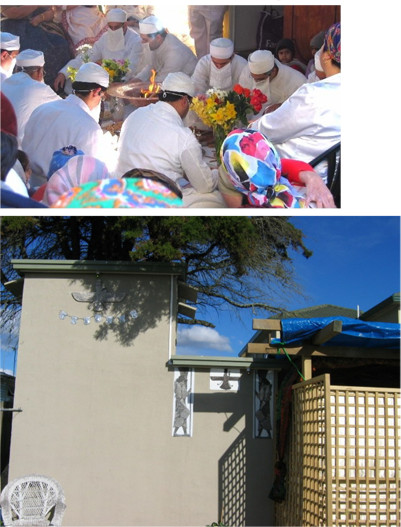
The inaugural jashan (above) at the F. Shahlori Dar be Mehr (alongside)
Settled on the city’s Pakuranga Road since the past 13 years, the project was born of Aspy’s desire to provide the nearly 70 children of Zarathushti parents in New Zealand the infrastructure to learn and understand the practices of the faith. The necessity for such a place stirred his consciousness when his twin children, son Darian and daughter Zeba, came home with stories of Jesus Christ when they were less than seven years old. Aspy met the school authorities and got them exempted from the school’s Bible classes, but there had to be something to replace them, he felt. "When we were children our parents took us by the hand to the agiary, explained the customs and practices. So I took a mortgage to build a separate structure of about 400 to 500 sq feet where the children can see things firsthand and their parents too can meditate in peaceful solitude before the sacred fire,” says Aspy. He hopes to extend the structure, build a community hall for navjotes and lagans, maybe, even elevate the dadgah to the status of an agiary in time to come. He says his faith in Ahura Mazda will help him to come through in due course.
Aspy had to overcome a lot of opposition to the idea of the Dar be Mehr which he has named after his late father. He says the community in Auckland were chary of the idea because they felt that the rites and rituals of establishing a dar be mehr were not known to them. They suggested that he build a community hall instead. But Shahlori says he soldiered on, keeping his vision intact. All the resources, financial and material, have been his own so far but he would be happy if Zarathushtis coming to Auckland carry some sukhad with them for the use of the holy fire.
The Lodge itself was born of the Shahloris’ desire to help a lone Zoroastrian immigrant with a six-year-old daughter. Having suffered the pangs of anxiety in a new environment, they understood the fears of newcomers. They started by providing homestay for a fortnight, accompanied by an airport pickup, references for jobs, house, bank account and schooling for kids, providing moral support so vital to the uncertain immigrant. They now proudly say that most of the Zoroastrians in New Zealand have been settled in by them, as notes Master’s feature in The Herald.
The demographics of the Zoroastrian community in New Zealand, as compiled by former ZANZ president Tehmus Mistry from 2003 data, sets the total figure at 840 individuals. Adult males number 331, and adult females 302. Comprising 349 families, 75 have one child, 120 have two children and 12 have three and over. About 142 families are unaccounted for in terms of their children and presumably are couples or single member households.The majority — 90 percent — live in Auckland, four percent in Wellington and two percent in Christchurch, states the write-up. The majority of new migrants were originally from Bombay, but the Middle East, Pakistan, Canada and the US have also contributed to the growing community.
The first known Zarathushti to come to New Zealand was Hormuzji Ratanjee Shroff, a businessman with a Master of Arts degree from Oxford University, England. He migrated in 1877 with his wife and three children and set up a hardware supply business, Shroff and Sons, in Auckland which is still being run by his descendants.
Though not much is known about Zarathushtis migrating to New Zealand until the 1960s, those who came thereafter were educated professionals in search of a better life, states the Gazette. In 1986 there were said to be about 17 Zarathushtis in the country. In 1990 the number increased to approximately 45 and by 1995 the number was 160. In February 2000 the community numbered 300.
The inaugural of the Dar be Mehr was the first event in Auckland where the two rival associations, the ZANZ and the TMZANZ (Traditional Mazdayasni Zarathushtee Association of New Zealand) got together with over 250 people attending even though the information only reached by word of mouth, notes an e-mail from Darayes Patel. "For many years now the Zarathushti community in New Zealand has been a fragmented one, divided on the basis of our own perceptions, ideologies, beliefs and understanding of the religion. The two associations are so completely diverse in their basic philosophy, that on a good occasion like the Parsi New Year, this small Zarath-ushtrian community of Auckland celebrates with two separate jashans, and two separate dinners on the same evening... Each group puts forth its own reasons to substantiate its own existence and sometimes you wonder if we all follow the same religion...The very fabric of our community is being torn to shreds by the disparity in our thinking. We pride ourselves on being a multiculturally tolerant community and yet is it so difficult to understand and get on with our own people?” writes an anguished Rashna Tata, president of ZANZ in the Gazette.
Tata notes in her "President’s message” that search for a middle ground has led to the formation of a steering group whose responsibility this will be. Set up by a majority vote on the resolution "Should a steering group be formed to work towards the unification of the two associations?” the Group will report to the ZANZ general body via its managing committee and will work within the framework of the ZANZ constitution. Though there are some in the community who call the process "an act of desperation,” Tata notes that the "constantly increasing membership numbers of ZANZ do not justify any desperate acts. The only real desperation here is to protect the integrity of our community in a foreign land...We need to tread wisely and with great caution, yet when our goals are so clear and our hearts so willing, failure cannot be an option.”
◆ ◆ ◆
From the archive