
Comment
Survival of the Parsi community
Urgent need for a multi-dimensional approach
Is this the Beginning of the End?
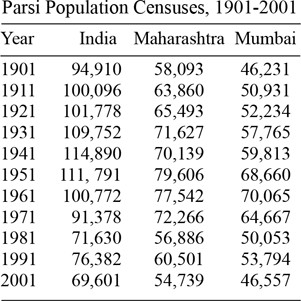
September 7, 2004 was an uncomfortable morning for the Parsi community. The front-page headlines of the official Census of India in The Times of India screamed "Parsi Numbers Plunge.” The bitter truth continued, "The Census report makes a special mention of Parsis, more specifically the "signs of definite decline” in their population in the country. As per the 2001 census, the Parsi population in the country was 69,601 (33,949 males and 35,652 females) as against their population of 76,382 (37,736 males and 38,646 females) in the 1991 census.”
On the next day, the news was more welcome — the Parsis have the "stupendously” high literacy rate of 97%.
Of course, this was not startling news to many who knew about this demographic trend. There have been other surveys too but the skeptics did not take these surveys very seriously, but now it was official. There were questions from many quarters – how serious was this threat? What steps would the community take in the given circumstances?
This paper is divided into three sections. Initially, I wish to deal with the demographical issue, focusing more about the situation in the towns and villages of India. Secondly, whether the children of Parsi women married to non-Parsis be admitted into our fold. In the last section, I have discussed some strategies for survival, including the formation of a Global Think Tank to deal with this critical situation.
I) Demography
Austin Dobson had rightly said,
"Time goes, you say?
Ah, no! Alas, Time stays, we go.”
The table clearly shows the slippery demographic slope over the last hundred years. (Parsiana, September 2004, p.2.) A few other salient features would help us to obtain a realistic picture of the situation. In India a child is born every 1.8 seconds or about 48,000 every day. Out of the 17 million children born in India annually, only about 500 are Parsis.
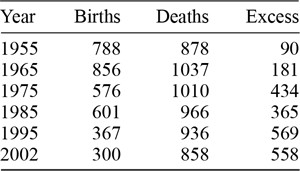
The excess of deaths over births in the last 5 decades in Mumbai also shows how critical the situation actually is:
A recent demographic study predicts that by 2021 when the population of India will be 1.2 billion, the number of Parsis will drop from their current level of 55,000 in Mumbai to just 21,000. If you extrapolate this figure, then by the year 2050 who knows??? (The BPP Review, Summer 2004, p.30)
Mr J K Banthia, I.A.S. Registrar General and Census Commissioner of India caustically commented at a recent Conference of Parsi representatives from all over India: "At this rate a day will come when the birth of a Parsi would be a cause for national celebration and when a Parsi couple gets married it would make world news.”
The Ghost Towns and Villages depict Demographic Disaster
There is only one term, which I find appropriate to connote the demographic situation faced by the community today, in some towns and villages, and that is ‘disaster.’ It is pertinent to note that Parsis flourished in these places some decades back. They say, that every cloud has a silver lining but I do not see any lining silver or otherwise. There are about 30 defunct Anjumans in India today. The future of the community in these places is not hanging in the balance but I would call it a graveyard of ruined dreams — the picture is disturbingly unforgettable.
I herewith furnish a list of these Anjumans in different parts of India. It is pertinent to note that in almost all these villages/towns, the community owns property. What is really shocking is the fact that in some of these places, there is not a single Parsi left and in other cases only a handful. It is only a matter of time when many other villages/towns will have the dubious distinction of being termed as ‘ghost towns’ as there will not be a single Parsi alive there. To cite one example of this demographic disaster is the example of Diu. Here our disused fire-temple is today being used as a Christian nunnery! (Parsiana, September 2004, p.4.).
Abu: The Anjuman has property
Amroli: Only 6 Parsis and many locked houses and a fire-temple
Cambay: Only 6 Parsis left and the Anjuman has lots of property
Deesa: Only 1 Parsi left and the Anjuman has property
Diu: No Parsis left but the Anjuman has property
Khajod: Only 1 Parsi family and the Anjuman has no property
Khergam: Only 4 Parsis left and the Anjuman has an Agiary and property including Dakhma encroached upon
Jamnagar: Only 8-10 Parsis left and the Anjuman has very valuable property
Junagadh: No Parsis left but the Anjuman has property
Nadiad: Only 1 Parsi
Surendranagar: No Parsis left but the Anjuman has property
In Karnataka
Amravati-Badnera: Only 10-15 Parsis left and the Anjuman has property
Carwar: No Parsis left but the Anjuman has an Aramgah
Dharwad: No Parsis left but the Anjuman has an Aramgah
Dhule: Only 3-4 Parsis left and the Anjuman has property
Gadag: No Parsis left but the Anjuman has property
Gulbarga: Only 8-10 Parsis left and the Anjuman has an Aramgah
Hubli: Only 8-10 Parsis left and the Anjuman has property and an Aramgah
Jalgaon: Only 15-20 Parsis left and the Anjuman has well maintained property
Jodhpur: Only 6 Parsis left and the Anjuman has property
Malegaon: No Parsis left but the Anjuman has property
Nanded: Only 2 Parsis left and the Anjuman has valuable property
In Madhya Pradesh
Bhopal: Only 6-7 Parsis and the Anjuman has an Aramgah
Chandrapur: No Parsis left but the Anjuman has property
Gwalior: Only 6 Parsis left and the Anjuman has property
Harda: No Parsis left but the Anjuman has property
Itarsi: No Parsis left but the Anjuman has an Aramgah
Khandva: No Parsis left but the Federation disposed the property
Neemuch: Only 15 Parsis left and the Anjuman has valuable property including Agiary and Dakhma
Rajula: No Parsis left but the Anjuman has small property
Allahabad: The Anjuman has 22 aged members. The three Trustees are aged, 71, 77 and 79 (Parsiana, August 2003, p.58).
Hyderabad: For the period August 19, 2002 to August 6, 2003, there were 6 births and 29 deaths as per the PZASH News Letter dated August 21, 2003 (Parsiana, October 2003, p.14).
Pune: In 2002, there were 27 births and 76 deaths (Parsiana, August 2003, p.65).
When one studies the above demographical picture, we realize that the noose of extinction is gradually tightening. To reverse this trend is a herculean task. Ms. C. P. Sujaya of the Centre for Women’s Development Studies states, "Demographic changes do not happen in a hurry. The transformation is a slow response to socio-economic progress that takes place over decades.”2
Shah Behram Varzavand
There are some who believe that the problem of our extinction due to dwindling numbers will be solved with the advent of Shah Behram Varzavand. I do not wish to mock at this idea but would like to throw some light on it. This belief in the "future Saviour” is common to many religions and in all probability it was a Zoroastrian concept, which was later, accepted by other religions. As a result that are millions of Jews, Christians and Muslims who also believe in it. But my question is simple, if this were so, why have Parsis died out in so many of our towns and villages as already pointed out? Why are we on the verge of extinction in many other cities and towns where we lived in large numbers? I ask, has not our Prophet taught us that ours is a religion of ACTION and considering this, should we not act to avert this imminent danger that is facing us? Should we not remove the stumbling blocks, which hamper reform? Or should we wait indefinitely till the advent of Shah Behram Varzavand? I believe that there are no keys to the magic kingdom and it does not help us in clinging to a shaky theory.
II) Should the children of Parsi women married to non-Parsis be admitted into our fold? This question, which is related to the demographic issue, is dealt with in detail in this section
The question about children of mixed marriages, i.e. between a non-Parsi father and a Parsi mother has been simmering for decades and even today it continues to remain as tangled as ever.
Being a neutral voice, I am neither an orthodox nor a reformist but a pragmatist. And I believe that in this discussion, questioning, criticism and dissent must be valued and protected.
I for one am not in favour of intermarriage and would not encourage it. My thoughts have been put forward in a lengthy article entitled "A Brief Study of Intermarriage in America with reference to the Parsi Community”, which has appeared in the Memorial Volume commemorating the 1251 Anniversary of the Installation of the Iran Shah Fire Temple, published in Bombay in 1972. But today, when 35% of our youth in Mumbai intermarry and we have not been able to arrest this trend, we ought to examine this situation in a new light and with great discretion. Are we to discard the children of such marriages? I believe that this question has to be discussed at different levels and this is what I wish to do here.
According to the Daver-Beaman Judgement of 1906, the offspring of Parsi fathers and non-Parsi mothers were to be admitted into our fold. But in the last 100 years much water has flowed. A number of important developments have taken place in the country and in our community, which have to be considered in order to obtain a holistic and balanced picture. Hence various facets need to be discussed. Whilst attempting to answer this question, I found it imperative to first examine whether the teachings of the Prophet throw any light on this issue.
A) Zarathushtra laid down the Magna Carta of Gender Equity
Although he lived in a patriarchal society he emphasized the idea of gender equity. This principle is clearly put forth when he expressed the concept of Ahura Mazda. As the late Prof. Zaehner had opined in The Dawn and Twilight of Zoroastrianism that "…in the Gathas we meet with a pure monotheism that not only has the stamp of a profoundly experienced revelation but also gives the impression of having been deeply thought out.”3 When we analyze the concept of Ahura Mazda, we understand the philosophy of the Amesha Spentas (The Holy Immortals). These Amesha Spentas preside over virtues, qualities, spiritual powers and also material creations. In other words, they are also the attributes or powers of the Supreme.
What is pertinent to our discussion here is that out of the six Holy Immortals, three are masculine while the others are feminine aspects. I quote Dr. I. J. S. Taraporewala who had stated that:
"It is rather remarkable that three out of the six Holy Immortals should represent the masculine aspects of God and the other three the feminine aspect. This is but one of the many hints we get in Zoroaster’s religion of the absolute equality of the sexes.”4
While Vohumanah (The Good Mind), Asha Vahishta (Divine Law) and Khshathra Vairya (Divine Kingdom) are the male aspects of Ahura Mazda, Spenta Armaiti (Holy Devotion), Haurvatat (Perfection) and Ameretatat (Immortality) are His female aspects.
In later Zoroastrian theology, we notice that some of the Yazatas (Worshipful Beings) are also feminine in nature.
From the above, I reiterate the point that the Prophet in propounding the very foundation of his religion, i.e., whilst explaining the nature of the Godhead emphasized gender equity. Moreover, his followers later accepted this thought when they elaborated on the concept of the Yazatas.
B) Zarathushtra was not only a Prophet but also a Reformer who Transformed the Religious Landscape of his Period
When one studies the early history of the world’s religions, we come to the conclusion that all Prophets were also reformers and Zarathushtra was no exception. When he propounded his religion at the early dawn of history, the Mazdayasna religion was already in existence. He brought forth changes in the religious thought, which was deeply embedded in the matrix of those days for centuries. He did so, as he thought it necessary at that point of time. The profound religious transformation brought about by Zarathushtra can be gauged through the opinion of Prof. Mary Boyce:
"Zoroaster was thus the first to teach the doctrines of an individual judgement, Heaven and Hell, the future resurrection of the body, the general Last Judgment, and life everlasting for the reunited soul and body. These doctrines were to become familiar articles of faith to much of mankind, through borrowings by Judaism, Christianity and Islam…”5
C) Position of Women in Ancient Iran
The position of women serves as an index to the condition of an age. Several references in our scriptures point to the fact that women enjoyed a high status in society. In the Aiwisruthrem Gah we come across the term nmano paiti and nmano pathni which terms connote the ‘lord of the house’ and the ‘lady of the house.’ This shows that a wife enjoyed an equal status at home. The Pahlavi text Madigan-i-Hazar Datistan deals exhaustively with the rights of a woman, wife and daughter. Women were allowed to select their own husbands and widows allowed to re-marry. They could hold property and represent themselves in court. She could legally conduct her husband’s case in court. Qualified women were appointed as judges. Some of these women had also evolved to a lofty spiritual stature and hence the Avestan allusion to women saints. It is thus evident from our scriptures that Iranian law firmly upheld numerous rights and privileges of the wife, which for obvious reasons cannot be discussed here.
Thus in ancient Iranian society, the wife held a high position in the social as well as the spiritual spheres, which was not inferior to her husband in anyway. The renowned scholar, Dastur Darab Peshotan Sanjana states, "In the Avestan period the position of the Iranian wife was one of equality to that of her husband.”6 (For further details see my paper on the "Position of Women in Ancient India and Iran” in Cyrus the Great Memorial Volume published by the Iran Culture House, Bombay, 1974). And I am further reminded of the words of that great French savant, Prof. James Darmesteter who had said: "The moral victory of Zoroastrianism is the work of a woman, and that no picture of woman is nobler and higher than that which is drawn in the Avesta.”
D) Human Rights of Women cannot be Ignored
U Thant, who was the Secretary General of the United Nations, once quoted Elenor Roosevelt’s statement: "The Universal Declaration of Human Rights was the ‘Magna Carta of mankind.’” Amongst the world’s major religions, there are many leaders who have supported human rights as an expression of their faith. Today the championing of human rights is a global reality. This encompasses economic and social as well as civil and political rights, the equality of the sexes and the rights of the individual on an international as well as a national plane. Fundamental human aspirations for human dignity are universal because they are rooted in human nature.
The Universal Declaration of Human Rights is the cornerstone for efforts all over the world by religious and secular leaders to build a system of law so that the moral imperatives of human rights might be promoted, respected and enforced. The Declaration asserts, "Recognition of the inherent dignity and of the equal and inalienable rights of all members of the human family is the foundation of freedom, justice and peace in the world…”
The source of human rights law is the Declaration, which is now an integral part of the customary law of nations. Today the question of religious freedom has become ‘inseparable’ from other fundamental human rights. We have to clearly understand that freedom, equality and participation are basic elements of all human rights.
Articles 2-21 of the Declaration emphasizes "…freedom of thought, conscience and religion; freedom of opinion and expression…”
Parsis have recognized the role of Cyrus the Great, the Achaemenian ruler, as probably the earliest player in this field. By granting the Jews religious freedom, by allowing them to rebuild their Temple destroyed by Nebuchadnezzar, by providing assistance from the royal coffers for this, Cyrus becomes the first known human rights activist.
At a function organized by the Rotary Club of Mumbai on April 22, 1993, the late Mr Justice Bakhtavar Lentin gave a lucid exposition on human rights. Pertinent extracts are given herewith: "This right to human dignity and to human self-respect is more than even freedom of speech and expression. It signifies the right to equality of all men and women, wheresoever they be and whosoever they are. It is the result of understanding and tolerance and the conviction that all men are born equal. If not born equal, they must be made equal and more importantly, made to feel equal.”
"The right to human dignity and the right to human self-respect is the birthright of the teeming millions of womenfolk in this nation. It is this birthright, which in this country is violated every month of the year, every day of the month…Let us face it. Ours, even today, is essentially a male oriented, a male dominated and a male chauvinistic society. We think of human rights as a male prerogative. It is not.”7 In the light of this, I ask the pertinent question, what about the rights of Parsi women married to non-Parsis?
At a seminar to observe Human Rights Day in New Delhi in December 2003, the Attorney General of India, Mr Soli J. Sorabjee said that the people must pledge to make human rights a living reality, adding, "Rights without remedies are useless.” He stressed that remedies also need to be addressed.8
E) The Constitution of India Safeguards the Rights of Women
It is pertinent to note that our Constitution also emphasizes the importance of human rights. Besides this, it deals with the various rights of women. Given below are the relevant Articles of the Constitution:
In the case of Valsamma Paul (Mrs.) v. Cochin University, (1996) 3 SCC 545, the Hon. Supreme Court after considering the various Articles of the Constitution including Articles 14 and 21, the Hon. Court held that:
"Human Rights are derived from the dignity and worth inherent in the human person. Human rights and fundamental freedoms have been reiterated in the Universal Declaration of Human Rights. Democracy, development and respect for human rights and fundamental freedoms are interdependent and have mutual reinforcement. The human rights for women, including girl child are, therefore, inalienable, integral and an indivisible part of universal human rights. The full development of personality and fundamental freedoms and equal participation by women in political, social, economic and cultural life are concomitants for national development, social and family stability and growth – cultural, social and economical. All forms of discrimination on grounds of gender is violative of fundamental freedoms and human rights.”
In various judgements given by the Supreme Court from time to time, the Hon. Court has held that "…The world has witnessed a sea change. The right of equality of women vis-à-vis their male counterparts is accepted worldwide. It will be immoral to discriminate a woman on the ground of sex. It is forbidden both in the domestic law as also international law…”
(Paras 33 and 36) John Vallamattom v. Union of India, (2003) 6 SCC 611.9
In this context, it is pertinent to examine the views of Justice Sam Bharucha, the ex-Chief Justice of the Supreme Court of India. Inaugurating the meeting of the Federation of Parsi Zoroastrian Anjumans of India which was held at Jamshedpur on December 2, 2000 inter alia he said, "I must go on to add that the Anjumans and Panchayats should consider the admission into the faith, by the performance of the navjote, of a child born to a Parsi mother and a non Parsi father, provided such child is the product of wedlock and the father is a consenting party. I know that a judgement delivered long back by the Bombay High Court would seem to be standing in the way, but if the Anjumans and Panchayats all resolve that this is the appropriate practice to adopt and the practice is challenged on the strength of that judgement, it can, given the change in the circumstances, be over-ruled.” (The BPP Review, Spring 2001, p.17).
Mr Fali Nariman, the eminent jurist had delivered a lecture in New Delhi on January 9, 2000 on the occasion of the Diamond Jubilee celebration of the Delhi Parsi Anjuman. The theme of his talk was "Parsi Law – Its effect on Parsi Society.” He had expressed similar views by stating, "…After all, customs are not eternal and ancient customs in a modern society are fast changing. Parsis settled in Canada and United States have shown the way quietly, unobtrusively — children of parents one of whom is a non-Parsi have been freely admitted into the religion, and have fervently professed and practiced it. We have to be patient.”
F. Several Customs that have been Dropped
A certain section of the community is of the firm opinion that nothing has changed for centuries as far as our customs and rituals are concerned. I wish to demolish this false notion by pointing out various customs, which have been dropped by the community over the centuries.
Dr. Sir Jivanji Modi who has been the greatest authority regarding Parsi customs states in the Preface of his monumental work, The Religious Ceremonies and Customs of the Parsis: "The times are rapidly changing. The ‘new’ has been springing rapidly upon the ‘old.’ As often said, the heresy of today becomes the orthodoxy of tomorrow; the liberalism of this year, the conservatism of the next. The reader will find that many a ceremony, ritual or custom has been spoken of as having become obsolete or as being more honoured in the breach than in the observance. Many more will be obsolete in the course of a few years. Customs are often as despotic as fashions but they also change as fashions.”
"Some of the intricate tedium of purification carried to an extreme from the original reasonable thoughts of sanitation and purification, has now passed off and is passing away.”10
Gleaning through the various chapters of the Vendidad and other texts, we come to the conclusion that different customs/beliefs have been dropped. A few of these may be mentioned here:
From the Vendidad translated by Prof. James Darmesteter:
Chapter IV. Deals with Contracts:
If a man breaks a hand-contract, the penalty is 600 stripes.
If a man breaks a verbal-contract, the penalty is 300 stripes.
Chapter XII. Various periods of mourning for father, mother, brother, sister, grandfather, grandmother, cousin, etc.
Chapter XIV.Atonement for the murder of a dog/otter.
Chapter XVI.On the various precautions for women during menses.
Chapter XVII. On disposal of hair and nails.
Chapter XVIII. On punishment of heretic priests.
From the Supplementary Texts to the Sayest ne-sayest (SnS.) translated by Dasturji Dr. Firoze M. P. Kotwal, Copenhagen, 1969:
1) One should recite prayers after the paring of nails (p.28).
2) When a child is born a fire is to be kept burning throughout for three nights for protection against the demons (p.30).
3) "Sins and their money-values. In the Pahlavi literature, we come across certain sins, which are redeemable when the sinner counter-balances his sins by performing a certain number of meritorious deeds, or by paying a fixed fine prescribed by the Dastwar’s, which may have been devoted to religious observances. The Sns. and the Persian Rivayats furnish us with the names of the sins and their corresponding values and weights, which are seldom uniform” (p.114).
4) The non-performance of five ceremonies, which leads to sin at the Chinvat Bridge (p.38).
5) When a goat is slaughtered, the different parts of the animal are dedicated to certain Yazatas and beings (p.23).
From A Guide to the Zoroastrian Religion edited and translated by Dasturji Dr. Firoze M. P. Kotwal and James Boyd, California, 1982:
1) Child marriages, which took place before the age of seven (p.125).
2) Rules regarding maternity (p.133).
The Uzirin Gah refers to the sraoshavareza priest before whom a person confessed his sins.
G) Lessons from other Religious Traditions
In every religious tradition there have been certain practices/customs, which have been in existence for centuries, but have now been discarded. A few books of the Bible actually support and sanction slavery (Exodus 21.21, Leviticus XXV: 44-45, Thessalonians 3:22). President George Washington and Thomas Jefferson were slave-owners. But the emancipation of slaves had to wait till the advent of Lincoln and a savage civil war. Let us not forget that slavery existed also in ancient Iran. The Pahlavi text, Madigan-i Hazar Datistan gives details about this.
In 1964, when Nelson Mandela was fighting apartheid, he was dubbed a terrorist. A few decades later, he was awarded the Nobel Prize and became President of South Africa.
It is a well-known fact that the caste system has played a very important role in Hinduism for thousands of years. Hindu scriptures like the Rigveda (Book X Hymn XC), Manusmriti (Ch.I.31) and Bhagwad Gita (Ch.IV.13) have supported it. But it is the caste system, which gave rise to the pernicious practice of ‘untouchability’, which has been anathema. Although Mahatma Gandhi was a devout Hindu, he fought against it. Notably, Article 17 of the Indian Constitution abolishes untouchability. Anyone abetting, inciting or practicing it in any form can be sentenced to a rigorous jail term.
From the above we see other religious traditions have introduced changes by discarding certain practices although they were sanctioned by their scriptures. Then why are some Parsis supporting gender discrimination even though it does not have scriptural sanction?
H) Dialogue is the Cornerstone — Flexibility is the Key
There is a divide between the orthodox and the reformists in our community. This is nothing unusual, as this type of a divide exists amongst all communities. Living in a vibrant democracy, each has a right to his opinion.
But it is time, high time, that both sides should be prepared to come to an understanding for the larger good of the community. This can be done if we are willing to dialogue, discuss and debate this most crucial (issue) with decency, dignity and decorum.
In light of the above data, it would be necessary to have a dialogue about the question of the acceptance of children of Parsi women, who are married to non-Parsis. If the non-Parsi husband has no objection, let the child be initiated into the fold. I know that there will not be a flood, but under the circumstances every single child counts! And I emphasize, that every single child counts. To buttress this argument further, I may state that Ms. Meher Amarsey, President of the Association of Inter-Married Zoroastrians (AIMZ) informs me that often she is approached by Parsi women who wish to have their children admitted into the fold as their husbands have no objection to this.
In this context let us not forget that a mother has a large role to play, or perhaps larger, in nurturing and ingraining the first seeds of religious fervour in her child.
I) This is not Conversion
Every time an intermarried child is refused admission into the faith, it causes pain, anxiety and a sense of rejection in the confused mind of a mother. Even when her non-Parsi spouse has no objection about their child being initiated into the Zoroastrian faith, the community slams the door into her face. We should thus dismantle the barriers of insecurity for these women by upholding their rights and allow their children to be admitted into our fold.
There are some who contend that in other patriarchal societies, the children of intermarried girls are not accepted. This does not help our case. This argument does not hold good because of the drastically dwindling population of our community. The problem of numbers is not so acute with the other communities.
Let us not forget that when Mr. R. D. Tata who was the father of Mr. J. R. D. Tata evinced a desire to marry a French lady, Suzanne Briere, it was the learned High Priest, Dastur Kaikhooshroo Jamaspji who performed her Navjote ceremony.
Moreover, it is a known fact that although Sir Ness Wadia, father of Mr. Neville Wadia was a born Zoroastrian, he converted to Christianity through the Church of England and married a Christian lady by following Christian rites. Their son Mr. Neville Wadia who was baptized in the Church of England, till the age of 80 years he remained a Christian. Later when he wished to become a Zoroastrian, his Navjote was performed although he had a non-Parsi mother and a father who had converted to Christianity!
In this context, there was a letter written by the late Dasturji Dr. Hormazdiar Mirza and Dasturji Dr. Kaikhushroo JamaspAsa wherein a reason for the performance of this Navjote was mentioned. They considered this as an exception. Why should religious injunctions be so flexibly interpreted? Why should our scriptures be interpreted to suit the convenience of a millionaire (who was a Christian for 80 years of his life and had a non-Parsi mother) and the same right be denied to a child of a Parsi mother who has been practising Zoroastrianism all her life?
J. The Patriarchal Form is being Challenged
There are a few amongst us who wish to deny the rights of Parsi women on the ground that ours is a patriarchal society. They fail to understand that male domination in every aspect of life is being challenged for the last few decades. They have to realize that an alternative outlook now exists and notice the signs of change, growth and evolution. We certainly see the decline of patriarchy and the emergence of new models of gender equity and partnership in different parts of the world. And the sooner this small coterie appreciates this, the better.
III) Suggestions
We ought to have several strategies to tackle the problem of survival. These should be implementable ideas, which break new ground. I have put forward a few of these, which may be considered:
a) Parents should instill a sense of pride in their children about being Parsis. They should be made aware about the achievements of the community in India and the urgent need to keep the community alive.
b) The Bombay Parsi Punchayet (BPP) has about 5970 flats in Mumbai today. Efforts should be made to persuade the elderly and lone occupants who have large flats to shift to smaller accommodation. This could in turn help the youth.
c) It should be borne in mind that the highly educated will only opt for one or two children. Whereas it is the middle class and the poor who will decide to have slightly larger families. Let us provide housing for this class at affordable rents.
d) A crash-housing programme for youth who wish to marry should be embarked upon at the earliest. Flats should be offered at an affordable rent.
e) Youth should be encouraged to seek employment and settle in other cities besides Mumbai where the pressure on housing is far less. To facilitate this, a dialogue should be initiated with industrialists and leaders of the community in other parts of India. The World Zarathushti Chamber of Commerce should also be involved in this project.
f) There should be more interaction amongst the youth not only in Mumbai but amongst the youth of various cities. Exchange programmes could also be arranged.
g) Youth should be encouraged, especially the boys to go in for higher education so that they could offer a better standard of living when they plan matrimony.
h) Youth should be encouraged to promote their own business preferably in states, which provide incentives.
i) Encourage the youth to shoulder greater responsibility — they ought to be increasingly involved in decision-making activities regarding communal matters and Trusts.
j) Sethias of the community, viz., Seth Pallonji Mistry, Seth Keki Jokhi and Seth Naryman Dubash be approached with long-term projects, especially for launching housing projects for the young.
k) There are about 48 agiaries in Mumbai many of which are languishing due to paucity of funds. Every now and then we come across appeals from them. How long can this continue? Let us plan and implement the shifting (and not merger) of some of these fires from agiaries, which are hardly frequented by devotees. The agiary in Lonavla may be used as an excellent model to follow in Mumbai.
l) Few Fire-Temples in Mumbai have large compounds. Let us use this space for housing the needy and youth. This will ensure more attendance in these Fire-Temples and also help their maintenance.
m) The BPP spends about Rs. 85 lacs annually on education today. Besides this a number of other Trusts help the youth in this field. The crucial question which we ought to decide upon is how much are we willing to spend for our survival?
n) Offspring of non-Parsi fathers and Parsi mothers should be admitted into our fold.
o) Efforts should be made to bring down the divorce rate, which is today about 10% (In 2002, there were 340 marriages and 40 divorces, Parsiana, June 2003, p.42).
p) Births and Navjotes should be registered.
q) Marriage bureaus should be set up in different parts of India where Parsis have settled and there should be interaction amongst them.
r) There are still a few Parsi families who possess land and have their roots in Gujarat. Sufficient opportunities should be provided to them to initiate agricultural/dairy projects as well as cottage industries in the rural areas.
s) The amount offered by the BPP for the maintenance of the third child should be enhanced.
t) The BPP being the apex body of the community should consider setting up a cell dealing with demographical issues.
u) Leaders of the community, economists and trustees of various institutions must discuss in right earnest the future of these institutions.
v) Create greater awareness among parents and laity about the seriousness of the demographic problem and explore ways and means as to how they could help the situation.
w) Anjumans in India where there are very few Parsis left should act expeditiously so that property under their control is not lost to encroachers.
x) The BPP spends about Rs. 80 lacs on medical expenses. Similarly other Trusts also offer help for this purpose. But how much will the community set aside for its very survival?
y) Wealthy Parsi families spend large amounts on entertainment, holidays, etc. Are they willing to donate anything for the survival of the community?
z) To appoint a Global Think Tank to study these problems.
Formation of a Think Tank
Having written this paper, I thought it imperative that a global Think Tank be formed comprising of like-minded persons who can see the gathering storm and wish to take constructive steps on many fronts. The community has a vast talent pool — let’s tap it. I am fully aware of the fact that this will be a herculean task but we cannot just accept defeat and do nothing about this — the uncharted road is difficult, but then which road is easy? There may be some areas where we cannot succeed but we have to forge ahead on other fronts, because I visualize this to be a multi-pronged venture.
Conclusion
Reality bites! Today, the very survival of our community is at stake. I am not alone in sensing this danger. Anyone who studies the demographical profile objectively can see the writing on the wall. Many of the towns/villages where we once prospered are not dying but dead. Our properties are encroached upon and in some cases even lost. How long will we live in a state of denial? The haunting question is: What will happen to the large number of our fire-temples, housing colonies and charitable Trusts in the next few decades?
This is the greatest challenge which is facing the community today. Will the leaders and all concerned rise to the occasion and lead the community out of this morass, or are we going to bury our heads in the sand as the dust-storm spirals out of control? If we are men of vision, wisdom and courage let us act now, as we have had enough of words. We need to explore other frontiers. There should be a paradigm shift in our thinking. Let not future generations say, we spoke too much, did little, for let us remember that there are some problems to which Father Time brings his own solutions.
Foot Notes
1) I am thankful to Mr. Sohrab Katpitia of Surat for furnishing the above information regarding defunct Anjumans.
2) Subrahmanian V., "Family of Fallacies”, The Times of India, Mumbai, August 19, 2003
3) Zaehner R. C., The Dawn and Twilight of Zoroastrianism, London, 1961, p.50
4) Taraporewala I. J. S., The Religion of Zarathushtra, Bombay, 1979, p.40
5) Boyce Mary, Zoroastrians: Their Religious Beliefs and Practices, London, 1979, p.29
6) Collected Works of Dastur Darab Peshotan Sanjana, Bombay, p.519
7) The Mumbai Samachar, May 2, 1993
8) Indian Express, New Delhi, December 10, 2003, p.1
9) I am thankful to Mr. Manek Kalyaniwalla of Mumbai for furnishing the above information.
10) Modi J. J., The Religious Ceremonies and Customs of the Parsis, Second Edition Reprint, 1986, p. VI-VIII

Founder president of the World Zarathushti Cultural Foundation and a scholar of Zoroastrianism, Dr Homi Dhalla has represented the community at various international conferences and interfaith meets. Among the community projects he is involved in are the conservation of Bahrot caves, the Sanjan excavation, documentation of Parsi history and the introduction of solar concentrators at Bombay’s Doongerwadi.
◆ ◆ ◆
From the archive