
Cover Story
Rare egg-hibition
Using egg shells as her medium of expression, Mani Cooper has been able to create appealing showpieces
A teapot, milk jug, sugar pot and cups, all ready for service on a tray — not in this interviewer’s honor, but an eggstravaganza of decorative pieces crafted from goose eggs and hen eggs!
There was more. Cinderella riding to the ball in her glittering coach made out of a goose egg. Two doors on either side of the coach open on hinges. The coach is elaborately decorated with filigree and rhinestones and is drawn by two white horses. Yet other goose eggs, one featuring a time piece with floral decorations all over, another glittering one showcasing a real mother of pearl-faced clock.
The 71-year-old lady behind these creations, the well-known lawyer Mani Cooper, could well be the first Parsi (if not the first Indian) to take up egg-craft. She’s passionate about decorating eggs in Fabergé style. Fabergé was a Russian jeweller famed for his small, intricate ornaments and eggs. It is said that Queen Elizabeth is a proud possessor of at least 12 eggs made by Fabergé. But Fabergé mainly used metal as his medium and molded it to resemble an egg, whereas Cooper uses real eggs of goose, turkey, emu, sparrow, quail, rhea, ostrich, guinea fowl, hen and canary and decorates them. As a matter of fact, she finds metal eggs, "except Fabergé’s,” she clarifies, not artistic enough. "Today’s commercial metal eggs look so tinny!” she dismisses.
These rare creations were on view at an exhibition held at her residence at August Kranti Marg in Bombay between March 19-21, 2004. After she had mastered the craft and made several wonderful decorative pieces, husband Khurshed (Khatu) who would give her all possible support and encouragement egged her on to hold an exhibition. "I wasn’t that interested, but it was Khatu’s dying wish (he was suffering from cancer) that I hold an exhibition. He willed himself to live and see the exhibition, a week after which he slipped away.” She does not intend to sell any of her works presently.
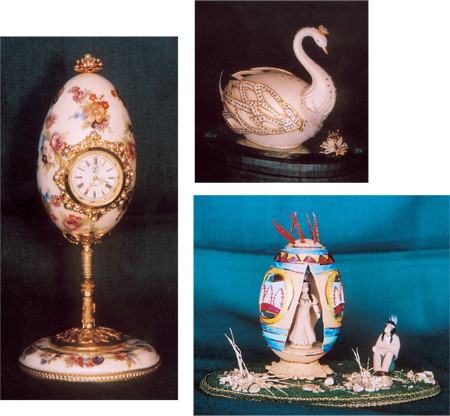
Cooper explains the andé ka funda (egg craft): "The egg is first blown by drilling a hole — sometimes two, one at either end — to remove the contents. It is next sanded to smoothen the shell and give it a natural gloss. Thereafter the design is drawn or engraved. The egg is next cut either with an electric drill or an air-compressor drill (4,00,000 revolutions per minute) in order to prevent it from cracking. Different bits are attached to the drill head for different kinds of cuttings. Then the decorating begins — painting, varnishing, glazing, fixing of hinges, filigrees, rhinestones, pearls, diamonds and other trimmings ... The most difficult part of decorating an egg is the fixing of hinges. If the hinges are not properly aligned, the egg cracks at the site of the hinge and nothing can be done to salvage it... It is good to varnish an egg as varnishing preserves the egg better — dust does not stick to it; besides, it strengthens the egg... A final glaze is put to protect and seal the egg, which is then mounted on an appropriate base or stand.” All this she does without assistance.
Decorated eggs can last indefinitely, provided they are preserved in an enclosure or a showcase. If exposed, particularly in India, they can catch dust and fade by the sun’s rays.
Most of the material — the eggs, the decorations, the hinges, electric drill (not the air-compressor drill), the paint, the varnish comes from England, and some from South Africa (for example, ostrich eggs) and South America (for example, rhea eggs): "None of the eggs, except hens’ and pigeons’, are available in India... All my supplies come by mail order. The eggs that come by mail are blown "else they’d stink like hell,” and disinfected before packaging. "I get in touch with suppliers only when I go to England.”

Cooper: intricate designs
Due to loss of habitat, several bird species continue to fall under the "endangered” list. The lawyer in the artist treads cautiously: "As far as my knowledge goes, I am not using eggs of any protected species. In England, even if one finds an egg on the floor and picks it up, one can be penalized!”
Law and egg-craft are poles apart. While the former deals with rules and legislations, the latter brings to mind free, artistic works. But there’s one factor common to both — patience. Legal cases in India can pend for months and years; decorating an egg can also be equally tedious. "It can take up to eight months to just plan an egg before one can actually start working on it. Besides, eggs like that of the canary are so tiny and fragile, they can break in one’s hand, and one needs to be extra patient and take that extra care in handling them!”
"My source of inspiration was my husband,” maintains Cooper. "We were very fond of travelling. We used to attend international conferences together where I read papers on Family Law (Mani was vice-president of the Family Law Division of the International Bar Association). Instead of travelling by air, we decided to travel by cruises from 1997 onwards. Our first cruise was on the Oriana. Among the various activities on board, was a lecture on egg-craft. In a subsequent special demonstration, those interested were shown how to cut an egg into half. Since Cooper desired to learn more about the craft, she started reading books such as Eggshell Artistry by Eileen Rintel and Decorating Eggs: In the Style of Fabergé by Pamela Purves. "Some instructions are written on the catalogs which come along with the material from mail order houses. I have one or two issues of the Egg Crafters Guild magazine. I have never attended any classes to pick up this craft. In fact I haven’t even seen a single demonstration on egg-craft at shops abroad, where artists demonstrate at malls and hobby centers.”
At the Fisherman’s Wharf in San Francisco standard-size goose eggs were priced at $ 300! Rhinestone chains are sold by the meter with each meter costing about £ 15. In one of my works, I’ve used about six meters of rhinestone chain! The rhea egg costs about £ 12... If I try to sell even a simple, ordinary decorated egg here, it would cost at least Rs 1,200,” she analyzes.
"The lady who demonstrated egg-craft on the Oriana had told us — after costing an egg, charge three times the price when you want to sell it. But that’s just a rough estimate because sometimes an egg may involve a lot of labor but less material and vice versa. Since each and every item is imported, the price would run into thousands!” In fact cost is one of the main factors restraining her from teaching this craft to interested parties.
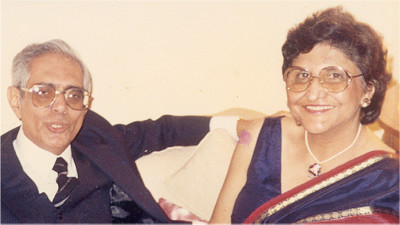
Khatu and Mani Cooper
With advancing age, Cooper is worried that in future her eyesight may get weak and, as a result, she may not be able to cut the eggs. But just as she passed on the profession of law to her children, she would like to pass on this part of the creative legacy to her children and grandchildren as well, before giving it up.
Born to Homai and Pirojsha Shroff, Mani passed her Senior Cambridge from Clare Road Convent and joined the Arts stream at St Xavier’s College. She was among the last batch of students who were allowed to progress directly from Inter-Arts to the Government Law College. "My parents were very proud of the fact that I was the first lawyer in the Shroff family. In September 1954, I left for England for a year to specialize in Debt (Estate) Duties, which was recently introduced in India. After my return to India, I resumed my practice at the Bar.” For some years she taught criminal law and other subjects at the Government Law College and K. C. Law College. She also practiced criminal law and worked in Ram Jethmalani’s chamber for many years. Mani and Khatu got married in 1956. Khatu, also a lawyer, grew to be a senior advocate in the Supreme Court of India who appeared in numerous celebrated cases such as the landmark Judges Transfer Case in the Supreme Court, the Patil-Fernandes election petition, etc. Sons Soli (47) and Tushad (45), after graduating in law from Bombay, obtained their postgraduate degree in law from Harvard University and are busy practicing lawyers in Bombay and in New Delhi.
Both Mani and her late husband supported the Society for the Right to Die with Dignity. Although they are not quite happy with the present method of disposing the dead at the Towers of Silence, whether by vultures ("because there are no vultures”) or by the solar system ("as its effects are very limited, particularly during the monsoon”), Khatu’s last rites were performed at the Doongerwadi.
On the subject of interfaith marriages Cooper states, "It is because we marry within the community that many Parsi children are retarded.” According to her, archaic Parsi laws need to be amended and brought in tune with modern times.
Although Cooper’s passion is decorating eggs, she has also found the time to cultivate her flair for some other arts and crafts such as painting on silk, Pergamano (parchment craft), quilling (craft made in thin paper strips) and quilting (gem trees made from semi-precious stones and twisted wires). Regretting that members of her family are not keen on learning this art from her, Cooper mentions that her eight-year-old granddaughter Leah is the only one who is "really interested” in this craft. She derives her inspiration from Cooper who gets tremendous satisfaction from "creating anything with my hands.”
◆ ◆ ◆
From the archive