
Life-Style
The glamour of gold
White gold is gaining in popularity among the younger generation of Zoroastrians
It could be white or yellow… hallmark or trademark… bought off the counter or specially designed… gold will never lose its sheen within the Parsi community. Whether it’s wedding or navjote time, purchase of gold jewelry has become a sacred familial duty, almost one of the many ceremonial rites.
Ask any of the established jewelers catering to Parsi tastes and they will vouch that despite the appreciation in the cost of gold the demand for jewelry has not waned. For a wedding set (that includes a necklace, earrings, bracelet and ring) Rs 40,000 is the minimum one is expected to set aside. The more presentable ones are priced around Rs 80,000. There is no upper limit for it all depends on one’s choice and purchasing power, and the ability to withstand income tax interrogation. The set is traditionally gifted to the bride by her inlaws. Her own family would present her the jewelry pieces she has acquired over the years as gifts, heirlooms and bequests, and the items she had adorned at her navjote. Besides the wedding ring, a chain and pendant suffice as a gift for the bridegroom as few now are willing to invest in gold buttons or cuff links.
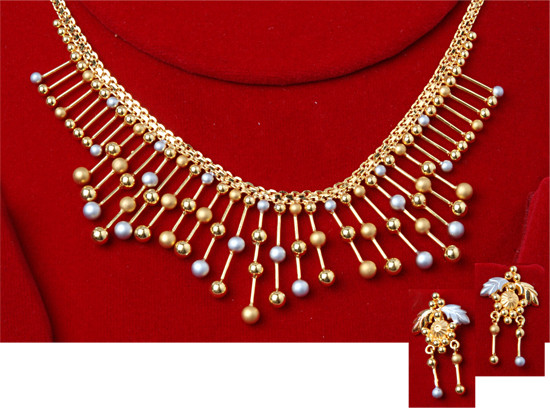
"The older generation continues to prefer gold in its natural, yellow form although the younger generation, following the western trend, seem to prefer white gold which is more sober,” observes Khurshid Vakil of Framji Rustamji Choksey. "The younger generation is not looking for more weight but something more delicate,” she adds because of which jewelers like them have introduced a variety of designs offering a blend of gold and rodium (white polish on gold). In fact, quite popular is their heart-motif dainty set comprising a necklace, earrings and ring in the Rs 20,000-25,000 range. It may not be appropriate for a wedding but more suitable for a smaller function like an adarni (engagement) or as a navjote gift for a girl, she clarifies. For a boy who is newly initiated the family prefers to present him with a chain and pendant, maybe a ring or bracelet he may want to wear later.
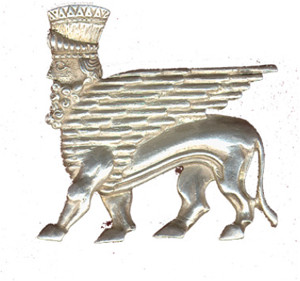
Jewelry designs sourced from Framji Rustamji Choksey, Pestonji and Company, B. Jamshedji Jivanji and Mahendra Jewellers
Photos: Homyar J. Mistry, Homz Prints
Whilst earlier the inlaws would decide what set to present to the bride, these days the daughter-in-law is involved in the decision making process, mentions Yasmin Divecha of Pestonji and Company. The bride-to-be is often "willing to experiment with different styles, kinds and color of gold, various precious and semi-precious stones, asymmetrical designs…not the insistence on ék hiro aiya chhè né bijo tauj hovo joiyé (one diamond is here and the other should necessarily be placed at the other end).” As a community "we are far classier in our tastes and style,” Divecha is convinced. Even those with no budgetary constraints will not flaunt their wealth by loading their necks with tiers of gold but will opt instead for a bigger variety of a precious stone which becomes the pivot of an aesthetic design. Another distinguishing feature of Parsi customers is the insistence on quality and good finishing within the stipulated budget, specifies Divecha. Although a lot of readymade jewelry is now available with hallmarking (stamp of genuineness), Parsis would still prefer to consult their trusted jeweler to ensure that they are investing in good quality gold.
Not only hallmark gold, it has to be VVS1 (super deluxe quality) for his Parsi clients, states Kamlesh Jain of Kumar Jewellers. The price of gold is presently in the region of Rs 7,000 for 10 gms but that does not deter Parsis from purchasing the metal. In fact the demand for their jewelry is increasing, he reveals, as customers know they would get the full resale value of their jewelry (after deducting the making charges). Most members of the community would prefer to use 22 carat gold for their jewelry, says Mahendra Jain of Mahendra Jewellers. Hallmark 916 is the trusted variety among his customers, with the flower, leaf and the horseshoe being the most popular motifs. Those who have been patronizing them over the years continue to do so even though they may now have settled in different parts of India or even outside India. Why should any customer wait for the cost of gold to come down? Has the cost of any valuable ever gone down? he asks rhetorically.
There are extraneous factors which determine the price of gold, analyzes Khushroo Press of B. Jamshedji Jivanji. "At the time of floods, it would come down, during Diwali there is a boom. We can’t expect things to be hunky-dory all the time. The current trend is high prices and low turnover. With the share markets soaring the husbands are inclined to tell their wives, ‘Jara thobi jaa (temporarily defer purchasing jewelry).’ But sooner or later they’ll flock to gold when they find share investments less attractive.” Their shop at Zaveri Bazar may show 15-16 percent increase in business this year although their actual sales may be down by 25 percent when compared to last year’s statistics, Press explains the disparity in figures due to price fluctuations. According to him, "Buying gold is like putting money in a bank. It will be secure five years down the line” with a guaranteed 5.2 percent return on investment as against expending on clothes and other accessories. Ultimately "the value of gold is not measured in terms of rupees but the value of a rupee is measured in terms of gold,” declares Press.
"Show us something new,” is what many of Press’s customers tell him. But after surveying the new designs and making their rounds of other shops in the vicinity, "they will come back and select one of the oldest designs,” he notes with amusement. Just as a gara is considered an ultimate purchase among saris, a chhéra (thick chain) will continue to remain evergreen among the community, he is sanguine. "Moti-manék (pearl and ruby) studded jewelry is hardly in demand now. It must be constituting barely one percent of our total turnover.” Their forte is handmade jewelry, with every little component being made inhouse, he informs us. The jewelers in south Bombay, trusted and patronized by Parsis over generations, find that their clientele even include a few Catholics, Bohris, Gujaratis and Sindhis who appreciate Parsi tastes and style and may come all the way from Juhu and Bandra to make their purchases.
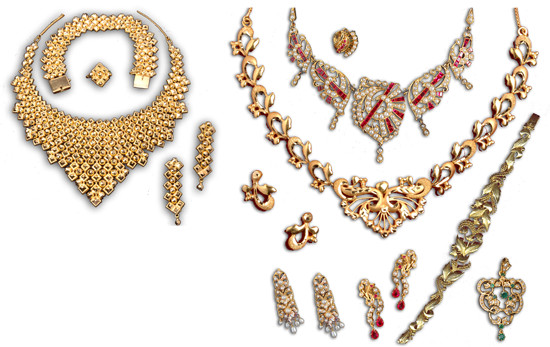
Going to Dubai to purchase gold was in vogue until recently. But with the difference in rates between Bombay and Dubai having narrowed down to less than five percent, going to the Middle East is no longer such an exciting proposition. Besides the labor charges are more economical here, reveals Press. In fact Parsis settled in the West are now inclined to buy their jewelry from Bombay, especially when they want a Zoroastrian symbol like a farohar or afargan engraved on it, reports Divecha. The overseas Zoroastrians, would not opt "for a heavy, ostentatious style. They want something which is more wearable, more convenient. Rather than a necklace they would prefer to buy a ring,” she adds.
When doing the actual costing before a wedding or navjote, the family realizes that it is not just jewelry which has become more expensive but also the cost of the lagan nu patru, clothes, floral decorations, music, lights…And those who are setting up a new house realize that after the purchase of a flat even doing up the interiors requires considerable investment. Depending on their priorities they would naturally try to save wherever possible. Until a couple of years ago customers would bring in their old jewelry and ask for that gold to be used in a new design of their choice. Selling off jewelry was considered as an option only by those in dire need. Currently there is a greater eagerness to buy gold on the premise that gold is one metal you can rely on. Any addition to their stock of antique jewelry is welcome. They don’t need to be lured with emi (easy monthly instalment) schemes or bargain offers for they believe "whatever we have is there for keeps.” Chhèllé aapré nahi tu aapraa bachaao pèhrsé (if not us at least our children will wear it).
Get gold to glisten
Protect your gold jewelry by keeping it wrapped in a soft cloth when not being worn
Dry your gold jewelry before storage as moisture can weaken springs and clasps
Jewelry pieces should not be in direct contact with other pieces lest they scratch each other
Keep your genuine gold jewelry away from costume jewelry
Exposure to direct sunlight for lengthy durations could cause it to lose its luster
Don’t wear your favorite piece 24 hours a day, seven days a week. Limit the exposure to daily elements
Remove gold jewelry before engaging in activities like sport, housework or gardening where it is likely to come in contact with destructive chemicals
Chlorine and other disinfectant chemicals in swimming pools and spas can react to the alloys in gold resulting in pitting or discoloration
Personal care products like lotion, make-up, perfume, hairspray, shaving cream can form a dull film covering the gold which is hard to remove
Tips to clean your jewelry
Once in a while gold ornaments should be cleaned by dropping them into boiling water in which a pinch of sodium bicarbonate has been added for just half a minute. Drop one piece of jewelry at a time, remove it and wipe immediately with a soft cloth. Light tarnish can be removed by using soap water and scrubbing with a soft bristle brush. Rinse and dry
Grease can be removed by dipping the jewelry into alcohol
When cleaning gold use soft, non-abrasive material. Dry and polish jewelry with a chamois or soft lint free cloth
Gold cleaning solutions can be useful for maintaining the shine on your gold pieces or on delicate links, granulation and filigree. Never use a chlorine bleach substance which can oxidize the metal and turn it black
Use a small, soft bristle brush that will reach gently into crevices where a cloth alone may not reach
Frequenting your jeweler at least once a year would serve as a good opportunity to polish your jewelry as also to correct at the earliest any possible flaws e.g. loose gem stones, fragile clasps, etc
◆ ◆ ◆
From the archive