
Business
A flour-ishing bakery
The rising demand for Dotivala's products made Surat's longest standing bakery open its second outlet
When the Dutch left India they handed over their ovens in Surat to Faramji Pestonji Dotivala. Even though he enjoyed a big slice of the bakery business, making the dough rise was a challenge for... there were no flour mills then and the wheat used to be stored in big wooden rooms sealed with cow dung to avoid germs. It would be milled by the ladies on manual grinding stones in the house. The coarse flour would then be sieved through muslin to separate the bran and chaff. The use of fat too was dependent on the supply of pure ghee brought in by the villagers in leather containers. Toddy was used as a fermenter. Successive generations of Dotivalas (starting with Faramji, Edulji, Jamshedji, Homi, Jamshed and Cyrus) have tried to blend this respect for earlier procedures whilst introducing modern mechanisms. "Being the pioneers of this industry we have survived over two centuries and six generations due to our emphasis on high production standards and excellent quality and long-term straightforward dealings,” observes Jamshed Dotivala who has been actively involved in the family business since the last 35 years.
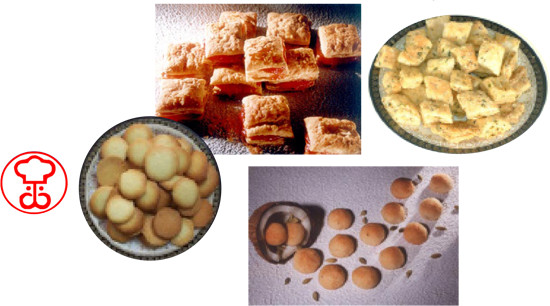
Ever since prohibition was introduced in Gujarat they had to substitute toddy with another fermenting agent made of hops and potatoes. However, "the taste and texture obtained from toddy was lost,” reports their website www. dotivala.com which gives a historical account of their beginnings as also an update on their latest products. When bread was fermented with toddy it would not spoil for considerable time. The ones left unsold did though become dry due to loss of moisture and would then be sold to the poor who appreciated the light and crispy texture. As the demand for such lighter and crispier variety increased, the Dotivalas specially placed their fresh breads in the ovens to achieve identical results. Today they are popularly known as Irani biscuits. Being low in calories and easily digestible, doctors would recommend these biscuits to their patients. Once the patients regained their health they were advised to eat biscuits with fat and thus were created the famous Farmasu Surti Batasa or Butter Biscuits. The locals in those days used to make a sweet called ‘dal’ which was baked by the early Dotivalas and thus was created the Nankhatai.
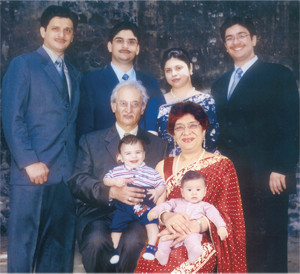
Dotivala family (standing, from left): Cyrus, Sharukh Zinobia and Mehernosh; (sitting) Jamshed with Rustam, Yasmin with Homyar
The owners may experiment and introduce new varieties like Cheese biscuits, methi khari, vanilla biscuits, sweet sticks, coconut macaroons, fresh cream pastries, pizza bread... but the batasa, khatai and khari continue to remain the perennial favorites at Surat’s Dotivala Bakers and Confectioners. Baking these biscuits may require little supervision from the owners for it is the "same, old time-honored recipe” that continues to serve the establishment. Quality control needs to be monitored periodically when there is a change in climatic conditions for "depending on the weather the quality of the product changes,” explains Jamshed.
The winter months from November to March are believed to be ideal for the business. In summer the shortening gets too soft; in the monsoons the humidity affects the products. If there is a stock of new wheat in the market, the quality of the flour differs. "We have to be very careful. We have to make changes in our proportions. It is not like in other countries where a consistent standard of flour and shortening is available throughout the year,” explains Dotivala. Despite all their efforts sometimes the consistency of their products may differ but they make sure that the taste never does. Customer complaints are thus minimal. Patrons may however get disheartened when a product of their choice is sold out before they reach the outlet. For over an hour when Parsiana was present at their shop there was never a single moment when the assistants did not have to attend to customers. The searing midday heat in May was apparently no deterrent to the steady stream of patrons.
Whilst originally their products were sold only from their shop at Makkai Bridge, they now also retail their products from their outlet at Parle Point Place on Ghoddod Road. Jamshed’s wife Yasmin regularly oversees the operations at the Parle Point Place which is close to their residence. Jamshed and son Cyrus jointly or in turns visit their Makkai Bridge premises because that is where the production activities in their seven ovens are concentrated.
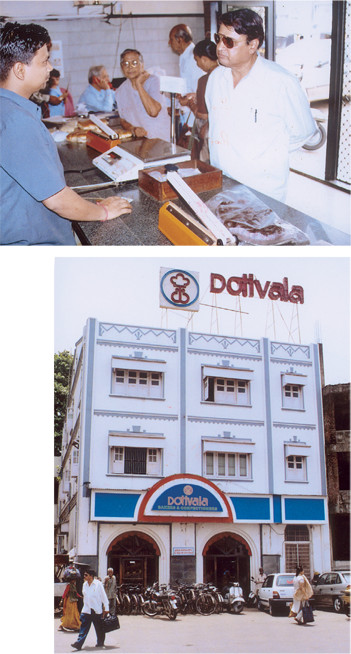
Brisk business at the Dotivala outlet at Makkai Bridge
Gone are the days where the laborious kneading of flour was done manually. A massive dough mixer now does the job effortlessly. An oven, which works on gas and not on electricity which is too expensive in Surat, can simultaneously accommodate 30 trays of bread. In Surat, "the first conversion from a conventional wood fire to gas was done in my bakery,” recalls Jamshed. The furnace being at a ground level, the men loading and unloading the trays have to lower themselves in a pit facing the oven to deftly undertake the job. Within the oven too the trays have to be regularly rotated to ensure even distribution of heat. Baking each day invariably starts with the breads because they require maximum heat as compared to sweet items that require less time in the oven, reveals Jamshed.
Among the other gadgets that minimize manual labor are the bread slicer and the bun divider. There is also the drying apparatus for the biscuits. After the batasas are baked the tray loads are invariably positioned in the dyer where the heat and light ensure that there is no residue of moisture. A freshly baked batasa has a different texture and taste from the one which has undergone the subsequent drying process, we are made to sample the difference.
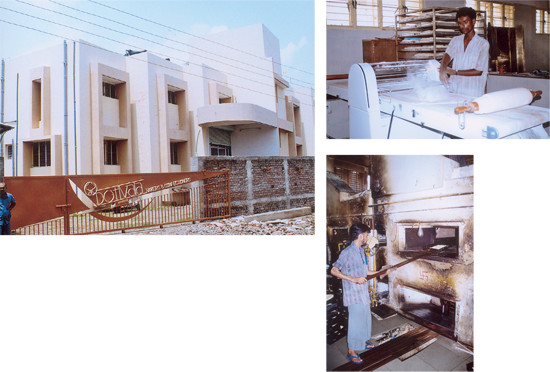
The new outlet at Parle Point Place with the different baking processes
The upper floors of their two-storeyed building are also used for specific production processes, whether it is packaging of biscuits, buns, cheesecakes or jam puffs or decorating their party cakes specially made to order. In addition to the popular Minnie Mouse and clowns and kittens they also offer exotic themes like a farmhouse or a swimming pool.
When Jamshed joined his kaka (paternal uncle) Homi in the business in 1969 after completing his science graduation and a certificate course in baking and confectionery from the Indian Hotel Management, the Dotivalas owned only one oven and production consequently was limited. In 1985 they bought a small plot of land with the intention of expanding their business. Six new ovens were constructed and the whole shop was renovated. By 1989 they were well equipped to handle the additional demand for their products. Ten years later Cyrus joined his father after completing his commerce graduation and a course in Hotel Administration and Food Technology from Bombay’s Sophia College. That emboldened them to start the second outlet. Thus while the first shop operates in the name of Dotivala Enterprise of which Jamshed and his second son Sharukh are partners, the new outlet functions in the name of C.S.M. Enterprise, the initials standing for the first letter in the names of Jamshed’s three sons (Cyrus, Sharukh and Mehernosh) who are partners. In the parent firm Dotivala Bakery, Yasmin and Sharukh are partners. Despite these divisions Jamshed is very much at the helm of the business and when he is preoccupied with his Rotary commitments being a district governor this year, Cyrus officiates. "Even if we are both not there my younger brothers can manage,” Cyrus is confident. "They happily come to the shops when they are in Surat.” Having just completed his MBBS Sharukh hopes to do his masters in surgery while Mehernosh is studying for the Bachelor of Dental Surgery. They stay in Bombay with their paternal grandmother Freny Dotivala. Neither did Jamshed’s late father Peshotan who ran a ginning and pressing factory in Amravati join the Bakery, nor do his siblings take an interest in the family business which has been known to exist since the beginning of Portuguese reign in Surat. Jamshed has a married sister Roshan Joshi and brother Dinshaw is a chemical engineer.
Presently the two other popular Parsi owned bakeries in Surat are Mazda and Meher. In between others too tried to get a market share in this business but were not able to succeed. The Dotivalas are used to seeing workers trained by them setting up their own independent businesses and taking with them some other employees too. In the case of one family which had four brothers working for the Dotivalas, each of them left to set up his own bakery, mentions Jamshed. Presently there are 60 people employed by the Dotivalas.
"There is no recession in the food industry,” Jamshed is convinced. "Even if you start a fast food corner you can generate a turnover of Rs 5,000 to 6,000 a day in Surat if the food is vegetarian and reasonably good,” he qualifies. This is due to "the prevailing culture of eating from roadside stalls which are now licensed by the municipal corporation.” Establishments like Dotivala are permitted to operate only if they have annually renewed the requisite licences and obtained a clearance from the food, factory, weights and measures, health and sanitary departments. Officials may walk in any time to check whether the workers’ nails are clipped or hair is trimmed, or sample the products on sale,” Jamshed takes it all in his stride.
Starting a new business requires you to invest a "lot of time, energy and money. It is not like a salaried job. Our production starts at 6.30-7 a.m. and continues till 9 p.m. Our Parsi boys don’t want to work hard,” observes Jamshed who being a senior trustee of the Surat Parsi Panchayat remembers one occasion when the Panchayat even helped a man with land for his manufacturing business but yet the business floundered. Cyrus thinks that Zoroastrian youngsters today are more keen on making their careers in the professions.
Having studied at the Manibai Gujarati High School and the Vidharbha Mahavidyalaya, Jamshed views himself as an orthodox. "We have to preserve the community, not let it go haywire with mixed marriages. If the families are not united, it is usually the children who suffer. With the youth today being exposed to so many other communities, if something happens, you can’t help it,” he concedes. Fortunately for Bombay there are many residential colonies where the Zoroastrian youth get a chance to interact. In Surat the major bonding factor are the ghambars, usually 20 in a year, he points out. The Surat Panchayat’s upcoming residential buildings — Dhan- Parin Sadan, Zartoshty Brothers Building — will soon be available for occupation and will hopefully generate opportunities for fraternization. Religiously inclined, Jamshed is also the managing trustee of Surat’s Bhikhaji Faramji Khan Adarian which only two years ago was renovated at a cost of nearly Rs 15 lakhs, he states.
With his parents’ grooming, Cyrus too takes his religious and community responsibilities seriously. After studying at Surat’s Sir J. J. School he did his commerce graduation from Bombay’s H. R. College of Commerce and Economics. His outstanding performance at the Sophia College course earned him the Nestle Trophy for Best Chef of the Year. Cyrus’ wife Zinobia, being tied down with two young sons Rustam and Homyar, is currently not able to help out at the shops although she likes cooking and making chocolates.
Cyrus, according to his father, was responsible for introducing fresh cream pastries at the Dotivala Bakery and evincing keen interest in their modernization plants. They next plan to export their products. The foreign settlers had taught the Dotivalas the fine art of baking. They now want to show those abroad how they have perfected this art.
◆ ◆ ◆
From the archive