
Environment
Romancing the rain
The Jogeshwari based Malcolm Baug Zoroastrian Association has taken the lead in tapping rainwater for later use
The Malcolm Baug Zoroastrian Association (MBZA) is set to pioneer 21st century rainwater harvesting (RWH) among the Parsis of Bombay. Though the concepts of global warming, diminishing fresh water resources and the need to conserve this precious commodity have been acknowledged and debated in various community fora, this pilot project at Jogeshwari may be the first practical step in the desired direction.
Currently limited to tapping the rainwater off the roofs of Malcolm Hall, which is the community center, the roofs and terraces of the adjoining Agiary — the Motlibai Wadia Adaran and by way of channels alongside the Agiary road, the natural harvest will be led through pipes, respectively to recharge a bore well near the Hall, the Agiary well and a disused heritage well which will be cleaned of its heavy overgrowth of scrub, its wall repaired, etc. Currently the bore well which provides water for the Malcolm Hall kitchen and for the Agiary garden is said to be slightly contaminated by kitchen waste and needs repair. The Agiary well provides water for ritual purposes but has a history of running dry over the summer months. The large old open well outside has not been operational in a long time.
The project aims at securing half-round gutters on the periphery of the roofs of the two structures connected to pipes to enable the water to be collected in brick-lined pits with sand, gravel and pebbles to sift the percolating water. The pits are to be located adjacent to the bore well and the agiary well so that the collecting water seeps in to recharge the ground water of the wells. A tee in the pipes would even enable the collected water to be directed into the wells.
The revival of the large disused open well outside the agiary/Hall where the water running off the paved streets in a circumscribed area of Malcolm Baug would be directed, would provide water for gardening and flushing purposes with the aid of a pump and a central tank to the residents of the Baug. A few live fish, burnt coconut shells and Avla tree branches would prevent mosquitoes breeding in the open well, notes the plan prepared by chartered engineer Sarosh Bala at the request of the MBZA.
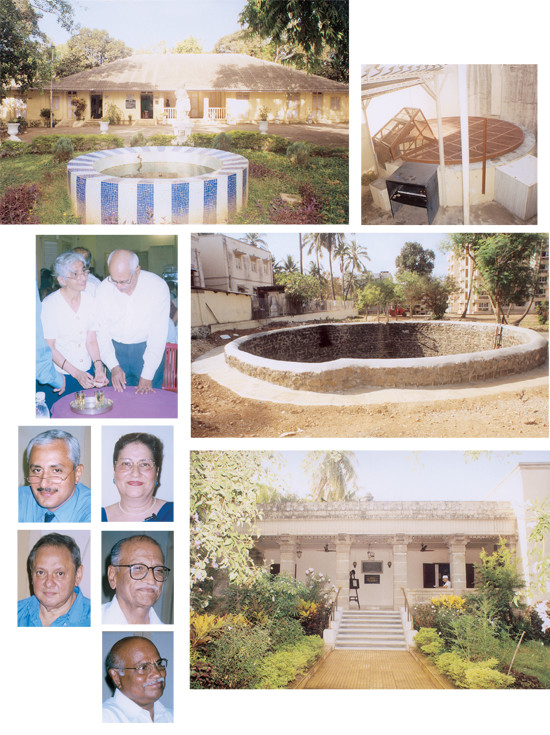
Top left: Malcolm Hall and bore well Below (in descending order): agiary well, heritage well and agiary Photos: Hoshi Patel ; Bottom left : Clockwise : K. Bhagalia,Bala, Gool and Homi Talati, D.Bhagalia, Dhoka-rikar and Gopinath Photos: Arnavaz Mama
The unveiling of the project was the focus of an evening’s seminar on rainwater harvesting hosted by the MBZA at the Malcolm Hall on April 4, 2004. The N. M. Wadia Trust which owns Malcolm Baug and has assented to the project, was represented by Homi Talati who lit the inaugural diva in the traditional ses. The day’s speakers included retired government geologists and water conservators who provided an insight into the problem of water management in India. Although invitations had been extended to residents of Zoroastrian colonies from Bandra to Andheri, there was no representation from any of them. In his welcome address MBZA president Kersi Bhagalia referred to the newly incorporated provision of the Bombay Municipal Corporation that makes RWH a compulsory feature of all new building constructions in Greater Bombay. Dolly Bhagalia as the evening’s emcee fielded questions on behalf of the speakers and ensured everyone a fair hearing.
The project, when implemented, is expected to generate over 30 lakh litres of water per season and considerably impact the water bill in the course of a couple of years. Considering that an average of 1,000 millimeters of rain is said to generate four million litres of water per acre (4,047 sq metres), Bombay’s average seasonal rainfall of 2,500 mm over the entire Malcolm Baug area would be a mind-boggling figure.
An estimated Rs 3.5 lakhs have already been promised for the project including two lakh rupees from philanthropist Shahrukh Kathavala and one lakh from the Divecha Trust. With MBZA members contributing their personal expertise and contacts to access raw material at substantial discounts, the project may be accomplished within a four lakh rupee budget, hope MBZA committee members.
Poona based consultant to the World Bank and former director of the Maharashtra Government ground water survey development department, Dhokarikar attributed the current bleak water scenario in India to increased agricultural and industrial needs as well as to the burgeoning population. "Exporting food grains is as good as exporting water,” he noted.
Heavy duty drilling machines had exacerbated the problem by draining ground water at deeper and deeper levels, he added. Given India’s major hard rock terrain, Dhokarikar emphasized the need for proper geological surveys before undertaking infrastructure for RWH.
Chairman Gopinath of the Madras based KRG Rainwater Harvesting Foundation spoke of the need to revise cultural values in order to inculcate in people the need to conserve and appreciate water. Whereas Indian children chant "Rain, rain go away,” water literacy is imbibed by primary school children in Japan where rain water is diverted from highways into tanks; "here we allow it to damage and decay our roads!” He advocated the creation of a separate network of pipes and tanks in multistoried buildings for the collection of used water for the purpose of flushing toilets.
Dr Rajan Sharma of Asian Paints presented an audiovisual on the com-pany’s RWH experience which is steadily pursuing its goal of eschewing the use of external water by the year 2005.
All the experts were unanimous in their appreciation of the MBZA initiative, providing further technical suggestions to exploit the vast potential of the area. It is hoped that the pilot project will spawn further, smaller projects by individual bungalow residents as well as the apartment buildings that have now come up in the colony.
◆ ◆ ◆
From the archive