
Readers' Forum
Value water
Some time ago, I had an opportunity to meet a couple of trustees of some fire-temples in Bombay who were rather concerned about the future of the water supply from agiary wells considering that tanker loads of water were being daily supplied to high-rise buildings and other places.
On visiting some of the agiaries I was surprised to find that in one well, water was being drawn out through a six-inch delivery pipe for supply to water tankers from morning to night. Even for agricultural purposes, at the most, three-inch pipes are used.
As a concerned individual who, in his capacity as chairman, water conservation, Lions Club of Mhow in Madhya Pradesh, has gained some knowledge and experience I would like to make the following observations:
The main source of piped water supply for a mega city like Bombay are the huge monsoon lakes situated on the mainland which are fed with rainwater. In the old days, before piped water from these lakes was available, the population of Bombay derived its water from the numerous wells dotted all over the place. While some wells still supply water many of the others are now in disuse, having been filled up.
The main source of water that fed these wells were the underground aquifers that were recharged annually by the seepage of rain water from the surface during the monsoon months. With the copious rain that Bombay was blessed with, these underground aquifers, over the years, became vast reservoirs of enormous quantities of water, and we can safely assume, that it is these massive reservoirs of underground water which are charging the wells even today, enabling us to draw out enormous quantities of water.
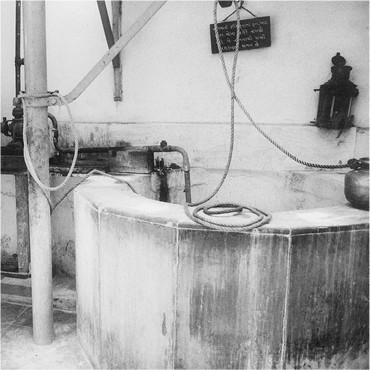
An agiary well serving as a reservoir of underground water
Since the last 30 to 40 years, Greater Bombay, covering an area of about 125 sq km has been converted into a concrete jungle. This prevents the rainwater from seeping into the soil during the monsoon months and recharging the underground aquifers.
God forbid, but only one failed monsoon will leave the monsoon lakes high and dry in Bombay. We would then have to resort to the only other alternative source, viz the wells, only to find that they have already been pumped dry. The underground reservoirs of water built up over the past many years, when there were plenty of open spaces around and Bombay had not yet become a concrete jungle, would have finally thrown their hands up at man’s thoughtless profligacy.
Our small community has ever been in the forefront of the development of this magnificent city, and it is time for us to again take the lead, and prevent it from slipping into anarchy. This year we have had only 55 inches of rain against the average of 85 to 90 inches. Water riots have already taken place in certain parts of our country. It is said that future wars will take place over water.
The Bombay Municipal Corporation has finally woken up and decided that all new buildings over 1,000 sq m i.e. about 10,000 sq ft area will require to have water harvesting arrangements which is a viable alternative.
Underground aquifers can be recharged by simple methods such as terrace/roof water harvesting: This involves the diversion of all the rainwater from terraces and roofs of large buildings such as hospitals, schools, colleges, residences, baugs, offices and commercial buildings and industries into nearby wells and/or percolation pits. Even old disused wells can very well serve the purpose. These wells can be cleaned and reactivated.
A moderate one-time expenditure will ensure the channeling of enormous quantities of rainwater into wells for years to come, as long as the infrastructure (such as pipes, etc) last.
However certain precautions should be taken to prevent the well water from being polluted: do not store any polluting material such as chemicals, cement and corroding articles on the terrace; clean the terrace/roof before each monsoon; ensure that the first two showers do not enter the recharging system; do not allow pets on the roof during the monsoon; provide mechanical filters to filter out any matter like leaves, etc.
A mere 1,000 sq ft of terrace/roof area is capable of harvesting 80,000 litres of rainwater per year, which translates into 400 barrels/drums of 200 litres each. Similarly, one acre of open land can recharge about 18 lakh litres of rainwater per year.
Hence, the trustees, administrators and owners of large building complexes should take steps in this matter on a priority basis. Additionally, individuals can save water by the simple expedient of using water by mug and bucket instead of directly from the tap for daily activities such as brushing of teeth, washing the face and hands, toiletry, washing of clothes and utensils, etc. It just requires a change in attitude and mindset.
Further, simple methods such as prevailing upon children not to throw away the water remaining in their bottles at the end of the school day, or reducing the capacity of one’s flushing cistern by putting in any solid thing such as glass bottles, bricks or stones, etc can result in saving enormous quantities of water daily.
In the small cantonment town of Mhow in Madhya Pradesh where I come from, the Parsi Zoroastrian Anjuman has successfully installed terrace/roof water harvesting systems in its agiary and common hall complex, as also several residential buildings, connecting them to four open wells. At the Tower of Silence, one open well and two tube wells are being charged by rain water from about eight acres of hilly slopes by way of several trenches, percolation pits and soak pits.
Several schools and private individuals have adopted the terrace/roof water harvesting to charge wells and bore wells.
A lake has been constructed on military land with the help of the Infantry School, Mhow, the Lions Club and cooperation from the public.
Any queries or clarifications may please be addressed to the author at the following address: Phiroze B. Illava, 143, Simrole Road, Mhow (MP) 453441, Tel: 07324-73336.
PHIROZE B. ILLAVA
Mhow
◆ ◆ ◆
From the archive