
Cover Story
Inspired interiors
The range of designer furniture and artefacts displayed at Trafford House and Modesta show how space can be optimally utilized
Furniture could be functional, a fixture for some and a source of fascination to others. For those who value the lines and curves that constitute period or progressive pieces, Trafford House and Modesta, the two relatively new outlets in Bombay’s Fort area within walking distance of each other, offer an interesting array. While Modesta showcases the functional and aesthetic range designed by Firdaus Dadabhoy, Trafford House displays the classic-contemporary designs of Nilofer and Reshad Rustomji as also their partner Sam Maneckshaw.
Specializing in furniture, antiques and collectibles, the Rustomjis and Maneckshaw have worked out an amicable arrangement whereby the left section of the store Trafford House is stocked with Maneckshaw’s merchandise and the right side with Rustomjis’ ware. One corner of the showroom is reserved for Aadore Sayani’s Sleight of Hand confectionery. Respecting each other’s space and style, conjointly they are promoting their nearly two-year-old venture as "a friendly happening place” in south Bombay which would serve as an ideal venue for play readings, book launches, workshops, theme evenings, art shows.
Although technically they are "independent businesses sharing common premises,” as explains Nilofer, they function harmoniously such that the custom-made arts and crafts style of furniture on view complements the rare and vintage treasures they may have sourced from different collections. Customers patronize any one or all, depending on their requirements. When an event is scheduled at the shop there is no ‘yours’ and ‘mine,’ only ‘ours.’
As we are taken around Maneckshaw’s area we are given meticulous introductions to the items on display. His area of expertise being "fine furniture and antiques,” the entrepreneur not only designs the pieces, he also buys, restores and resells antiques. The eye-catching furniture sets, "made by me though not necessarily designed by me,” clarifies Maneckshaw, use wood or steel and glass to give it a contemporary look. Among the coffee tables on view was one interesting piece where the glass is made to rest on antique brackets. His workshop at Kalachowky has about four-five craftsmen working under his bi-weekly supervision.
There is no dearth of the "very collectible” artefacts he has displayed at Trafford House: an antique Chinese bed-board/headboard, a south Indian piece of architecture, probably of the 19th century, depicting high quality of carving, imposing chandeliers, Chinese jade figurines, carved agate curios, a carved rosewood screen about 130 years old, probably made by Goan craftsmen, over 100-year-old oleographs from the Chitra-shala Steam Press in Poona, a photo called Study in Motion by Austrian photographer Prof Rudolph Koppitz, Parsi portraits, grandfather clocks, salvaged pieces of kor, jacket with original Chinese embroidery... Placed strategically along the store are handcarved teakwood asho farohars. The prices at the store could range from Rs 400 to lakhs depending on the exclusivity of one’s selection.
Restoration of photo frames with composite gold leaf gilding, if the client can afford it, or using substitute gilding material like silver, bronze, aluminium, in different hues and shades is another service that Maneckshaw has introduced.
The Rustomjis’ commitment to the Arts and Crafts Style of furniture followed their study and fascination with this movement which emerged in England between 1876 to 1915. The characteristic style of this furniture is simplicity, clean lines with the use of natural materials and superior craftsmanship quite distinct from the mass produced furniture in the Victorian homes, we are told. For the Rustomjis, the high quality of workmanship in terms of joinery and finish is a prerequisite before they introduce their rich design patterns abstracted from nature. Solid sections of old, recycled teakwood is used for their Arts and Crafts as also country style furniture. For their Classic Contemporary designs, especially for their tables they source new kiln dried teakwood. Depending on the desired finish, the sanding and polishing differs.
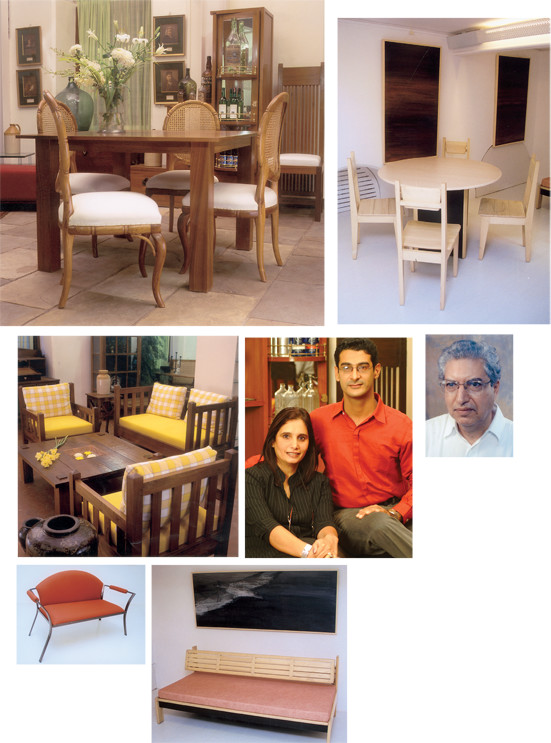
Left (top and center): Trafford House collection offered by Nilofer Rustomji and Maneckshaw; Right (top and below): Modesta range designed by Dadabhoy
Among the Rustomjis "the areas of conflict and interest are well spaced out such that Reshad has the final say in production and I have the final say in marketing,” smiles Nilofer. Handling the media too falls within Nilofer’s purview, with Reshad preferring to concentrate on the production assignments at their workshop in Wadala where they have a carpentry, polishing and upholstery unit. Their accessorized product line includes handloomed upholstery fabric in cotton, jute and voile, bamboo and jute window blinds, household linen, hammocks, garden umbrellas... The designing department is common to them both. They have a permanent staff of 20 who have been working with them for the last 13 years, plus they have to take add-ons depending on the volume of work on hand.
After having specialized in modular office furniture when Dadabhoy decided to introduce his range of residential furniture he needed a display place for his retail business. A friend offered to display his products and thus Modesta was launched in 2002 as "the complete interior outlet” offering an eclectic blend of furniture, art and accessories with a wide range of custom designed workstations, compact work tops for students and home offices, chairs and settees with flair and flexibility, storages, conference, dining, peg and center tables... Dadabhoy likes to use rubber wood which is light and adaptable with any décor for his furniture pieces, being the closest equivalent of white cedar which contributes to the favored Scandinavian look. Among Modesta’s innovative, cost-effective solutions for optimizing space was a commodious chair which can be stretched into a single bed, fold-back collapsible screens which can serve as room dividers or offer the privacy of enclosed cubicles, wall units with adjustable sections and add-on possibilities... Since he manufactures pieces himself he has three units (two in Silvassa and one in Andheri) with a core group of 12-13 people working for him. Depending on the work on hand he may need to employ extra craftsmen when needed.
Customer sensitivity
Whatever the needs of his customers Maneckshaw likes to give them individual attention on the rationale "I like to meet each personally and interact on a one-to-one basis.”
"You have to make time for the clients,” corroborates Nilofer. Considering that the treasures at Trafford are generally bought to transform the aesthetic appeal of one’s residence, she realizes that "a client should feel secure with the design. A home being a personal area” she would rather let the client make his/her own selection and offer an opinion only when sought. "Once you deliver what you have promised” and earned the confidence of the customers, "everyone’s defences are down,” observes the furniture consultant. Although 60-70 percent of their customers are Bombay-based according to Nilofer’s estimates they are privileged to entertain others who specifically come to scout for tasteful additions, "Bombay being the happening city of India.”
With one-fifth of their customers being Parsis, Nilofer candidly admits, "You can understand and connect with the Parsi sensibilities and eccentricities... They are very easy, straight and nice to deal with...In fact, I can say that for all my clients with the exception of one or two.” Maneckshaw too has been happy with the "trust and freedom to design” reposed by his clients acknowledging however that his "best and worst experiences have been when dealing with a Parsi.”
"We have a mixed clientele,” says Dadabhoy. "Now people are aware of many developments. Parsi clients are very responsive and easy to communicate with.”
Fondness for furniture
Reshad was formerly an accounts executive with Lintas and Nilofer worked for the Taj. Since both of them wanted a "break from the rat race, the corporate sales and marketing world, in 1990 we bought over a coffee farm in Kodai-kanal.” When setting up their house the old colonial style of furniture appealed to them. "We saw that as a business opportunity. Reshad is passionate about agriculture and his second passion was to have a workshop of his own. His vision was to marry the two,” states Nilofer.
Following the birth of their daughters Simonil who is now in Std IX, and Zara who is in Std VI at the J. B. Petit High School for Girls, they once again relocated to Bombay and launched their proprietory concern Colonial Collections, under the aegis of N. R. Rustomji and Associates, Nilofer gives the details. "When we started the business we did only restoration of old furniture,” Nilofer relates. "We had no formal training. Only a passion and feel for furniture.”
In fact when they decided on their Trafford House premises, close to J. B. Petit the disappointed children chided their parents for not being able to find a location elsewhere but in close proximity to the School. Subsequently though they have reversed their opinion when they realized the advantages of having a ready cash supply at such close quarters! Trafford House is not the only outlet for the Rustomjis. They also have their lifestyle store in Goa called Rust.
While Nilofer is from Bombay, having studied at the Rose Manor Garden School in Santa Cruz, and subsequently at St Xavier’s and Elphinstone College, Jaipur born Reshad (son of M. K. Rus-tomji who was famous for his management books) spent some years in Auro-ville and subsequently at St Peters in Panchgani. After studying at the Catering College in Dadar he had worked at the Taj as a trainee before he joined Lintas.
Maneckshaw (whose father Navzar was an assistant commissioner of police) had worked as interior designer with Phiroza Neterwala Associates before he founded his partnership firm, Jeswani and Maneckshaw Interior Designers in 1995. Originally he started with restoration of furniture and subsequently he started accepting orders for new pieces too. He is an ex-student of Campion School and St Xavier’s College. At the age of 18 he left College to gain experience as an interior designer and subsequently completed his graduation through correspondence. His brother Roomi manages the workshop for Sam’s partner Rakesh Jeswani, while the second brother Jimmy has an aquaculture business in Saphale.
An architect by profession, Dadabhoy started with K. P. Davar and Company and after a year worked for the Tatas when Nari Gandhi was the consulting architect for the Tata Electric and Tata Consultancy Services. His specialized modular systems which had earned him patents abroad were adopted at the offices of the Tata Consultancy Services all over India. He then left the Tatas to set up his own practice. Interlock Systems (known for its fabrication of The Instant Office), Firma (in partnership with his mother Mani) and Modesta Systems are the three companies he started. As an architect he designed farmhouses, a community center in Goa, holiday homes for Tata Consultancy in Panchgani, lent his expertise at the Masina Hospital’s Burns Unit, the private rooms of medical consultants... Among the corporations that bear his touch are the fourth floor offices of Bombay Dyeing at Ballard Estate, Barmag-India at Nariman Point...
"Always interested in creative activities,” after his early education at St Xavier’s High School followed by two years at St Xavier’s College, Dadabhoy joined Sir J. J. School of Art. "I also paint,” reveals a reticent Dadabhoy whose first show was at the Jehangir Art Gallery in 1975. Painting in oils and acrylic, his works are on view at the Modesta showroom. Yet another facet to his creativity has found expression in two of his published works, A Casual Glance and Two Novellas: Living Doll and The Most Beautiful Girl in the World.
Exploring new avenues
Entrepreneurship within the community has "unfortunately receded,” regrets Nilofer who is constantly exploring new avenues. The vacant space next to their shop is now being developed as a nursery. And happiest of all with this new development is Lord Trafford. After building up our suspense we are officially introduced to Lord Trafford — a tortoise who enjoys his walks and draws attention of passersby who seek permission to bring their little children to see him. The owners are now planning to gild his name on his shell — to recognize his contribution to the success of Trafford House.
Barring a few young people who may want to launch a new venture, Nilofer has noticed that "Parsis don’t want to take a chance.”
Dadabhoy however believes, "If you see the size of the community and the comparative level of professionals, it must be very high. It’s a misnomer that we are a laid-back community. Our community has a record of being entrepreneurs. Considering our dwindling numbers we should encourage entrepreneurship within the coming generations.” After designing work stations based on the currently popular Feng Shui, he is now contemplating on introducing personalized furniture. Retaining one’s genuine antique furniture while blending within it the contemporary tastes — a table with one’s insignia or a chair with one’s image — requires conceptua- lization and vision.
◆ ◆ ◆
From the archive