
Environment
Reaping a rainy resource
Dr Rashneh Pardiwala’s rainwater harvesting project for the Bombay police will benefit the environment and the budget
"In 50 years, the city’s groundwater level has dipped by 120 feet,” states environmentalist and founder-director of the Centre for Environmental Research and Education (CERE) Dr Rashneh Pardiwala about Bombay. Citing rampant concretization and unchecked building activity, Pardiwala says that rainwater has nowhere to go, therefore you see flooding. Ruing that municipal laws making rainwater harvesting (RWH) mandatory for new constructions "exist only on paper,” Pardiwala believes that all gated communities, land owners "and everyone with a social responsibility,” should implement this method of conservation of water. She was speaking to Parsiana on October 18, 2017 about the successful completion of a RWH project for the Bombay police.
The three-and-a-half-month project implemented by CERE at one of the major police facilities in Naigaon will lead to more availability of water, recharge the groundwater table and in addition, result in annual savings of Rs 19.40 lakhs in water bills. Pardiwala told us that their organization also collected funds on behalf of the police for the project that was completed at a cost of Rs 31 lakhs. The work was done by June this year, but CERE wanted "to assess the impact of the project during the monsoons” before formally announcing it. Pardiwala notes that the low lying Naigaon area which is flood prone did not see water logging this year, "even on days of the heaviest downpours in August and September” thanks to their project.
While on a mission to "plant 500 native trees under the Urban Afforestation Project,” Pardiwala learnt about the water shortage and the flooding problems in the Naigaon police headquarters on one such visit. The complex also houses a residential colony, a municipal school, a hospital and three large training grounds and a hockey field. After a survey and a presentation to the authorities, "we received the go-ahead immediately,” Pardiwala told the mid-day (MM) of October 8.
The three-and-a-half-month project implemented by CERE at one of the major police facilities in Naigaon will lead to more availability of water, recharge the groundwater table and in addition, result in annual savings of Rs 19.40 lakhs in water bills. Pardiwala told us that their organization also collected funds on behalf of the police for the project that was completed at a cost of Rs 31 lakhs. The work was done by June this year, but CERE wanted "to assess the impact of the project during the monsoons” before formally announcing it. Pardiwala notes that the low lying Naigaon area which is flood prone did not see water logging this year, "even on days of the heaviest downpours in August and September” thanks to their project.
While on a mission to "plant 500 native trees under the Urban Afforestation Project,” Pardiwala learnt about the water shortage and the flooding problems in the Naigaon police headquarters on one such visit. The complex also houses a residential colony, a municipal school, a hospital and three large training grounds and a hockey field. After a survey and a presentation to the authorities, "we received the go-ahead immediately,” Pardiwala told the mid-day (MM) of October 8.
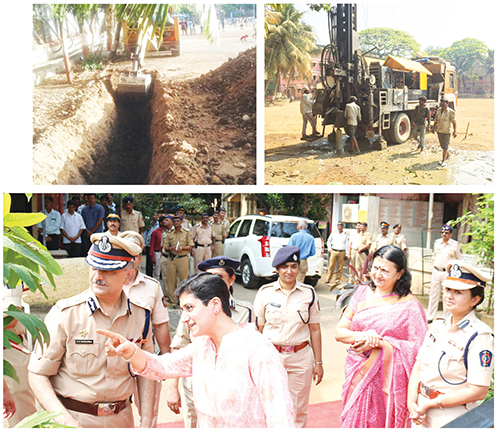
Benefitting the force (clockwise from above, left): digging percolation trenches; preparing the ground;
Dr Rashneh Pardiwala (center, pointing) with Commissioner of Police Dattatray Padsalgikar and others
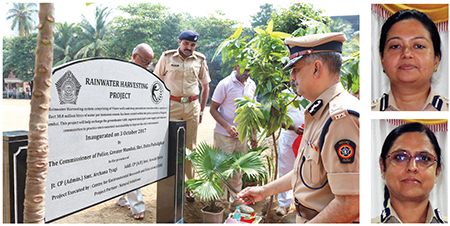
Clockwise from above: Padsalgikar, unveiling a plaque; Additional Commissioner of
Police Aswati Dorje; Joint Commissioner of Police Archana Tyagi
Capable of harvesting 38.8 million liters of water each monsoon, the project involved digging deep percolation trenches along the periphery of three open grounds in their premises "to recharge the water table.” Nine defunct bore wells were repaired to access the recharged water table, which will now supply water to the bathroom blocks in the complex. Awareness sessions on water conservation in general and the RWH project in particular amongst the police community were also conducted.
A CERE brochure states that the project has benefitted 2,335 police families. The MM report stated that "they once received just 15 minutes of water supply” each day from the municipal corporation. There are indirect benefits of the project too: When groundwater gets recharged, it impacts wells in a five kilometer radius, recharging them with water, Pardiwala told MM. The project was "thrown open” by police commissioner Dattatray Padsalgikar on October 3 who acclaimed the success of the project and said that "we are considering taking this up in other police grounds too.”
Harvesting of rain water is not only about collecting it on your terraces and roofs. The construction and rejuvenation of bore wells is another way to do this, states Pardiwala. According to the environmentalist, one should "just allow rain water to seep into the ground for the first time. Water will find its own level… this will also push back the brackish water that seeps into the island city from the surrounding seas.”
The Centre has previously conducted RWH projects for the Seth Hormusji Dadabhoy Saher Agiary and residential colony Malcolm Baug in Bombay (see "Harvesting the rain,” Parsiana, September 7, 2006). A new proposal is pending before the trustees of the M. F. Cama Athornan Institute. "Agiary well waters are becoming brackish… this must be attended to urgently,” she believes. Earlier this year, the well at Rustom Framna Agiary in Dadar had run nearly dry and had only "three to four feet of water left” (see "Dry in Dadar,” Events and Personalities, Parsiana, May 21, 2017). A quick check by Parsiana with trustee Nasha Jassawalla on October 23 revealed that "the level is still low, but not that bad.” For a Parsi trust, Pardiwala is ready to assist with arranging funding from well-wishers. "If I can collect funds for the police why not for my community?” she questions rhetorically. The police project "was a prototype that we (Parsis) as among the largest landowning communities in the city can follow,” she ends.
Cofounded by Pardiwala in 2002 with environmental educationist Kitayun Rustom, CERE has, since its inception, worked on tree plantation at Doongerwadi 2015 onwards ("here too, as was the case with the Saher Agiary and Malcolm Baug, I have worked pro-bono, except for the materials”), river rejuvenation projects among the Warli community in Dahanu, measuring and mitigating carbon footprints for corporate bodies and promotion of environmental education. In 2015, CERE was associated with the setting up of "the first of its kind” native bio diversity park in Alibaug, near Bombay (see "Ecological Eden,” Parsiana, October 21, 2016).
◆ ◆ ◆
From the archive