
In Memoriam
Dinshaw’s devotion
Died: Dinshaw Framroze Joshi, 77, former president of the Zoroastrian Association of Metropolitan Washington, Inc (ZAMWI) and chair of the Federation of Zoroastrian Associations of North America’s (FEZANA) Awards Committee, suddenly, in Washington DC on November 10, 2003.
"His quiet but firm stance on issues of concern to the Zarathushti community worldwide earned him utmost respect. He sought not to hold official positions and wield power for himself. He has been variously described by friends, acquaintances and co-workers as ‘righteous,’ ‘impartial,’ ‘straightforward,’ ‘ingenious,’ ‘compassionate’... Those of us who had the privilege of knowing him through the years will always think back on how Dinshaw would have advised us in any given situation,” notes Khorshed Jungalwala, chair of FEZANA’s Publications Committee, in her tribute in the FEZANA Journal (Spring 2004).
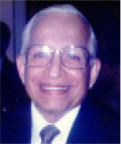
Joshi: telecom pioneer, community champion
"Unlike some who achieve pre-eminence and never let anyone forget (it) Dinshaw... remained modest and self-effacing, wearing his world and national honors lightly on his shoulders... His professional pre-eminence was matched by fierce devotion to living according to the principles of his faith, whose navar he had become when he was 12. Despite the demands of his career, he always had time to help those who sought it, and to serve the community wherever he lived, (in) India or North America...
"Dinshaw’s sagacity and ability to give sound advice based on true Zara-thushti values, made him a valued counselor to successive FEZANA presidents. They frequently turned to him for counsel on most North American community matters. He got no public recognition... It is a measure of his greatness that this mattered not one bit to him. What fulfilled Dinshaw was that he could give of himself for the benefit of the community he loved... North American Zarathushtis are better-off because he silently played this beneficial role for years,” mentions ZAMWI founding president and former director of the World Bank Adi Davar in his piece for the "Great Zarathustis” series on the Vohuman website.
Former editor of the FEZANA Journal and former president of the Zoroastrian Association of Quebec Ervad (Dr) Jehan Bagli depicts Joshi as "a man of deep sense of integrity and a champion of moral values.” The newsletter of the Zoroastrian Association of Metropolitan Chicago (December 2003) describes him as a man "known for his judicious impartial decisions.”
Perhaps Joshi’s most significant community contribution was his structuring of FEZANA’s North American Zarathushti Community (NAZC) Awards that accompany the biennial North American Zoroastrian Congresses for which he was presented a special plaque in 1998. Instituted in 1988 the awards process had been the responsibility of the member association hosting the congress. To overcome the lack of continuity, inconsistent assessment criteria and procedures, then FEZANA president Dolly Dastoor institutionalized the process by setting up an awards committee as one of the standing committees of FEZANA in 1996 with Joshi in the chair ("Achievers All,” Parsiana, January 1999).
Procedures for inviting nominations were formalized and specific evaluation criteria established for judges in each category. So professionalized has been the work of the Joshi led committee that now independent panels of five respected Zarathushtis evaluate nominees in each category with members of the awards committee as chairpersons to coordinate the results and determine the winners.
For the 2002 awards, when the committee discovered that some of their selected judges — whose names were not divulged even to each other — had been nominated for awards by the community, it made sure that the nominee did not serve on the judges’ panel for the award for which he/she had been nominated ("North American Awards,” Zoroastrians Abroad, Parsiana, September 2002).
Work on the World Zarathushti Community Awards 2000 presented at the Seventh World Zoroastrian Congress in Houston had been performed with the same meticulous attention to detail. Joshi was presented a memento at the end of the ceremony by his awards committee whose vice chair Yasmin Pavri of Houston described Joshi as a "fantastic person to work with and a very easy person to work with because he does all the work!” ("World winners,” Parsiana, March 2001).
Shortly before his passing Joshi had been working on the NAZC Awards for 2004 to be presented December 04-January 05, notes the FEZANA Journal (Spring 2004). In a report he submitted to the FEZANA executive he urged the need to standardize award categories, their definitions and evaluation criteria, rules governing the awards, criteria for selection of judges, items to be presented to the winners, etc. He had wished to incorporate them into the terms of reference for future awards committees, states the Journal.
A telecommunications wizard by profession, the son of Framroze and Dinbai had schooled at Boys’ Town, Nasik, acquired his BSc from Bombay’s Elphinstone College and the Royal Institute of Science and topped the Bombay University’s list of successful Bachelors of electrical engineering. He also acquired a degree in mechanical engineering. Ranking first among all-India candidates for the Telegraph Engineering Service of the central government in 1945, Joshi began his long innings (1945-73) with the Indian Posts and Telegraphs (P&T) starting as a junior engineer and ending as deputy director general of the P&T, note Jungalwala and Davar. "Recognizing his brilliance, P&T first sent him under a UN Technical Assistance Fellowship to Germany, Switzerland and UK to hone his expertise in advanced telecommunications and later, to other courses abroad. To enhance his managerial talents, he was sent to the National Academy of Administration and the National Defence College in India,” states Davar. Along the way he was a highly successful — both efficient and popular — general manager of Bombay Telephones.
In the course of his P&T sojourn, Joshi is said to have coordinated telecommunications for India’s defence services during the Indo-Pak and Indo-China wars and served as chief liaison officer to visiting dignitaries like Queen Elizabeth, General Eisenhower, Pope Paul II and others. "He designed and developed the national telephone numbering plan for India which is still in use in the national long-distance subscriber trunk-dialing (STD) network,” writes Jungalwala. The multi-exchange telephone system — one of several technical improvements that he pioneered — earned Joshi a joint patent in India and the UK, states Davar adding, "Dinshaw pioneered new telecommunication technologies which were applied not only in India but internationally. (He) was recognized world-wide as an authority on switch gearing which, in the early 70s, was at the cutting edge of telecommunications technology. A Zarathushti has still to reach (such) world pre-eminence in telecommunications!”
Inducted into the World Bank in 1973 as telecommunications engineer — "a position specifically created for him,” and on retirement, as consultant until his death, as per Jungalwala, he traveled widely, advising, assisting and monitoring IBRD financed projects in developing countries. "Even through his profession, he lived the Zarathushti precept of giving of oneself to improve the lives of others,” writes friend and admirer Davar.
During his P&T years he had been posted for a time in Delhi where he had helped draft the first constitution and bylaws of the Delhi Parsi Anjuman, been instrumental in the establishment of the Mengusi Agiary there and had co-edited its house journal, Dipanjali, which he had cofounded, Jungalwala informs us. On arriving in Washington, his expertise and experience were harnessed in drafting the constitution and bylaws of ZAMWI where no one can hold an executive office for more than two two-year terms. "We don’t want anyone to capture one post and not move,” Joshi had told Parsiana ("Come to a decision,” February-March 1997). The clause, which was later incorporated into the FEZANA constitution, has ensured that new blood keeps the executive boards energized with fresh ideas and, at ZAMWI, has helped induct the youth into the decision making process.
Scholarly quibbling had dismayed Joshi who believed that the Zoroastrian community needed a guide through the various interpretations of its scriptures. It pained him to see troublemakers deliberately confusing the layman. "E-mail controversies are giving Parsis a bad name,” he said. He had told Parsiana that the North American community as a whole was tending to be more liberal despite attempts by some people to enforce a doctrinal orthodoxy on FEZANA: "I don’t think it will ever be ultra orthodox. Intermarriages will lead to tolerance... (At ZAMWI) we have no restrictions. Everyone comes in and sits at the jashan.”
Joshi’s wife Goolcher (née Kotwal) and their daughter Shehernaz (married to Iranian Zoroastrian Farhad Verahrami) were throughout a source of joy and comfort. In later years the senior couple were happy baby-sitting their two granddaughters Anahita and Roksana. In Jungalwala’s words, Joshi was "a supreme example of a senior statesman for our North American Zarathushti community, who was devoted to his family, his work and to his community.”
Arnavaz S. Mama
◆ ◆ ◆
From the archive