
Zoroastrians Abroad
“We need strong leadership”
The 21st century Zoroastrian world needs leaders with intellectual integrity and moral stamina, feels information technologist Darius Mistry
Soft-spoken Darius Mistry was profuse in his apologies for keeping Parsiana waiting, though it was only a matter of a few minutes. The managing director of Auckland based Imagetext Publishing Systems Limited is a deeply religious man. We had arrived before his prayers were complete.
Dealing in Apple and Macintosh computers integration, the company is the only one in New Zealand which provides such cross platform systems integration. The specialized workflow software it supplies is avidly sought by the graphic, printing, publishing and advertising industries for their large image handling requirements and for the secure communication of their files. Mistry says, "We have brought in software, investing our own money to make ourselves unique in New Zealand, years ahead of our competitors.”
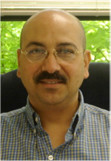
Darius Mistry: "we have to be pragmatic
With a staff of 27 and a sub-office in Wellington, he imports workflow related software from the US and Europe. For example, the remote proofing facility from the UK enables the advertising industry to proof an advertisement anywhere in the world over the Web, saving huge turnaround of documents and providing information quickly to the right users. The communications software from the US is used by advertising agencies who are extremely time bound, he says. "It is critical that the software ensures automatic receipt of signals, enables conferences online with 99.9 percent delivery, something of value to any company looking for fast transmission of large volumes of data around the world,” says Mistry. Sophisticated printing technology known as Lenticular Printing comes from Israel and is great at producing 3D posters, and has other complex technological uses, he tells us. He provides a catalog of automatic software to his clients, among whom are the New Zealand Herald and top advertising agencies like Saatchi and Saatchi. Researching their requirements, attending European IT fairs and bringing in appropriate software to New Zealand has helped the company stay ahead of the competition, he notes.
Mistry says he charges a premium to provide post sales service and support contracts which provide total IT coverage over a 24x7 time frame in tandem with other guarantees. It is a very popular service in Europe and America, he notes, but not many New Zealand companies can afford it.
"New Zealand has four million people. Eighty-seven percent of businesses employ fewer than five people. We have carved out a very substantial niche, winning industrial awards. There are no enterprise funds or government grants of any real substance. Banks will only loan you money on tangible assets, like a house, which you need to provide as collateral. But things can be done if you are financially savvy and run a tight business with frugal spending habits. We are doing it completely from our internal profits,” states Mistry. "It takes a lot longer, but you can sleep well at night, if you don’t borrow too much, and run the operations with smart thinking,” he adds. "We don’t see some of our engineers for days but I get their reports on the web. Once a week we call them for lunch to meet and resolve departmental issues. We don’t have too many supervisory roles,” Mistry describes his objectives-based style of management.
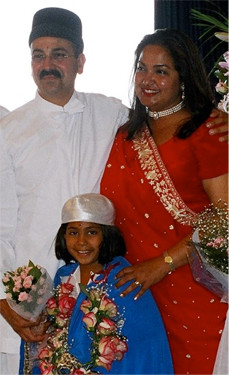
With Edwina and Farrah after the navjote
Mistry grew up in the Godrej Colony in Vikhroli where his late father Shiawak had been an engineer with the company for 36 years. "(The late) Jai Godrej used to teach us in the Udyachal School — lessons which have really instilled the value system within me. I have very high regard for the Godrej family; they treated their staff very well. It was a settlement by itself, complete with a theater,” Mistry recalls fond childhood memories of his days in the Godrej Colony, running the Godrej Scouts Troop, noting, "I was the first President Scout to pass out of the Godrej Scout Troop.” Later the family moved to a house in Dadar Parsi Colony built by his father along with other Parsi friends. They continue to have a flat there and he comes every two or three years to meet his mother Freny, a former school teacher.
A graduate in chemistry from SIES, Mistry had originally intended to become a doctor, but ended up with post graduation in business management. Leaving India 27 years ago, he worked with Siemens in Dubai for four years, followed by Wang in Bahrain for two more. By the time he left the Middle East for New Zealand he was involved in setting up and managing as an Apple re-seller in Bahrain where he met his wife Edwina, an IT engineer as well. Taking advantage of a cousin’s invitation he visited New Zealand, took complete packaged tours through the youth hostels. "I went north to south in 21 days. It was very picturesque. There were lots of outdoor activities and good jobs in the IT field.” Mistry migrated.
Apple had an opening for a new business development person. There was no salary, only commissions. "I took it as a challenge!” Later he joined Hewlett Packard (HP) for two years, specializing in selling Unix systems to the manufacturing industry. When HP took most of their process to Australia and made several staff redundant, he joined Soft Works, a private company which developed software for the banking industry based on Apple computers. A competitor offered a partnership and he initially joined on 50-50 basis his current company Imagetext, on the advice of Price Waterhouse Cooper.
Darius and Edwina and their nine-year-old daughter Farrah live a busy life. Darius’ main preoccupation is reading technology and management manuals, attending short courses in IT and management at the University of Auckland. He enjoys music — western classical as well as Bollywood — spends time with his daughter who plays the violin, provides social service to the old people’s home once a week and, time permitting, tries to improve his hand at golf. Edwina reads a lot, lectures on IT at the local polyclinic which helps her keep in touch with the industry. Darius’ brother Porus continues to work for Godrej, looking after the company’s investments. His Nirmala Niketan educated sister Kashmira Kambatta is a kindergarten/nursery teacher in New Zealand.
Facing challenges and uncertainties has strengthened Mistry’s faith in Zoroastrian prayer. He devotes an hour to prayer every day, noting quietly, "It has helped me tremendously.” He says he was the 20th Parsi to land in Auckland in 1987. Now there are 1,300. There was a time when he used to conduct a prayer class, every second Saturday. Now a young, 28-year-old mobed, who works in an insurance company, conducts it. The Parsiana Lodge, the facility run by Dolly and Aspy Shalori for immigrating Indians, came up later. It has also helped keep the community to stay connected, he tells us.
With his deep religiosity we wonder if Mistry is orthodox in his view of the Zoroastrian faith and the community. "I just consider myself a good human being,” he says, noting that his concerns and ideas belong to many of his generation. "It’s a pity there are so many factions in our small community. There are so many young Zarthoshti boys and girls who do not attend community functions because of the fights and bickering. There are a couple of mixed marriages with very bright children. But they gave up on their prayers because of the dogmatism which has supplanted the core values of the religion.”
Mistry speaks of a Zoroastrian doctor and his non-Parsi wife who have been there for over 36 years and who used to look after most of the new Zoroastrian arrivals during those early years, extending to them the hospitality of their home. All functions used to be held at their home. They are now too turned off by the orthodox-liberal bickering to be involved with the community at all.
"We need real strong leadership. Dogmatism and traditionalism is fine to a degree. But what is required is a united Zoroastrian community that teaches the Prophet’s message in its true and pristine form, rather than human interpretation that changes from era to era and person to person. We are becoming a laughing stock among other communities. Every time people add their own concoctions and say that’s what the Prophet preaches, (it) seems to cause a multiplicity of religious beliefs, and sends the wrong signals to the intelligent and curious Zoroastrian youth of today…We have to be pragmatic rather than dogmatic. Even if we follow 10 percent of the religion it would be better than nothing, especially in a foreign land.” In keeping with this philosophy, in the hope of keeping their youth within the fold, the Zoroastrian Association of New Zealand invited Zoroastrian scholars Dina McIntyre of the US and London based Farrokh Vajifdar to share their knowledge with the local community. "The traditional Zoroastrian organization boycotted them. To whose loss?” asks Mistry.
"There is a place for traditionalism in the community. But when it breaks up our unity, confuses our youth and divides our strength, you need to question the wisdom of our traditional leaders. I don’t know what is the solution,” admits Mistry, adding, "But I sincerely hope we reach one soon.” The community has started collecting funds to buy land and have a place to meet for social and religious functions. Vicky Mistry, a finance oriented person, has started asking people for weekly or monthly commitments. There is also the intention to seek help from banks as well as other international Zoroastrian communities. Darius Mistry, who has tried to talk to the rival Traditional Mazdayasni Zoroastrian Association of New Zealand on several occasions, hopes it will become a point of unification for the community during his lifetime.
◆ ◆ ◆
From the archive