
Observation
Were the Jakhs Parsis?
The identity of a mysterious people who lived in Kutch is questioned by the author
The origin and identity of the group of Jakhs in the Kutch region has been a cause of considerable speculation. Their physical description and intellectual development have resulted in one school of thought believing that they could have been Zoroastrian migrants from Iran. This subject has been discussed in the book, The Black Hills — Kutch in History and Legend — by Professor L. F. Rushbrook Williams, Quondam Fellow of all Souls College, and published by Weidenfeld and Nicolson, London. Excerpts from the book were forwarded to Parsiana by Rashid S. Medora of Ahmedabad who had borrowed it from Astad Rusi Pastakia who is a Fellow, Indian Institute of Management, Ahmedabad and consultant, nature resource management.
"Jam Punvro succeeded to the throne without opposition. He has left a very evil reputation in Kutch. He is said to have been notably cruel even in that harsh age: it is told of him that after Padhargadh (Palace) was finished, he cut off the hands of his chief architect to prevent the great artist from doing similar work for another prince. But he is best remembered for his connection with one of the most remarkable episodes recorded in Rajput history — the arrival of those mysterious people, the Jakhs, whose brief and tragic incursion into the affairs of Kutch is inseparably connected with the death of Jam Punvro and the destruction of Padhargadh.
"The popular legends concerning these events were first collected on the spot and written down by Major (later Sir Alexander) Burnes in 1826; copied with minor variations by Ms Postans (1839) and later writers and finally embodied in the ‘standard’ account of Kutch.
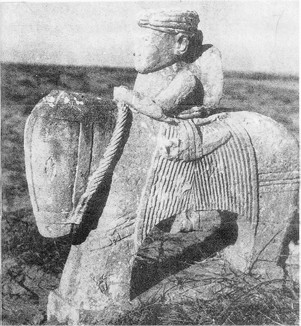
"The story is still told among the Kutchi people today. Along with it there is a slightly more sophisticated version which relates how the Sanghars, oppressed by Punvro, sought the aid of white-skinned, horse-riding foreigners from Central Asia, who stormed Padhargadh and killed Punvro.
"The Jakhs became demi-gods; images of the 72 men and one woman, mounted on horses, are worshipped to this day in Kutch. Many stories are still told of their power... The Jakhs have been tentatively identified with the Yakshas, the supernatural horsemen of Hindu and Buddhist writings, with Greeks, with Romans, with Sakas, with White Huns. Yet in fact there exists in the memorized history, passed down through many generations of the royal bards of the Jadeja dynasty, a perfectly consistent and intelligible version of the Jakh affair, which, so far as the present writer knows, is here written down for the first time.
"The present royal bard, now pensioned off, and the last of his line, received from his predecessors this account, which he repeats in exactly the same manner, without any variation in language or detail, as often as he is asked to do so.
"Early in the reign of Punvro, there arrived on the shores of Kutch 72 men and one woman. They had been shipwrecked and they landed on rafts at the anchorage of Jakhao, the name of which still preserves their style or title of Jakhs. They were tall and of fair complexion, blue or grey eyed, speaking no language which the widely travelled Kutchi longshoremen (who must have been familiar with Arabic and Swahili) could understand and they communicated by signs until they learned the Kutchi speech. It was thought they came from somewhere near Byzantium. They stayed at Jakhao for some time, where there are still many statues in their honor, and then broke up into parties of twos and threes and travelled through the countryside. They were skilled in medicine and other useful arts and they gave instructions in these to the villagers whom they met. They became well liked and were presented with horses so that they could travel about more easily.
"Their activities, and particularly their popularity, brought them to the unfavorable notice of Punvro, who arrested a party of them who were working near Padhargadh. The other Jakhs then gathered round Padhargadh and begged Punvro to release their colleagues. When he refused, they established themselves on the nearby hill of Kakabit and kept a careful watch on the King. One day, when he was bathing, they cast a missile from a powerful engine which they had constructed on top of Kakabit. This missile struck a corner of the palace and brought down some of the great roof stones on the head of Punvro. He was so badly injured that after lingering for 40 days, he died. His widow, in revenge, had all the Jakhs hunted down and murdered. The people, appalled at the massacre, remembered their good deeds, and revered them as saints, setting up temples to them in many parts of Kutch.
These temples still exist; each is set on the top of a hill, which must be ascended by flights of steps. There is at the highest level an open square enclosure, or courtyard, along one side of which are arranged 73 equestrian images. A light, generally in an enclosed lantern, burns night and day but hangs on a post, and is not set at the feet of the images, like the votive lamps in a Hindu temple. These images are replaced, as they become weathered. A comparison between the new and the older discarded examples (which are reverently stored not far away from the more modern examples) reveals not the slightest change in style, which appears to be traditional. The riders carry no arms (such as might be associated with supernatural warriors) but bear boxes and scrolls, as though they were chapmen or travelling doctors. An annual fair and pilgrimage is held near these temples.
"Who can these people have been? The royal bard knows all their names, which have been handed down to him by his predecessors; but those names are so shaped by the Kutchi dialect that there is little clue to their original provenance. The name of Sairi, the woman, and of Kakar, occur as in the popular form of the Jakh legend. That the Jakhs came from some country west of India seems certain. They may have constructed and used some form of classical siege-engine, perhaps a ballista or mangonel, which could easily throw a rock or iron-tipped beam on Padhargadh from the elevation of Kakabit. This argues some acquaintance with 10th century western warfare. Possibly they were adventurous members of the Varangian Guard which the Greek Emperors of Byzantium were accustomed to recruit from the Viking villages. But it is difficult to suppose that such fierce warriors would know much of medicine, or, indeed, would devote themselves to public instruction: they would have been more likely to look for plunder. On the other hand, Zoroastrians from the northern parts of Iran, who, during the whole of this period, were emigrating to India in search of the religious toleration which Islamic persecutors denied them in their own country, would certainly strike the Kutchis as fair in complexion. Their peaceful traditions and skill in the arts would favor the kind of behavior which the Kutchis associate with their memory, while their high level of education and learning could provide at least one member of the band with a knowledge, at least in theory, of the kind of siege-engine which could be constructed from materials — leather, iron and wood — available in Kutch at the time. The presence of fire in their temples may be another indication of their possible Iranian origin. It should be added that the Parsis of Bombay have a tradition that some of the ships bringing their ancestors from the coast of Iran to the coast of India, went astray and were heard of no more. In the absence of conclusive evidence, certainty is impossible; but a hypothetical association of the Jakhs with the series of long-continued migrations which established the Parsi community on Indian soil does not seem unreasonable.”
Incidentally, like many other historians, the writer of the above book also states: "Among them were certain chiefs of the Samma Rajputs who claim a northern ancestry, with Syrian and even Egyptian affiliation, and whose original early title of Jam is by tradition associated with the mighty Iranian monarch Jamshed.”
◆ ◆ ◆
From the archive