
Books
The journey to India
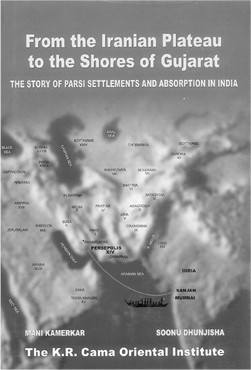
From the Iranian Plateau to the Shores of Gujarat. The Story of Parsi Settlements and Absorption in India by Mani Kamerkar and Soonu Dhunjisha. Published in 2002 by Allied Publishers Private Limited, 5, J. N. Heredia Road, Ballard Estate, Bombay 400001. Pp: xxviii+220. Price: Rs 390.
The book under review is informative for any reader who wants to get acquainted with the history of Parsi settlers in India, their social and religious customs (Chapter 8 is solely devoted to this theme), and with their achievements and contributions.
The very first chapter gives an illuminating picture of the common Indo-Iranian heritage and linkages. Although Dr Mani Kamerkar, a historian interested in Parsi history and vice president of The Asiatic Society of Bombay, and Dr Soonu Dhunjisha, reader of history at Bombay’s S. N. D. T. College of Arts are aware of the various contending theories pertaining to the Aryans (including the one which claims that the Aryans did not come into India but spread westward from India which was their homeland), they adhere to the traditional view that the Aryans entered India from a common northern home. This explains the remarkable similarity in language (Avesta is described as an ancient sister dialect of Vedic Sanskrit) and common basic teachings contained in the Gathas and Rig Veda which according to the authors are contemporaneous works composed between 1700-1000 BC. The authors highlight the many common principles enunciated in the Rig Veda and Avesta, viz. the principle of one single creator who governs on the basis of order (rta) and truth (satya) while society had natural social divisions headed by the teacher (Brahmanas in Vedic and Athravans in Avesta). Other similarities highlighted include the investiture wherein the child is received as a member of the faith. This is called the upanayana after which the child is described as twice born or ch’ija in Sanskrit, while the similar Zoroastrian ceremony is called navjote meaning new birth.
The Zoroastrians and Vedic Aryans held similar ideals and lived as one people for many centuries. Subsequently a break or rift seems to have arisen due to disputes over religious matters, and this explains why certain ancient words relating to worship in the Avesta came to mean the opposite in the Veda. The asuras are evil in the Vedas, but good in Avesta. Zarathushtra, "probably a priest of the old Aryan religion,” came in the sixth century BC and preached reform and a return to worship of the one and only divine Ahura Mazda. Zarathushtra urged his followers to abandon the degenerate practices of worshipping the elements like fire, earth, sky and water as divinities which were but the expression of the one divinity. The coverage of the Indo-Iranian heritage and linkages is fairly comprehensive and lucid and the authors correctly conclude that the question is not whether India influenced Iran or vice versa, but whether the people of these two great civilizations were one and the authors seek to leave us in no doubt that they indeed were one.
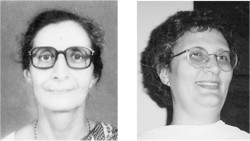
Kamerkar (right) and Dhunjisha: extremely valuable research
The second chapter takes us through the myriad and conflicting theories and accounts of the date and place of the Parsi advent into Gujarat and the Konkan coast of India. After the initial defeat of the Sasanian dynasty at the hands of Arab invaders, the Zoroastrians spent nearly a century in Iran living in refuge in the south-east mountainous regions of Khorasan and along the coast of Hormuzd. However with the rise of the Abassids, the Zoroastrians were discriminated against and economically marginalized. Their trade and professions suffered, especially with the development of new cities like Baghdad. This began a chain of migrations. The authors give a comprehensive account of the many legends, stories and records of the date and place of arrival of the Parsi refugees to India which would be of invaluable assistance to the interested scholar.
What emerges as broadly certain is that migration from Iran started around 670 AD and continued for about two centuries, resulting in Parsi settlements all along the Gujarat and Konkan coast of western India. Of all the settlements Sanjan was perhaps the most important and best known and prospered by 871 AD. The authors opine that "The leadership of the community seems to have, from the beginning, been taken up by the priests, who through discourses with the learned Brahmins established the existence of common ritual practices. The concept of ritual purity and other exclusive practices made it understandable for the Hindus to accept the Parsis as a caste group within their cultural and religious traditions.” The authors also opine that the Parsi settlers of Sanjan "probabably suffered the most” due to Muslim invasions of Gujarat around 1393 or 1405, when the Parsis true to their pledge of assimilating with the local population and loyalty to the ruler, gave "tremendous support to their local chief. Unfortunately the Hindu-Parsi defenders were ultimately defeated. There was a terrible massacre and the surviving Parsis fled to the nearby Bahrot hills with the sacred Iranshah (holy fire) and hid in the hills where they spent nearly 12 years. The authors claim that "the flight to Bahrot Hills, 20 km away and the sojourn of the Zoroastrians there is no longer disputed as preliminary explorations have uncovered possibilities of a Parsi settlement.” From Bahrot Hills, the Parsis found refuge in Vansda on the Ajmalgarh hills and stayed there for another 14 years before the Iranshah was carried to Navsari under the leadership of Changa Asa and installed there in 1419. Both the dates 1393 and 1419, Kamerkar and Dhunjisha admit are controversial, "but seem to be closest to the facts.”
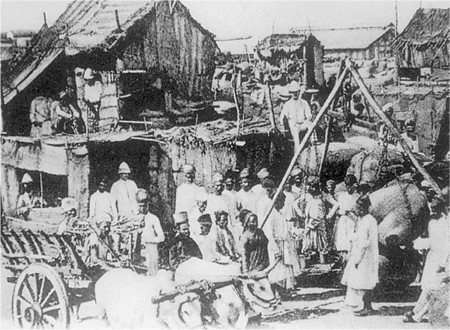
Cotton merchants weighing the bales of cotton Courtesy: Asiatic Society of Bombay
The most important settlements after Sanjan were Navsari and Surat, with Navsari becoming the first important center of Parsi religious and political leadership. We learn about the Parsis arriving in Navsari from about 900 AD and their participation in trading activities and their varied craftsmanship and occupations (especially farming, growing cotton, and "becoming the master weavers of Gujarat”) from local references, European travelers and Arab historians. The Parsis of Navsari and later of Surat are specially mentioned for their kinkhabs, tanchois and baftas. By 1100, the Parsis of Navsari had become a sufficiently united and sizeable community to ask for priests to be sent from Sanjan to serve the community. Kamdin Zarthost is believed to have consecrated the first fire-temple to be built in Navsari in 1142. The mobeds assumed the leadership of the community and became the keepers of its literary, religious and cultural traditions. The checkered history of Parsis in Navsari is well narrated and documented under the local rulers, Muslims and during the period of Maratha invasions. As other towns of Parsi settlers like Bharuch, Khambhat, Ankleshwar and Thana grew and thrived, each of these towns called for priests from Sanjan and Navsari to conduct their religious affairs. As the number of priests increased, so did the conflicts amongst them over jurisdiction, etc as also conflicts/differences between the priests and the laity began to surface.
The years of peace which had enabled the people of Gujarat to develop peacefully and prosper ended with the invasion of the Khilji rulers from the North and were followed by 200 years of continuous uncertainties, warfare and sufferings (famine, etc). It was a period of great confusion with little governance beyond military control. With Akbar’s entry into Gujarat times again changed for the better. The role played by Dastur Meherjirana during Akbar’s reign is well examined by the authors who inform us that so impressed was the emperor that he is reported to have installed a small fire-temple in the palace and put it under charge of Abul Faz’l, and, that he even donned the Zoroastrian sudreh and kusti for a very short time and later removed them only on his mother’s behest. The authors significantly observe, "This investment of sudreh and kusti if true, belies the fact that the Parsis did not convert people to Zoroastrianism. No doubt during the early days, quite a number of such conversions must have been made.”
Having established the holy fire (Atash Behram) in Navsari the life of the community became very stable and Navsari became the center of the Parsi community. Its head priest acquired precedence and authority over others and came to be recognized as the head priest of all the panthaks. The members flourished as landlords, traders, money changers, merchants, ship-builders, toddy sellers, weavers and artisans and even vaids (physicans). Parsis were also found amongst the talatis, patels and desais during the Sultanate and Mughal period.
With the coming of the Europeans we find that from the beginning, the Portuguese, Dutch and English employed Parsis as interpreters (dubashs) and agents (shroffs). It appears they were always close to those in power and succeeded in becoming a part of the administration.
As the power of the Parsi laity increased, thanks to economic trade, enterprise and prosperity, they began to demand a separate identity for themselves and not let the priests enjoy an unchallenged monopoly in all matters of social life. This factor was responsible to a great extent for loosening the community tie. Thanks to the internecine warfare, the Sanjanas decided to take the holy fire out of Navsari to Bulsar in 1740, stayed there for two years where they were given a warm welcome and then took the holy fire to Udvada where it has found a revered place up to now.
With the growth of Surat and then Bombay as centers of commercial and economic importance, Parsis began to migrate to these towns. The various crafts and industries continued to flourish in Navsari till the imperial economic policies of the British destroyed the indigenous industries in Gujarat as elsewhere. Commercial transactions began to be conducted more and more from Surat (described by the authors as the city of gold) which overtook Navsari as the premier Parsi center in the 18th century. The authors also have a chapter each devoted to three other Parsi settlements of Bharuch ("A Known and Welcome Refuge”), Khambhat ("A Once Thriving Entrepot”) and Bilimora, whose development from a village to a prosperous town is well detailed. Interested readers will find a rich collection of history and data in each of these chapters. The chapters dealing with the settlements could have been made more readable by avoiding repetitions and paying less attention to many "petty” details.
The authors conclude with the advent of the Parsis into Bombay. The migration towards Bombay was not only the result of the shift of the East India Company’s headquarters from Surat to the harbor city of Bombay, but also due to a general economic decline brought about by the breakdown of Mughal rule in Gujarat in the early 18th century which had created conditions of uncertainty around the gulf of Khambat and the "traumatic” Maratha incursions into the Gujarat towns of Surat, Navsari and Gandevi. The first few Parsis migrated as agents, contractors and shop-keepers in the Fort area. When the British established a mint, dry-docks, a court of justice, printing press and a local panchayat, again, the major group to take advantage of these facilities were the Parsis. As Parsi sethias began to amass wealth and attain a high status, they also took time to make Bombay a better place for all to live in. Their social service and charities soon became legend. The Parsis of Bombay were also the first to take advantage of English education and thus take the initiative in entering new professions like journalism, law and medicine. As the power base of the community shifted from wealth to education, they also began to acquire a position and role of significance in the area of political authority and governance. The names of Dadabhai Naoroji, Dinshaw Wacha and Pherozeshah Mehta are now part of the well documented history of India’s demand for constitutional self-government. The year 1905 was a turning point in the history of India’s industrial development. Reacting to the call of Swadeshi (economic nationalism), several Parsis responded by starting enterprises. Many of these collapsed, but many also survived. The notable success, to mention a few, were the Tatas, the Godrejs, Davars, Wadias...
The book ends with a sketchy reference to a few Parsi achievers in the post-Independence era in the fields of Hindustani and Western music, science and nuclear physics, and others. The concluding paragraphs of the book also has a one line comment on Parsi achievers abroad: "The Parsi diaspora abroad has achieved leadership in various fields the world over as well.”
The value of the book is enhanced by the photos (in color as well as in black and white) inserted at the beginning and middle of the text. No doubt, such books can be written regarding all the communities that progressed immensely especially after the advent of British rule in India, like the Banias, Marwaris, Jains, etc. The volume under review is the outcome of the painstaking and extremely valuable research undertaken by the authors at the behest of the K. R. Cama Oriental Institute on the occasion of its platinum jubilee celebrations from December 18, 1990 to December 18, 1991.
◆ ◆ ◆
From the archive