
Professions
Nailing the art
Leading nail technologist Scherezaad Panthaki’s clientele ranges from homemakers to celebrities
Are you embarrassed about your ugly, bitten nails? You may have tried your best to grow them, but you can’t, and are always dreaming of having long, healthy, stunning ones. Scherezaad Panthaki, too, had very bad nails before she qualified as a nail technician.
After Panthaki passed her Standard X, the family went for a holiday to Phoenix, Arizona in 1999. While glancing through a newspaper, her mother Sanober came across an advertisement of a nail technology course conducted by the University of Nail Technology in Arizona. "It was a six month — 12 hours a day, six days a week — intensive and extensive training program on nail and skin biology, nail disorders, etc. We had exams every week. We also had practicals where we were shown how to make forms, sculpt fake nails and art work (open hand painting/making designs on nails). Nail art is done to make the nail stand out amongst all the other nails. Hence, it’s done only on a maximum of two nails on each hand. We were also taught manicure and pedicure,” recalls Panthaki. Sanober and her second husband Srinath Rao stayed in Arizona in a rented house till such time Panthaki finished her course, became a licensed nail technician and practiced the technology there for the next six months. Panthaki says with love and gratitude: "My dad Srinath used to drop me to the University of Nail Technology and pick me up every day without fail.”
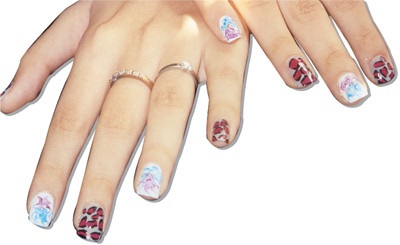
The family then returned to India and Panthaki slowly but surely made a name for herself. She is now well settled. On an average, she gets 22 clients a day, but, if they need nail extensions, then she can cater to only five clients as it takes three hours to work on a set of fake nails. She has named her services "paaws’nclaaws” (e-mail by the same name) and has assistants (whom she has personally trained) to assist her during fashion shows and other events. She has been part of the Lakme India Fashion Week and freelances for beauty parlors.
Her clients belong mostly to the fashion and movie industries: Pooja Bedi and Achla Sachdev (actresses), Alisha Chinai ("my best friend”), Tanaz Currim ("she used to baby-sit me when I was small”), Anusha Dandekar (an MTV VJ), Diandra Soares, Binal Trivedi and Suchitra Pillai (models), Anaida and Sunita Rao (singers) to name a few.
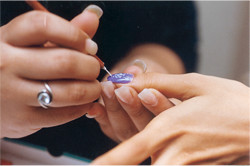
Panthaki explains nail technology in simple terms: "Nail extensions or fake nails are a Korean art form. Nail forms are intended for use as a structural support for the sculpting product. There are many types of forms available. The three most common are the horse shoe, the extended foil form and the reusable foil form. I stick the nail form (looks like a stick) under the natural nail. This forms a base to work on. I then use any sculpting product (chemical) of the client’s choice — gel, acrylic, fiberglass, silk wraps, etc. The popular ones are acrylic and gel. In case of acrylic, there are two chemicals — liquid and powder, which, when blended, form a little ball of wet powder on the brush, which I place on the nail near the cuticle. I start forming or building an entire nail over it. Once the nail is formed, I wait for it to get hardened, remove the stick and you have a ready nail, which is then filed (for shaping), buffed (for a smooth finish), polished and painted. If the client desires, I then do nail art by drawing a fancy design on the nail.” Nail extensions have a different texture. They are slightly thicker than natural nails. But, if done in a professional manner, they look natural.
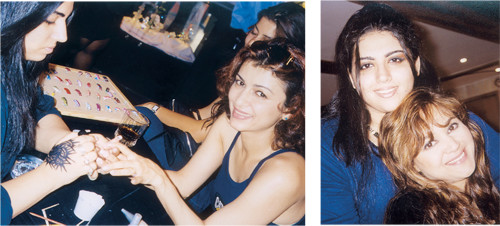
Panthaki (left) working on Anaida’s nails and with Chinai (right)
There’s another nail technology called tip application: "Tips are a popular choice for accomplishing nail extensions. Using tips are ideal in the initial stage, as these pre-cast plastic extensions require minimal sculpting and shaping. Sometimes, a client can have an allergic reaction to sculptured acrylics, but may still want her fake nails done. Then, tips are the only choice of nail extensions. Use of tips gives a nice, temporary set of nails. However, for more stronger and permanent treatment, it is better to cap them with acrylic or gel.”
Nail extensions last for six months to a year. Panthaki clarifies: "If one has to perform household chores, the nail art may remain, but the nail polish may get chipped off.” But then, this would be the case even with natural nails. A touchup is needed every month: "As the nails grow out, a gap is seen between the cuticle and the fake nail which needs to be filled. To close that gap, I do fill-ins for my clients once a month.”
The advantages of nail extensions are that "you have a whole set of long, beautiful nails in a matter of just three hours! Nail extensions also help grow your natural nails. Your nails don’t crack or chip that often and they have a classy finish.” The only disadvantage is that "if it’s not done professionally by somebody who is trained in each and every aspect of nail technology, it can lead to fungus, nail disorders and you can lose your nails for life! Abroad, it’s different; you have to be qualified and you need a license to work as a nail technician.” She does not find any Indian brand up to the mark and uses imported, "professional brands” such as Sally Hansel, Red Earth, Mac, Christian Dior, Schisedo, etc: "The products are very expensive. To have them shipped by my Los Angeles dealer from America, London, Hongkong, costs me a bomb. Yes, if ever India starts manufacturing world-class cosmetics, then this technology can become affordable for the middle-class as well.”
Familial support
Her early years were spent in Trinidad and Tobago. She studied at the Nelly Beilly Preparatory School and later, the Blackman’s School, University of West Indies. When the family decided to return to India and stay with Sanober’s parents at Cusrow Baug, Panthaki was admitted in Standard III at the Fort Convent School where her mother and maasi (maternal aunt), Pervin, had also studied. "When I first came here, I missed Trinidad a lot. The friends here were not genuine. Also, the climate of Trinidad was far more pleasant with green-blue waters, white sand, rains — just like Barbados and Bahamas. I missed my close friend, Anisa Farabi. I got in touch with her only recently through the Net... In my school at Trinidad, I studied Spanish and English as languages. Back in India, I found it difficult to cope with Hindi, Marathi and Mathematics. I failed in Standard VI,” reminisces Panthaki.
Missing her "extremely religious” maternal grandmother, Dhun Dali Dastur, who died a few years ago, Panthaki feels that some of her grandma’s good qualities, especially her generosity, have brushed upon her as well. "I am indeed lucky and grateful to be born a Parsi. I have a lot of non-Parsi friends. When I look at other religions, I feel that Parsis are more honest, open, free-spirited and don’t have many restrictions. If I were ever given a choice in my next birth. I would like to be reborn a Parsi,” says Panthaki who derives a lot of inspiration from Ahura Mazda and has great faith in the late Nadirsha Aibara and the late Kookadaru Saheb. She respects "the decision of the high priests and prefers to go by the rules” whether it concerns intercaste marriages or dakhmenashini or any other issues concerning the Parsi community.
The nail technician is grateful to her mother, a beautician, for "teaching me a lot of things,” to her father Yazdie, a manager with Air India with whom she is in regular touch, for "teaching me the right English diction,” her late grandmother Dhun for "giving me the good qualities” and to her dad Srinath, former owner of Caribean Insurance Company Limited in Bombay for "inspiring me, for he himself has gone through a lot and has come up the hard way.” Her elder brother Kaizaad works as flight purser with Jet Airways.
But there’s one more surprising facet to 21-year-old Panthaki’s life. Singing being her hobby, she renders songs of popular bands and solo artistes (Eagles, John Denver, Elvis...) for Not Just Jazz By The Bay, Red Light, CO’s Bowling Company (Sports Bar) and Tian Restaurant. Currently, she is learning the piano from Banoo Kanga and the guitar from her uncle Sharukh. After nurturing nails she plans to groom her voice: "I want to gather enough money to go abroad and study music; take vocal training... Entering the field of nail technology was a fluke. I would have been a singer had my mom not come across the newspaper ad in Arizona...”
◆ ◆ ◆
From the archive