
Law
Adoption not an option
The Bombay High Court judgment on adoption by Christians is distinguishable in the case of a non-Parsi child adopted by a Parsi
Adoption is an area in which we Parsis really need a personal law. The community is fast dwindling and that results in an alarming situation calling for urgent measures. The present population of Parsis in India is just above 76,000. The birth rate as compared with the death rate is extremely low. This has assumed greater and greater importance in the community, necessitating urgent action in the matter. The earlier, the better.
In the absence of any law regarding adoption by Parsis the matter is left to be governed by the case law or decisions of the courts on the subject. At one time there prevailed amongst Parsis a custom of taking a palak (adopted) son. But that custom soon became extinct, specially after a decision of the Bombay High Court in 1929 holding that although in the Baroda state a custom prevailed among the Parsis of taking a palak son, such custom could not be recognized in respect of succession to immovable property in British India. The Bombay High Court held in 1998 that the Parsi community does not have any right to adopt children. It is thus authoritatively laid down by the High Court that the custom of adoption does not prevail among the Parsis residing in India.
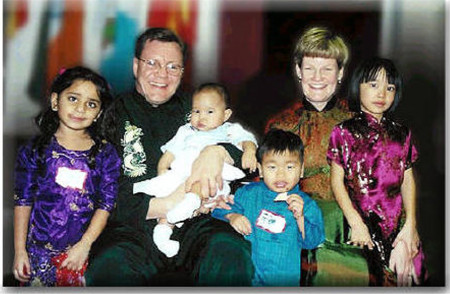
Meaningful consensus on adoption required Photo courtesy: Children’s Hope International
We Parsis have no general law of adoption in India despite repeated representations primarily for the reason that Muslims (the largest minority in India) by religion oppose adoption, since it is prohibited by the Koran, stating that the personal law of Muslims does not recognize adoption as a mode of filiation. Parsis anxious to adopt a Parsi child find it extremely difficult to find one (specially a male). This has left them with no alternative but to adopt a non-Parsi child. Such adoption gives rise to several problems.
In the landmark judgment in Soonoo Tata’s case (1909) the Bombay High Court held that the Zoroastrian religion not only permitted but enjoined the conversion of a person born in another religion and of non-Zoroastrian parents. But relying on ancient usage the Court held that the well-established usage overrides the tenets of religion "as are shown to have fallen into desuetude and conflict with ancient usage prevailing in the community.” It is a long-standing custom and usage prevailing in the community that conversion or proselytization to the Zoroastrian religion is not recognized by the community.
Article 26 of the Constitution of India confers on all persons (including Parsis) a fundamental right to freedom of religion or religious practices including freedom to manage religious affairs. This right is subject to public order, morality and health. It is well established that a Parsi can only be a Parsi by birth and cannot be a Parsi by conversion or absorption, e.g. adoption. Hence a non-Parsi child adopted by a Parsi will not automatically become a Parsi (i.e. a Parsi Zoroastrian). Consequently such a child would not be entitled to enjoy rights and privileges available to a natural born child and other members of the Parsi community.
Having regard to the directive principles of state policy regarding the uniform civil code for the citizens throughout India as contemplated in Article 44 of the Constitution, the Adoption of Children Bill, 1972 was introduced in Rajya Sabha on June 1, 1972. The Bill was to apply to all communities including Muslims who had some reservations in the matter. However, a strong lobby of Muslims in Parliament opposed the Bill with the result that it was subsequently dropped by the Government.
Another opportunity to have a general law on the subject arose when the Adoption of Children Bill, 1980 was introduced in the Lok Sabha on December 16, 1980. It was to apply to all communities except Muslims. At the instance of the Bombay Parsi Punchayet (BPP) a resolution amending clause 14 of the Bill (dealing with the effect of the adoption order) was moved by me and passed unanimously at a meeting of the Samast Anjuman held by the trustees of the BPP in Bombay on August 28, 1981, whereby an adopted child would have the same rights as the natural born legitimate child for all purposes other than purposes which are wholly of a religious nature. Soon thereafter a sharp divergence of opinion arose in the community. As a result this Bill was also dropped and never revived. The golden opportunity of having a general law on the subject was thus lost to the detriment of the community.
In 1999 the Bombay High Court gave an important judgement regarding adoption by Christians. The Court held that in the absence of any general law regarding adoption, persons who have taken a child in guardianship under the Guardians and Wards Act, 1890 will have the right to move the Court to adopt that child. It further held that the legal consequence of an order for adoption passed by the Court will be that the personal law of the adoptive parents will apply to the adopted child whose right to inheritance will be the same as of the natural born child.
Principles laid down in the above case will, so far as may be, be equally applicable to adoption by Parsis. This is no doubt subject to the personal law of Parsis as adoptive parents, which will be applicable to the adopted child, whether a Parsi or a non-Parsi. As observed earlier, a non-Parsi child adopted by a Parsi pursuant to the adoption order passed by the Court does not become a Parsi and cannot therefore claim the estate of the deceased parent on intestacy (dying without leaving any will). The decision of the High Court regarding the right of the adopted child to inherit the estate of the adoptive parent is thus distinguishable and will not be applicable to inheritance by a non-Parsi child adopted by a Parsi dying intestate. Such a child can succeed to his estate only if a bequest is made to him under the will of the deceased parent.
Though the adoption order virtually assimilates the position of an adopted child with that of a natural born child to the maximum extent possible, it cannot affect the well recognized custom of the Parsi community against conversion.
As observed above in the celebrated Soono Petit’s case the Bombay High Court held that the Zoroastrian religion not only permitted but enjoined the conversion of a person born in another religion and of non-Zoroastrian parents.
However relying on the ancient usage and the resolution passed by Parsis in Bombay at a public meeting held in 1905 expressing strong disapproval of any conversion in the present times and resolving henceforth not to admit even the children of Parsi fathers by alien mothers, the Court held that this well established usage must override tenets of the religion which are shown to be in conflict with such ancient usage. As a non-Parsi child adopted by a Parsi cannot on adoption become a Parsi, the child cannot be taken into the Zoroastrian faith by performing his navjote ceremony, since that would amount to conversion of a non-Parsi child into the Zoroastrian religion which is not permissible under the long-standing custom against conversion. I may add here that cases have reportedly arisen where the navjote of an adopted non-Parsi child whose parents are not known has been performed and such child has been taken into the Zoroastrian faith in a clandestine manner, though that amounts to conversion and goes against the long standing custom against conversion as aforesaid. To avoid such incidents law should provide for registration of navjotes just as marriages of Parsis are required to be registered under the Parsi Marriage and Divorce Act, 1936.
The child cannot on attaining majority have the marriage with a Parsi solemnized by undergoing the ashirvad ceremony under the Parsi Marriage and Divorce Act, 1936, which applies only when both the spouses are Parsis. Persons belonging to different religions, castes or communities have their marriages solemnized under the Special Marriage Act, 1954 without renouncing their religion. Inter-caste marriages (known as civil marriages) almost invariably take place under the said Act. Further the child cannot claim any right or benefit under the trusts or schemes relating to atash behrams, agiaries, dar-e-mehers, baugs, dakhmas, aramgahs, cemeteries, etc meant for Parsi Zoroastrians only, nor can the child similarly participate in religious ceremonies meant for Parsis only, e.g., jashan, afringan, geh sarna and uthamna ceremonies. Similarly a behdin child adopted by an athornan will not on adoption automatically become an athornan.
All these disabilities create an embarrassing situation for an adopted child being a non-Parsi vis-à-vis the adopted child being a Parsi under the personal law applicable to Parsis. A general law on the lines of the Adoption of Children Bill, 1980 proposed to be amended as aforesaid will simplify the procedure regarding adoption. However, it will not be much useful unless the personal law of Parsis is amended with a view to removing disabilities referred to earlier. The policy of the Government of India is not to interfere in the personal law of any minority community unless the community itself asks for an amendment. However, this can only be done if there is a meaningful consensus, if not unanimity, in the community. Some people would like to move the Court for the purpose. I would not, since that will split the community in India which is already greatly diminished. We must wait for a meaningful consensus on the subject. It will all come in time if the community is to survive. It will not be in my lifetime but hopefully it will be in the lifetime of some of the readers of this article, since all customs are not eternal and ancient customs in modern society are fast changing. Parsis settled down in the USA, Canada, etc have shown the way quietly and unobtrusively regarding reforms in the community.

Rustom S. Gae, a former law secretary to the Government of India, is presently a senior advocate practising in the Supreme Court of India. He is known for his expertise on subjects relating to fiscal laws, company law and constitutional law. He writes frequently on legal issues pertaining to the community.
◆ ◆ ◆
From the archive