
Cover Story
Contours of a community
The emphasis at Poona’s Third World Zoroastrian Youth Congress was on “communitarianism,” rather than controversy
The country has probably the largest concentration of Zoroastrians in the golden season of life, but a World Zoroastrian Youth Congress arrived in India 10 long years after the first one, held in 1993 in California, USA, followed by the second one in London in 1997.
The venue for the Third World Zoroastrian Youth Congress (3WZYC), the first in the new millennium, was appropriately enough Poona, the city with the largest Parsi/Irani population in India after Bombay. The pensioner’s paradise and laid-back colonial cantonment of the 20th century has recently metamorphosed into a yuppie (young upwardly mobile) town, hurtling along the expressway of infotech, biotech and BPO (business process outsourcing), with malls, multiplexes, rattly rickshaws and daredevil drivers, the scream of Sukhois from the nearby air force base an occasional overhead accompaniment!
The five days (December 27-31, 2003) of discourses, deliberations and of course dance saw, in the words of BPP (Bombay Parsi Punchayet) chairman Minoo Shroff, "a bright, attractive assemblage” of 530 delegates from USA, Canada, UK, Germany, Middle East, Hongkong, Australia, etc and from Indian metros like Calcutta, Madras, Delhi and Bombay to smaller towns like Ahmednagar, Jalgaon, Dahanu, etc.
The Congress venue was the five star Taj Blue Diamond decorated in festive finery for the Christmas season. In keeping with the colorful character of the community, the images and impressions were varied — thoroughly modern Millies in tank tops and spaghetti straps, the demurer ones in salwar-kameezes, lasses with lustrous hair (and Parsi noses!) in gorgeous garas and backless blouses, boys in faded blue jeans almost unrecognizably transformed on the last day (theme night) into crisp, white dugli-clad gentlemen!
And amidst the pontification of the pundits on stage came the occasional anesthesia of boredom induced by repetition, the surreptitious smoke of a youngster while waiting for the buses to arrive, the small, private group discussions which sought to sift fact from fiction, embellishment and conjecture.
The inauguration function on the evening of December 27 (after the registration for delegates, minors and patrons and games to break the ice which occupied the greater part of the day) saw 21 priests, including delegate mobeds, led by Ervad Eruchshaw Dastoor of the Sir J. J. Agiary perform a jashan in the arboreous Garden Court of the Blue Diamond. The youngest mobed, 11-year-old, cherubic Ervad Shahyan Dastur who lives in Dubai, then presented a brief description of the jashan ceremony — the symbolism of the metals and implements used, the role of Amesha Spentas, Yazatas, etc. "You must be wondering, do I understand the prayers, or do I recite mechanically,” he stated. "I don’t understand everything, my eyes water with the smoke, I do get distracted by the talking of people around, I sometimes look longingly at the malido which I love... but I love the chanting, I feel a sense of calmness and an inexplicable feeling of goodness...” The humbandagi that followed saw the mobeds out of sync — while some were on Yathas, others were on Ashems!
In perfect communion with lyric and melody, however, was Poona’s Soonu Doctor and her young Zoroastrian choir whose mellifluous rendition of Yatha Ahu Vairyo carried the serene intonations of the prayer on wings of song.
Sarosh Palkhiwala, the president of the 3WZYC who is also the president of FOZYA (Federation of Zoroastrian Youth Associations of India), welcomed the chief guest, London-based entrepreneur and chairman of Verity Recruitment Group Shernaz Engineer, the guest of honor Dr Cyrus Poonawalla, chairman of the Poonawalla group of companies, and the host of dignitaries and delegates. "We hope the different streams of thoughts, words and deeds will channelize to form a beautiful tapestry that will warm our hearts,” he said. Palkhiwala expressed special appreciation to Poonawalla, his wife Villoo and son Adar for their sponsorship of the evening, including dinner.
Taking the delegates "on the swings and roundabouts” of her business career, Engineer’s inspirational speech aimed to ignite the spark of entrepreneurship in the youth. She related how she came to London from Pakistan at the age of 16. "I was to study medicine but failed my entrance exam. It was the height of the swinging ’60s and I spent a lot of time at college having a really good time! I got chucked out of college and my father said, ‘Either come back to Karachi or get a job in London.’ So I got a job.”
Working for a recruitment agency, she spent long hours sitting at the phone and calling people endlessly. "Persistence pays!” she said smilingly. "My best client is one I got after five years of calling!” Being of Indian origin had its subtle roadblocks and she decided to branch out on her own in 1993 when Britain was in the midst of a recession!
But no bank, including her own where she had been a customer for 20 years, would lend her the funds. Borrowing money from an individual at 30 percent interest, she paid it back within two years. When her previous employers sued her for taking their clients, the arbitrator’s award required her to pay 30 percent of her gross profits for the first year to them! "I virtually worked on my own for two years... I twice had to pawn my jewelry.”
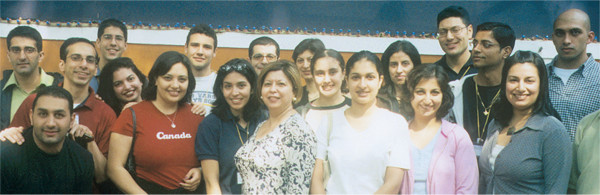
London’s Shernaz Engineer (center) with delegates from abroad
Photo: Hilla Guzder
In 1995 she took a calculated risk to diversify into teacher recruitment which is now "the biggest division in the group. It turns over many millions. We now have recruitment offices in Australia and South Africa. It is absolutely essential to look for new trends and markets... Remember you are only as good as your next order, not your previous one.” Verity Recruitment Group now encompasses legal secretarial, multilingual staff, teachers and IT (information technology). "On December 8 we acquired another education agency. But we see a threat to this from yes, India. A huge amount of administrative work is being outsourced to India and that means less staff will be recruited in the UK. To make sure we have another income stream, we are now in partnership with two typing bureaus in Bangalore where we send legal typing to them through the web to be typed and sent back to our clients in the UK,” she narrated, exhorting the youth to never take shortcuts and never compromise on ethics. "To me, business is fun,” she said, "the stress is of your own making.”
Poonawalla’s announcement that he "would be happy to fill up the entire deficit of the Congress, whatever it be” was greeted with loud cheers. "I believe more in action than words. I’ll limit myself to just say that it is very good that the Congress is being held in Poona. It has given us an opportunity to host today’s function and mingle with delegates from all over the world.” Poonawalla especially commended Navaz Palkhiwala (Sarosh’s wife) who was on the organizing committee for her "untiring efforts to motivate us to sponsor this evening.” Villoo presented silver mementos from the family to each delegate at the Congress.
Reading out a message from Meher Amalsad, chairperson of the First WZYC, was delegate Dinsha Mistree who is a student in Boston: "This Congress offers a platform for our Zarathushti youth to express a rainbow of thoughts from all seven continents of the world. But within the spectrum of these beautiful colors, everything will not always be in black and white. Sometimes it may put us in the gray area... The Congress theme, ‘Rekindling the spirit,’ fits very well with our Zarathushti tenets of good thoughts, good words and good deeds... together we can strengthen the ‘unity’ that resides in the word ‘community.’”
Carrying greetings from Kerman Jasavala, chairman of the Second WZYC in London, was delegate Farmeen Kapadia who is the chairperson of Young Zoroastrians in the UK, an arm of the Zoroastrian Trust Funds of Europe (ZTFE): "Congresses provide an outstanding platform for delegates to listen and form their own opinions. I urge you all to listen and seek to understand before seeking to be understood... Exploit all methods of communication... (but) it is now easier for half truths and gossip to find an audience. We need to unite and act quickly when such situations arise... if we are to stop our great religion from dividing and our community from fragmenting...”
"The organization of this Congress has entailed an enormous amount of work,” stated Shroff, commending the entire Congress committee including its young secretary Behafrid Patel and joint secretary Zenia Vajifdar, who is also the president of the Zoroastrian Youth Association, Poona. The BPP provided the seed capital of rupees five lakhs as well as administrative support, but the raising of sponsorships and resources was the task of the Congress steering committee with treasurer Tehmas Bharucha, who is the branch manager of The Zoroastrian Co-operative Bank Limited in Poona, controlling the purse strings.
"We must network globally,” asserted the BPP chairman. "Ideas and initiatives must come from the youth. The rate at which our numbers are going down is disturbing. The density per flat in our baugs and colonies is fast declining from six per flat to three or four now... Many of the trusts have second thoughts about pursuing new housing projects or expanding existing ones, at least in Bombay... Studies have shown that large numbers of families with spacious accommodation have contributed little to growth of population. Jamshedpur is a case in point — the Parsi population has shrunk to half despite ample accommodation.”
Parsis think it is their "god-given right” to be provided accommodation by the Punchayet, Shroff lamented. Earning levels have increased seven-fold in the last decade and housing loans are readily available. Do not look only to downtown and midtown areas, Shroff advised. Move to the suburbs — young couples of other communities cope with this, he stressed.
The BPP chairman also bemoaned the reluctance of Parsi youth to enter the IAS (Indian Administrative Service), IPS (Indian Police Service) the defense forces, or to hold civic or elective office. "There is only one Parsi MLA (Member of the Legislative Assembly) in the whole of Maharashtra, and just one nominated member in Parliament (Rajya Sabha). "We have no political clout worth the name... Who’s going to fight for you? Entering into elective office is a tough but imperative task.”
In a brief vote of thanks, Poona Parsee Panchayat (PPP) chairman Dara Irani spoke of the pride he felt at "this mega event” being held in Poona and commended the steering committee who worked "tirelessly for one year to put together this herculean task.”
As night claimed the day, the youngsters of Poona took center stage (see "The five-day flavor!” pg 43) with their "feel good factor” — a fashion show and candle-lit finale, rounded off with cocktails and a delectable dinner sponsored by Cyrus Poonawalla.
The four days that followed brought young and old speakers to the podium, despite the fact that the event was a youth congress. Among the information that brought cheer to many an outstation heart was the announcement by Ervad Zubin Writer of London that if Zoroastrians in places where priests were not available required a navjote/wedding, etc to be performed, "we have priests who will fly anywhere, at no cost to the family.”
Young Arnavaz Daruwalla of Poona received enthusiastic applause for clearing the Service Selection Board’s interview and medical tests for induction into the Indian Army as an officer. Awaiting the release of the merit list, Daruwalla would, if selected, join the Officers Training Academy in Madras as an officer on a five-year commission, extendable by another five years. She would become, as per General (Retd) Adi Sethna, the first Parsi woman to join in the 11 years since the services were opened up to women in India.
Topics like "Empowerment of youth in community affairs,” "Do changing times justify changes in approach to religion,” "In what way can the Zoroastrian youth spread religious knowledge amongst the younger generation,” "Heads of youth organizations: Where they are and where they are heading,” "What it means to be a Zoroastrian in India and across the globe,” and "Zoroastrian youth: Increasingly connected, decreasingly committed,” witnessed overlapping in scope and content. Despite their geographical isolation, be it in the vast territories of North America, Europe or Australia where Zoroastrian youngsters often do not come across other boys and girls from the community, the presentations by delegates from abroad showed their independent-mindedness, interest, confidence and commitment to their community.
Around the world
Sherazade Mehta, who lives and works in Boston, has been actively involved for five years with ZYNA (Zoroastrian Youth of North America), which is a standing committee of FEZANA (Federation of Zoroastrian Associations of North America). "The FEZANA executive has recently announced the new ZYNA co-chair team of Afreed Mistry (representing Canada), Freyaz Shroff (representing the east coast of the USA) and Negin Sharyari (representing the west coast of the USA) and I am very pleased to inform you that all three of them are present at this Congress.” Mehta is the out-going co-chair, having represented the east coast. "ZYNA is committed to holding a North American youth congress every alternate year,” she said, the last one being the Ninth North American Zoroastrian Youth Congress (9NAZYC) in July 2003 in Canada and the next one coming up in 2005. Some of ZYNA’s past activities include cruises to the Bahamas and Mexico, ski trips, white water rafting, a trek in the Grand Canyon and a camp in the Yosemite National Park. "A start-up amount of US $ 5,000 has been transferred to the FEZANA/ZYNA Performing Arts Scholarship Fund, for young Zarathushtis who wish to do further studies in the field of music, drama, singing, etc,” she stated. ZYNA has presented four young people with partial funding to enable them to attend the Poona Congress and will also make donations to the WZO (India) Youth Wing and to the 3WZYC. ZYNA had also earlier contributed to the Afghan Children’s Fund, Mehta said.
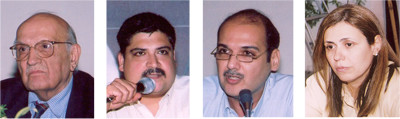
From left: Adi Sethna, Noshir Dadrawala, Jehangir Bisney, Bapsy Dastur
Afreed Mistry of the ZSO (Zoroastrian Society of Ontario), Canada, noted that theirs is the largest Zoroastrian community in North America, with 5,000 Zoroastrians and increasing on a monthly basis due to immigration. "We have a very large number of kids and youth and this year an alarming 150 kids (between 6-14 years) registered for the Sunday school religious classes. We are looking to increase the size of our darbe meher to suit the size of our community.” The ZSO youth organized the 9NAZYC which was attended by over 400 delegates. "All session chairs and moderators were youth, 80 percent of speakers were youth,” she stated. "Youth need to be given responsibility, opportunity and freedom to run congresses in future.”
"Our (ZYNA’s) primary focus now is the organization of the 10 NAZYC. ZYNA will also start a monthly newsletter with information on religion, activities and fund raising. We will establish a mass e-mail database. We are an open-minded committee and welcome suggestions,” said Sharyari, encouraging the youth to access the website www. fezana.org
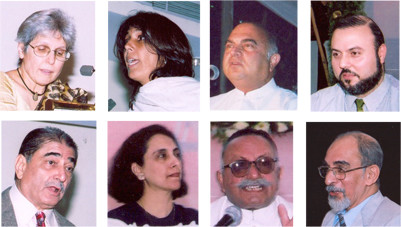
From left, 1st row: Anu Aga, Anahita Pandole, Firdosh Mehta, Malcolm Deboo. 2nd row: Behram Dastur, Behroz Guzder, Rustom Chothia, Hoshang Moogat
Sam Bapasola, who is a member of the Zoroastrian Association of Pennsylvania and New Jersey, spoke about the mobedyar training program and how he took up the offer to become a mobedyar or assistant priest. Religious classes, if started early, bring a feeling of togetherness, identity and belonging. "It gives us a sense of pride and I did not feel ashamed or embarrassed when kids saw me (with the sudreh-kusti) in the locker room,” he declared. Having learnt the correct pronunciation of the prayers, important customs and history of the religion, we can keep the faith alive, said Bapasola.
Pheroz Austin of the Zoroastrian Association of Quebec emphasized the need for a "critical mass” in numbers, and the difficulties of sustaining the momentum of interest (in the context of the North American environment). "Our association of 300 people could send eight delegates to this Congress,” he said. "We need to focus more on communitarianism (a sense of identity with the community).”
"I work with a very strong team of 10 committee members (in the UK),” said Farmeen Kapadia of London. "YZ (Young Zoroastrians) has its own separate identity. We organize talent contests, Thames cruises, quizzes, etc. Religious classes are held every third Sunday and currently 90 kids are enrolled for these classes... We have our own communication channels, funding and logo designed by Rohinton Munshi and his team.” The greatest problem, she believed, is apathy from the youth. "By being as open and accommodating as possible, YZ aims to build a strong network of Zoroastrian friends, believing that meeting socially will ensure the survival of our faith and culture.” Farmeen and newly-wed husband Cyrus and her brother Neville Sorab were part of the strong UK representation at the 3WZYC. (In several other cases too, more than one member of a family was present at the Congress).
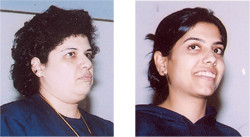
Minaish Doctor (left) and Arnavaz Daruwalla
With Zoroastrianism listed as one of the nine main religions of the UK, Zoroastrian youth have been representatives at major events, including the Queen’s golden jubilee celebrations in 2002. "Our most ambitious (immediate) project is to represent Zoroastrianism at the interfaith youth event the Westminster Council (of London) is hosting on February 25, 2004,” announced Munshi, with two specific events presented by Zoroastrian youth — a navjote ceremony and a dance which seeks to focus more on and incorporate our Iranian roots. "Interfaith helps our youngsters to appreciate our religion, build harmonious bridges with other communities, learning from them and from our own.” What we need, said Munshi quoting Elvis, "is a little more action and less conversation.”
Delara Mistry of Perth, Western Australia, touched upon the fact that Zoroastrian youth in that country are awakening. "In the past two years... we have realized that, hey, we need to network, stand up and do something for ourselves.” People’s attitudes are the biggest obstacle, and elders can be just as emotional, she noted. Access to resources, financial and physical (e.g. access to dar-e-mehers, religious information, etc) are difficult but we need to "make change happen. We need more workshops, more integration. I propose, and it may be a bit presumptuous, we have the Fourth World Zoroastrian Youth Congress in Australia. Here is the opportunity for you to visit our beautiful land... Logistically it will be expensive and coordinating will be a big issue. Everyone’s saying Melbourne, I say come to Perth!”
Zarathushtis in Iran are "facing restrictive political policies. Non-Muslim communities are not allowed to expand their religion,” said Mithra Dawaliyan, who came from Tehran two years ago to study computer science in Poona’s Wadia College. Participating with ease and élan in the fashion show earlier as well as in impromptu question and answer sessions, Dawaliyan was so overcome with emotion at the thoughts of her motherland that she was unable to continue with her presentation, requesting friend and fellow Iranian Armina Kapadia to take over.
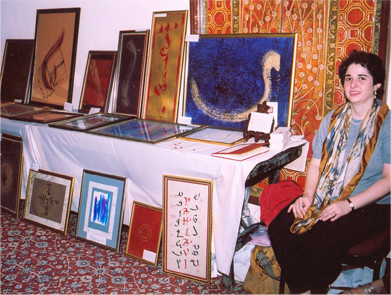
Perin Pudumjee Coyaji with her Avestan calligraphy
Armina, who came to India five years ago from Iran, is a management student in Poona’s Neville Wadia College. She painted a verbal portrait of life in Iran: "Minorities are not given all the rights, neither is there freedom of expression.” Government jobs are not open to minorities, nor can a non-Muslim, for example, become a pilot. "Boundaries for us are very small, but Zoroastrians have done a very good job so far of preserving our culture and history.” In Tehran there are eight schools, open to all, headed by
Zoroastrian trustees or committees, "which is an amazing quantity considering a politically restrictive place like Iran.” There is an active students organization, she said, which publishes reports and newsletters, holds Gatha classes, music classes teaching all the local instruments, sports meets, etc. Though loud music is prohibited, "we have our own places” where the police is not so strict and where the ubiquitous dress restriction can be somewhat relaxed. The elders have encouraged their youth and "we hope to be able to host something internationally, maybe a conference such as this in future.”
Also at the conference as part of the Poona organizing team and enthusiastic volunteer on site was Rostam Cawoosi (Zainabadi) who has come from Iran just six months ago and who is doing computer science at the Wadia College. Though there are many Iranian students in India, paying the Congress fees, even with part sponsorship, was difficult, Dawaliyan told Parsiana later. For some, fluency in the English language is a problem as well, she noted. Also attending the Congress were Goharbanoo Ormazdi and her daughter Parimah who had come from Iran to visit their relatives in India.
Seeking to provide his soft-spoken perspective of things in Tajikistan was Rakhim Rakhimov, his halting English not quite audible to all: "People are born as human beings, then they become Christian, Islamic, Zoroastrian...”
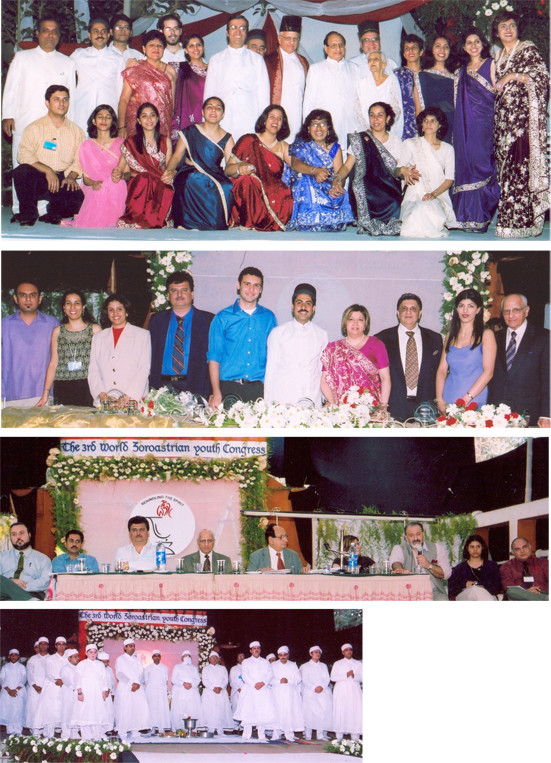
From top: Happy organizers with BPP trustees; At the inauguration (from left): Marzban Irani, Behafrid Patel, Zenia Vajifdar, Dara Irani, Dinsha Mistree, Sarosh Palkhiwala, Shernaz Engineer, Cyrus Poonawalla, Farmeen Kapadia, Minoo Shroff; At the "winding down”: Malcolm Deboo, Sarosh Palkhiwala, Dara Irani, Minoo Shroff, Dadi Engineer, Shernaz Engineer, Khojeste Mis-tree, Zenia Vajifdar, Firdosh Mehta; Humbandagi All photos by Cherag Mevawala (Dolly Photo Studio) unless otherwise mentioned
Zoroastrian youth in Pakistan have become more interested and active in community affairs of late, said Kaiyan Aga of Karachi, who along with Sheroy Irani, was part funded by the Zarthosti Banu Mandal and the anjuman in Karachi. "Ours is a secluded community. This was a chance to come out and listen to views and problems,” he said to Parsiana. It is the Zoroastrian youth who, despite the opposition from elders, brought up the topic of dakhmenashini and the proposed installation of solar concentrators, Aga told the delegates. "We convinced the elders that the youth wanted the system to work, rather than be done away with. We have now been asked to find out more details (about the concentrators)... Volunteers also help out with the greening of the Parsee General Hospital (in Karachi) and join in the cleaning of agiaries... We have to prove ourselves.” Parsis are generally respected and looked up to in Pakistan, he opined.
"There is a Parsi anjuman in Vietnam! I am the president, my wife is the secretary and my two kids are members,” quipped Khurshed Mirza who works in Vietnam and lives there with his family. "Though there is an Indian community, we are the only Parsi family. The Vietnamese do not even understand the concept of revering fire.”
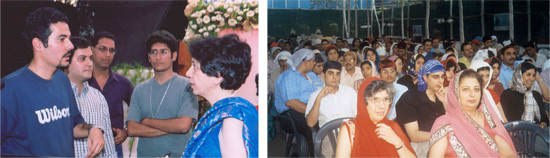
Zareen Karani Araoz (right) in earnest discussion with delegates; at the jashan Photo: Hilla Guzder
On the home front, Sarosh Palkhiwala touched upon the 16 all-India youth conferences held so far at different places in India. The youth initially used to view these conferences as a free vacation and "it was very difficult to get everyone up in the morning” (in time for sessions). Through trial and error, congresses were designed to provide a mix of education and entertainment. "Getting the right partners for our young people is a major problem and we should not run away from it,” he observed.
Vajifdar delineated upon youth activities in Poona. With regard to religion, "the direction given (by the elders) is not very clear. So many people say so many different things... there is a possibility we might split into different groups.” We must make sure we stay together, she asserted. The youth could start by reading the scriptures, try to interpret, discuss and debate. "We haven’t studied, we don’t know what’s right and what’s wrong... We should not blindly believe rituals and practices, but have a broader vision, with logical and scientific reasoning.”
Poona’s Minaish Doctor advocated a change in the attitude of the "so-called doyens and keepers of our society. I know that I would be inviting a lot of flak... The younger generation of navars and other forward thinking priests are being discriminated against... in the sense that they are not called upon when prayers need to be said and are shouted down by older, more established (priests)...” What are we doing for our priests in Udvada? Have you noticed the pathetic state they are in? she queried.
"It is wrong to say that Zoroastrian youth is less committed today,” emphatically asserted Parizad Daver from Nagpur. "The commitment of the Poona youth is proved in this Congress. In fact I see more of a spirit of revival now.”
The youth in Baroda is very active through BUZY (Baroda United Zoroastrian Youth), stated Bomi Talati. Besides organizing matrimonial meets, the education committee offers assistance to students and the youth body has even given a donation to the parent body, he stated.
In the picture
Aiming to ignite lambent flames of faith and infuse a sense of identity and pride in past glory were the audio-visual presentations and historical sketches. "The Shahnameh took 30 years to complete and I have been given 30 minutes,” quipped Ervad Parvez Bajan. "You must read Firdausi’s Shahnameh at least once in your lifetime. Of the original 60,000 couplets in poetry, around 50,000- 54,000 are remaining.” Benaifer Bhoot spoke about her epic task of putting the Shahnameh in user friendly form on compact discs.
Dr Homi Dhalla took the audience on a visual trip of the ancient cultural and heritage sites in India and the efforts of the World Zarathushti Cultural Foundation to preserve them. Feroza Punthakey Mistree’s colorful slides presented vignettes of Parsi/Iranian jashans, weddings, festivals, dress, furniture, theater, portraits and pirs (shrines). On view were traditional Iranian Zoroastrian bridal costumes in red and green; the rolled turbans; a picture of the members of the Yazd anjuman, with jama pichori and the compulsory white patch they had to wear to distinguish them as Zoroastrians; the red phetas, the clothing made from 50-60 strips of cloth held together by "teeth of a mouse stitching” because they were not allowed to buy cloth by the yard! And the advent of the Chinese pagodas and flying birds into India in the form of the garas, whose popularity remains undiminished even centuries later.
Tehmtan Davar elaborated on the trials, tribulations and achievements in Iran of his great-great-grandfather Maneckji Limji Hataria, who barely a handful of youngsters in the audience had even heard of.
Artistry and artefacts
Lining the Russet Room (one of the venues for the sessions) were colorful stalls with an assortment of goods on sale — Perin Pudumjee Coyaji’s famed and framed Avestan calligraphy, the rich detail and delicacy of garas (old and new), kors, caps and sapats from Jerry Kumana and Zinobia Schroff, beautiful bead torans, artefacts, etched glass, clothing, religious and other books, etc from Zarin Master, Navaz Palkhi-wala, Monisha Vakil, Designer Glass, Zoroastrian Studies and others, capturing the attention of delegates, patron members and invitees alike. The stalls shifted on the last day to the Sir J. J. Agiary for the ‘theme night’ where demonstrations of kusti weaving, etc were also held.
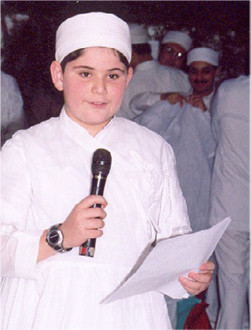
Young mobed Shahyan Dastur
Of facts and families
"It is popularly believed that cancer runs very high in the community. It is not so. Only three percent of the Parsi population died of cancer in 2002-03 (in the Bombay-Thana area for which fairly accurate statistics are available, through Doongerwadi). Cardiac failure and old age continue to be the two biggest killers,” asserted Behram Dastur, BPP chief executive, presenting his demographic profile of the Parsis/Iranis in India. Because of an above-average health standard, infant and child mortality is very low. "On all parameters, we are a healthy community, and not suffering from decrepitude as is popularly believed. The basic demographic fact remains that we are reducing (in numbers) at a faster rate than we are regenerating... one in three Parsis marries out... as many boys as girls marry outside... A major question that faces the providers of Parsi public housing is whether we should keep inter-married couples in our baugs or colonies which have a universal covenant of ‘only Parsis,’” stated Dastur, adding that in the BPP controlled baugs there are 71 known families which have performed interfaith marriages. There will be many more in other Parsi baugs and (among) those who do not live in Parsi baugs, he asserted. "The problem is not as acute in Gujarat as in Bombay, but in the metro towns this phenomenon seems to be irreversible and we cannot wish it away. The community has to address itself to this burning issue and not sweep it under the carpet.” It is also a myth, declared Dastur, "to say we are genetically superior, we are not. Of all creatures 99.9 percent have the same genes.”
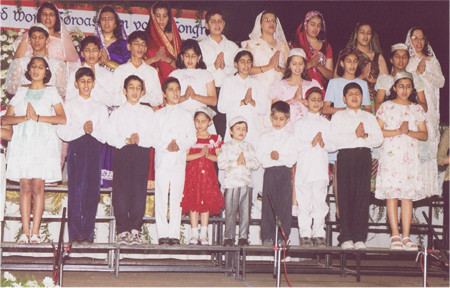
On wings of song: Soonu Doctor’s choir
With the Parsi/Irani divorce rate one in ten, well-known lawyer Armaity Khushrushahi Engineer, who has an extensive practice in matrimonial and testamentary matters, made a forceful plea for more compromise, tolerance and understanding in marriage, particularly among Parsi girls! And for parents not to interfere! "Make, not break, your marriage,” she exhorted. Every business, venture or partnership has teething problems; take the first two-three years to overcome difficulties, she advised, asserting that even financially independent women should not take the "why should I tolerate this nonsense” route without at least trying to make the marriage work through marriage counseling. "I request the BPP to set up a panel of marriage counselors,” she said.
"It is not advisable to wait till after 30 to have a first child,” prescribed gynecologist Dr Anahita Pandole, whose area of specialization covers high-risk obstetrics and infertility. "No woman is really infertile. Infertility is not a disease, 90 percent is treatable, but early diagnosis and management are important.” Pandole presented an audio-visual on cause and treatment, with step by step explanations and drawings, seeking to dispel myths from the minds of her young audience.
FEZANA president Firdosh Mehta of Alberta, Canada estimated the total Zarathushti population in North America to be 10,623 — with 3,658 in Canada, and 6,965 in USA. Large concentrations are in Ontario, California, British Columbia and Texas which make up close to 60 percent of the Zarathushti population in North America (as per the figures in the FEZANA Journal, Winter 1999 when a detailed demographic survey was undertaken).
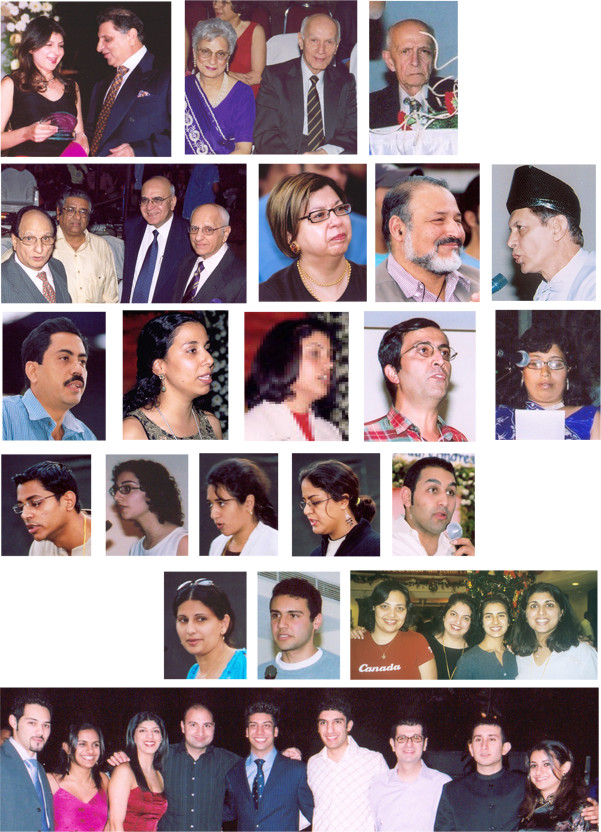
From left, 1st row: Delna and Cyrus Poonawalla; Maha-rookh and Darius Forbes; Keki Grant. 2nd row: Dadi Engineer, Dinshaw Mehta, Dinshaw Tamboly, Minoo Shroff; Shernaz Engineer; Khojeste Mistree; Homi Dhalla. 3rd row: Sarosh Pal-khiwala; Behafrid Patel; Zenia Vajifdar; Tehmas Bharucha; Navaz Palkhiwala; 4th row: Kaiyan Aga; Aysha Ghadiali; Armina Kapadia; Mithra Dawaliyan; Pheroz Austin ; 5th row: Delara Mistry; Dinsha Mistree; Afreed Mistry, Freyaz Shroff, Negin Sharyari, Sherazade Mehta, (Photo: Hilla Guzder) Bottom: Farmeen and Cyrus Kapadia (third and fourth from left) with some of the UK delegates
London’s Malcolm Deboo, the information officer of the ZTFE and co-vice chair for the Eighth World Zoroastrian Congress in the UK in July 2005, making a rough-and-ready estimation of the world’s Zoroastrian population put it at 1,35,000, taking 77,000 in India, 25,000 in Iran (not going by the Interior Ministry figures which say 90,000, but by the figures of the anjuman in Yazd), 18,000 (with fresh immigration, etc) in North America, 5,000 in UK, 3,000 in Australia, 2,500 in the Gulf, 2,000 in Pakistan and 2,000 in the rest of the world. "We have to instill confidence in the community. As an observer who works in the community, when you’re constantly told something like this (our dwindling numbers), youth lose confidence. We have to get around this,” he remarked. We have never been a community in millions. A few boatloads originally came to India; there were only 50 Zoroastrians in the UK when the ZTFE was formed; the North American community has grown from a few hundred hard working immigrants. The impact of this (emigration) has obviously been felt in India. "What you need to do now is to stabilize the economic equation so people don’t need to emigrate. The Indian economy is providing opportunities. If American and English companies are coming to India, why can’t we make money through trade, instead of emigrating? As for the falling birth rate, people in the West too are not getting married, or having no children or just one. What’s happening outside also refers to us... Reverse the decline in India and make yourself confident and self sufficient.”
The creed and the controversy
Of all the topics at the Congress, the ones probably that most brought to the fore the cadences and dissonances in the community were the talks on religion, though they did not even begin to scratch the surface by way of point and counterpoint! There was barely a meeting of minds or tussle of thought. What was on view were podium or "classroom lectures” with a largely passive audience occasionally popping up an inconvenient question!
Zoroastrian Studies founder, teacher and scholar Khojeste Mistree sought to capture the hearts and minds of religion’s foot soldiers (the youth) with his customary powerful oratory, taking them on a stirring verbal tour of the land of Aryana Vaejya and the glories of the Persian empire, as well as the theology and tenets of the world’s "oldest revealed religion... We Zoroastrians make our own destiny,” he declared. "We have one lifetime to maximize happiness and minimize pain... What you sow, you reap. Jesus died for the sins of the world. But in Zoroastrianism the link is direct — you do wrong, you’re busted for it. There is no intermediary.”
Zoroastrians do not believe in reincarnation, or in karma, he said. "Our body is the first temple of Ahura Mazda. It’s a sin to fast. Fasting and flagellation are sins. We have no sadhus or fakirs sleeping on beds of nails... We create and share wealth, Zoroastrianism is the religion of capitalists, not communists. At the allegorical Bridge of the Separator (Chinvat Pool), the soul is adjudged on its own good and bad deeds. For Zoroastrians, the realities are justice and fair play, living up to one’s commitments and contracts, recognizing rituals. "We came to India... but we did not bring the holy fire. Our forefathers walked back to Khorasan in Iran to bring back the alat (ritual implements), the sacred ash, nirang and varas (sacred hair of the bull) to enable them to make an atash behram fire. They didn’t say: ‘Let’s do something independently in India. Why bother about Iran? Let’s move, let’s change with the times!’ Today, we do not have the caliber or the number of priests required to make an atash behram fire... It takes 14,000 hours of prayers and rituals to make an atash behram fire. It takes four-and-a-half hours to consecrate a cathedral,” stated Mistree. "We treat our heritage with such disrespect. Old manuscripts are sold on the road. The sad thing is that Parsis are so gullible in getting rid of the old and bringing in the new.”
"Do we have a responsibility to the budding communities (of Zoroastrians) in Tajikistan, Uzbekistan, etc,” questioned Aysha Ghadiali of New York. Replied Mistree: "We have to look at this question (of conversion) very, very carefully. I, for one, am not keen to open our doors to conversion. Teach, yes. Share knowledge, yes. It is true that these communities were part of the Iranian-speaking people thousands of years ago, but are they flesh and blood Zoroastrians? They have been under the yoke of Islam and of communism. I want evidence — factual, scriptural material. And do you think Islam will observe this conversion (to Zoroastrianism) in a spirit of tolerance? No! We have to be very careful that our brethren in Iran are not affected. My concern is for Iran, the farmers in Iran are a hostage community. It is they who will be affected by the backlash, not the Parsis of India. The luxury of democracy does not exist everywhere... We Parsis are religious hippies compared to the Iranians who have suffered under the crushing burden of the jizya (tax on non-Muslims), the slaughter of large numbers of Zoroastrians during the Safavid period...”
In response to a question by Roshan Nanavati of Bombay as to why non-Zoroastrians are not allowed into agiaries, Mistree stated that doing padyab-kusti (untying and tying the kusti) is a ritual requirement, which a non-Zoroastrian cannot do, so it automatically precludes him from entering. "In Iran there are some fires which non-Zoroastrians can see through the filter of plate glass, but there are many other fires which even Parsis from India are not allowed to see.”
Questioned by Hormuz Mehta from Bombay as to why adoption is not allowed, Mistree stated: "Our race, our ethnicity is our ID card... We do not allow adoption, but guardianship. An adopted child cannot be a Zoroastrian as of religion... community membership is not negotiable.” On the subject of inbreeding, Mistree mentioned that we have produced stalwarts and icons like Dadabhai Naoroji, Jamsetji Tata, Sir Jamsetjee Jejeebhoy at a time "when inbreeding was rampant... We are still producing good looking boys and girls, with a good level of intellect... genetic fidelity we have maintained.”
Questions regarding girls being considered ‘impure’ during menstruation and the inequities of the boy marrying out or the girl marrying out raised, predictably enough, the decibel levels in the audience! When speaker Rustom Chothia’s answer did not satisfy the skeptics, co-speaker Behroz Guzder’s explanation that, as per norms of cleanliness and purity, even a man who has an open, oozing wound cannot go to the agiary, somewhat calmed things down.
"We are not willing to listen to the priests, or the punchayets or the scholars. Marrying out is not the right thing to do. By marrying within, you create a spiritual umbrella. Coming from the same tribe and value system, the chance of success is so much more. The divorce rate among North American Zoroastrians is as low as seven percent, the North American divorce rate in general is 42 percent... We are governed by the patrilineal law (coming from the father’s side). At one level, it (boy or girl marrying out) is unfair. But the issue is far more complex... It’s because we’re saying no that there’s all this noise. If we say yes, more and more youth will avail of this (marrying out). Is it right if I say yes? Within four generations, Zoroastrianism will be gone in that area,” stressed Mistree, adding that 12 couples came together as a result of meeting at the last WZYC in London: "I say that is paisa vasool. £ 100,000 well spent!...
"Don’t make a problem for the community, I’m pleading with you,” was Mistree’s passionate plea on the last day. "Focus that you want to marry a Zoroastrian and Ahura Mazda will create the situation and mechanics for it. Vibe it. We are a low critical mass. The community has given you so much. You have to give something back... Don’t rock the boat. We are so small.” There is no solution because "there is no mechanism to solve the problem. I would be most impressed with those girls (married out) if they created a new fire-temple with new rules. If the new system is better, the old system will automatically die out. Create two models, don’t destroy the old model which has lasted through time. But you (the intermarried) won’t put in your money. You want the community to change to suit you.”
Mission possible
Seeking to make entrepreneurship one of the assets of the Parsi armory, BPP trustee and WZO (India) president Dadi Engineer counseled the youth in the words of the English essayist Sydney Smith: "Do not stand back shivering and thinking of the cold water and the dangers that lie ahead. Just jump into the water and swim through as best you can.” At least in a modest way, young men and women can start new enterprises which may not require much capital and "grow from there,” he said, citing the examples of Shiamak Davar in the field of dance and choreography, Vispy Kapadia in karate, Tanaz Godiwalla in catering and Ervad Cyrus Dastoor in film and television serials. The World Zarathushti Chamber of Commerce, with new chapters opening in different places, the BPP Venture Capital Fund, the WZO and the WZO Trusts can help in small ways. Engineer demolished the myth that "Parsis are a blue-blooded race” and that "success is in our genes.” Do not harbor the belief that success will fall into your lap like manna from heaven. Hard work and single-minded dedication are absolutely necessary, he emphasized.
"Doing business in India is both exhilarating and frustrating,” opined Viraf Deboo, director of the family founded Albaj Engineering Corporation in Poona. With international business borders opening up, opportunities are ripe but "one should have a feel and flair” for business. "A hot head or a weak heart are not good for business,” he asserted.
Anu Aga, chairman of Thermax, one of India’s leading companies, suggested that every entrepreneur be provided with a mentor who is himself a successful professional. "You will not reach your dreams till you excel in any one area... Brand yourself so people connect you with an outstanding skill,” advised Dr Zareen Karani Araoz, president, Managing Across Cultures in the USA in a question and answer session on motivation and careers. "Human knowledge and technology in the last 50 years has taken such a quantum leap that it has surpassed all its combined efforts of over five millennia which have gone before,” observed Poona’s Prof Hoshang Moogat, retired principal of Poona’s Nowrosjee Wadia College. "This generation has been exposed as never before to not only a knowledge explosion but also an audio-visual barrage of unproportional dimensions and hence this generation does not believe in heroes or gurus and recognizes early that pedestals get dusty. I do not like to get involved in controversies but what frightens me is that the levels of tolerance are dipping sharply and fundamentalism, unheard of amongst us, is beginning to rear its ugly head in our otherwise tolerant and achieving community” said Moogat.
"...not all milk and honey”
Though every Indian newspaper ran banner headlines on the morning of the 27th about the devastating earthquake (with an estimated death toll of over 30,000) that destroyed the historic town of Bam (190 km from Kerman and 1,000 km south-east of Tehran) with its ancient fire-temple and small population of Zoroastrians, it was several sessions into the Congress that a two-minute silence was observed, an indicator perhaps of how far we are from our Iranian roots.
At the "winding down” session on the 30th, Kaizad from Bombay questioned why, though this was a Zoroastrian youth congress, there had not been a single person from the clergy or a youth as a keynote speaker. "We asked several of our Vada Dasturs, but they all declined for various reasons,” answered Sarosh Palkhiwala. "We have tried our level best.” From the panel of speakers, Malcolm Deboo voiced his personal opinion that he did not view their absence as a "detachment from the community.” They (vada dasturs) receive brickbats so often that they probably feel "hey, I’m wasting my time coming here,” said Deboo, adding that the Parsi Press too is all too often derogatory in its writings about the priests. While buying books, too, be discerning, advised Malcolm. Check the author’s credentials — digression or divergence is from people who have a set agenda, or from people who are not really qualified to write on religious subjects. "The commonality will be much closer if you use books by recognized authors.”
To a question from Navroz of Canada, Mistree stated that he saw "conversion fraught with danger... We do not have the spiritual infrastructure to support large numbers of converts... There is no evidence in history of non-Iranians becoming Zoroastrians.” At the continuation of the "winding down” the next afternoon at the Sir J. J. Agiary premises, Mistree launched a scathing attack on Ali Jafarey and his efforts to ‘convert’ people in South America and other parts of the world.
Looking at the current trends of Zoroastrian emigration out of India, Firdosh Mehta visualized more Zarathushtis by 2030 in North America. "But that is the situation today,” he emphasized. "It may not happen. The trend can change from now to 2030,” particularly with globalization and more opportunities opening up in India. "The West is not all milk and honey. You can make your own milk and honey,” said Mehta.
Parvez Bharucha from Ahmedabad voiced his cry from the heart: "Girls are unwilling to move out of Bombay and Poona (after marriage). The Ahmedabad, Baroda and Surat girls want to come to Bombay. So what will the boys do?” "In Bombay it is the mindset of parents of girls that is responsible (for this situation). They do not even want the girls to move from Dadar to Thana! ‘Does the boy have a separate home’ is one of the first questions they ask,” said Sarosh Palkhiwala. "Boys, re-evaluate your situation. In the West the wife often earns more than the husband. The man has to accept this fact in India too, as Parsi women have been highly successful, with higher postgraduate qualification,” responded Malcolm Deboo.
Sense and sensitivity
It was the one obviously jarring note that did no credit to those who participated in it, particularly as it happened in India, a country that prides itself on its democracy and freedom of speech and expression. Speaking from the podium as chief guest at the valedictory function in the Sir J. J. Agiary compound on the evening of December 30, octogenarian Dr Keki Grant, one of Poona’s most eminent citizens, was rudely interrupted in the middle of his speech as his outspoken remarks were anathema to a few in the audience. "I am not happy with the situation of the Parsis today,” said the doctor who is the founder of Ruby Hall Clinic and whose Grant Medical Foundation was the host for that evening’s dinner. "We are diminishing by leaps and bounds. The only way we can retrieve ourselves is by the thoughts and reformist policies of Western Parsis... We are sticking to the same old rituals, the same old ways. Do you want this wonderful community to just vanish away? Is it ever possible for a Parsi couple to marry and have four children? The wives and husbands married out, why don’t you take them in, and take their children in? Who is stopping you?” As verbal volleys were fired from the crowd — "we don’t want your dinner,” "we’ll tear up our dinner coupons,” — Sarosh Palkhiwala requested Grant to desist from touching upon this sensitive subject. The few who were agitated were ushered to the side and asked to calm down, while the rest of the function proceeded without a hitch.
Thanking the organizers for "giving us such a wonderful time,” Firdosh Mehta also presented a cheque from FEZANA as a contribution for meeting the expenses of the Congress.
"Respect for other people’s opinion is presently lacking in our community,” Dadi Engineer told Parsiana, having firmly endorsed also on the public platform at the "winding down” session the dictum "I may not agree with you but I will defend to the last your right to say it.”
Standing the test
"It was a very well organized Congress,” Navroz Gandhi of Maryland, USA said to Parsiana. "It was very informative, but there were not as many youth activities as there should have been, where youngsters could introduce themselves to each other and break city-cliques (delegates from the same city or country most of the time sticking with each other). I would have liked to see more initiatives on sharing and bringing Zoroastrian youth from other regions/countries, including India, closer together. I have met some very interesting Parsi youth and next time we should highlight this diversity.”
"Conferences connect youth,” opined California’s Khushchehr Italia. "It is so rare for us to see a Parsi walking down the street. Here (at the Congress) you see that Zoroastrians think and feel the same. It is also a good opportunity for male and female Parsis to mingle. When I leave, I’m more motivated.”
"The Congress was definitely worth it,” said London’s Rohinton Munshi. "Everyone was so welcoming, so hospitable, so cooperative and friendly.” "One can see the passion, the motivation, the love that has gone into the organization of this Congress,” said Freyaz Shroff of the US, adding that there could have been more youth speakers and moderators. (Sarosh Palkhiwala mentioned later that several young speakers/moderators scheduled to come whose names were printed in the Souvenir did not come due to various reasons.)
"It should have been more interactive. Youth have not been recognized. They have not given the names of any young achievers,” opined Bombay’s Zubin Jasoomani. The Congress website (www.wzyc.org) could have carried a feedback form or they should have given us something where we could write back and give our opinions, said Dilshad Kapadia of Bombay. "Opinion should be structured. There has to be some sort of systematic outcome or formulation.” Ours is a religion of convenience, she added. Not a single session started with a Yatha or any prayer. "But extremism will not work. In Zoroastrianism, one of the tenets is ‘take the golden middle path.’”
(Sarosh Palkhiwala stated that a feedback questionnaire was prepared on the advice of FOZYA founder president Jehangir Bisney and circulated to some of the delegates at the last session, but not all received them as the copies were late in arriving. Very few delegates actually filled up the forms and returned them to the organizers, added Sarosh. The website does include a feedback form.)
"At conferences you tend to believe what you hear. People present their opinions and theories as facts. This is a huge problem,” asserted Chicago’s Cyrus Rivetna, in India for three-and-a-half months to study the architecture, restoration and construction of fire-temples.
Congress contribution
The Poona Parsis have been wonderful, enthused Navaz Palkhiwala. "They have given so much help and support. Dinshaw Anklesaria of Dinshaw Shapoorji and Company, Pesi Anklesaria of Penosh, Eruch Aga of Aga Industries, Rohinton and Hormuz Mehta of Rohinton Mehta Constructions gave us free buses to transport over 500 delegates to and from the different venues and to the dormitories at the Erin Nagarwalla School; Ardaviraf Sinor of Golden Spike Travels and PPP president Dara Irani gave us cars, Farokh Irani helped with the website, Maneck and Minoo Davar of Spenta Multimedia of Bombay even printed the Souvenirs for us free of cost, and that too in a week’s time; the sponsors, the fashion show people...”
"We had no experience of a world congress. I had never attended one, even as a delegate. Our two main worries initially were registration and finance,” elaborated Sarosh Palkhiwala. "In the beginning registration was slow, particularly from abroad and we had to extend the early bird offer a couple of times,” says Behafrid Patel. "Malcolm Deboo was a big help, guiding and advising almost like a member of the committee. Meher Amalsad helped coordinate the North American delegates and to spread the word. In Bombay, Sheroo Master (of the BPP) took much of the administrative load. Silloo Kavarana (BPP trustee) helped us with getting advertisements. The Taj Blue Diamond people were wonderful, particularly general manager Sanjay Singh and deputy sales manager Nauzer Batha who was there practically all the time and responded promptly to all our urgent appeals!” "There are always small, last minute hitches. We were occasionally like ducks, paddling furiously below water, but all has been smooth on the surface!” laughed Zenia Vajifdar. The delegates were very well looked after and never even came to know of the problems, she added. "It has been so much anticipation, so much fun!” Remarked Tehmas Bharucha: "This has been an excellent experience for the youth of Poona. They need a little push sometimes to come forward! We supplement their efforts.”
"Yes, it has been an excellent effort by the organizers,” endorsed BPP trustee Dinshaw Tamboly. There had been some thought earlier of holding the Congress in Agra, but the infinitesimally small number of Zoroastrians there (less than 20 in an 18-lakh city, as per Agra’s Porus Debara) would have made it difficult. "I am a great believer in our youth. It is true that in the USA conferences do have more workshops — they exchange ideas, filter them around among themselves and come up with a solution,” Tamboly added.
Future focus
Perhaps in a community struggling to survive, the mere coming together 24 x 5 (five days) of 500 plus young men and women from all parts of India and across the seas, in an atmosphere of vivacity, verve and cordiality will go far in instilling the sorely needed esprit de corps. Perhaps the scholars and savants and other fountainheads of knowledge need to "chill out.” With no penchant for pretence, the youth will perchance take up the tsunamis of challenges facing the community and with resolve and resilience, sense and sensibility turn bugaboos into buoys and bridges and carry the community into a new growth orbit.
◆ ◆ ◆
From the archive