
Seminar
A Zoroastrian conclave
Community leaders from around the world met to discuss the local implications of common issues
"We Zarathushtis are achievers. Our goal has always been to influence history, not to merely observe it being made,” was Bombay Parsi Punchayet (BPP) trustee Dinshaw Tamboly’s clarion call when Zoroastrian leaders from around the world gathered at an "international convention” organized by the BPP at Bombay’s West End Hotel on January 22, 2003. At the end of the day it seemed that there were many more areas of concern than they had bargained for and those areas were growing.
The demographic gloom overshadowing the Indian community is not balanced by decisive growth in the western diaspora and Zoroastrian properties in Udvada continue to face the ingress of the sea with the growing salinity in its ground water likely to affect the Iranshah’s foundation. Nonetheless, the growth of international networking could widen the educational and entrepreneurial horizons of priestly and lay Zarathushtis in time to come. Awareness of the dismal condition of Zoroastrian books and manuscripts could lead to more integrated effort to preserve them.
Glimpses of the diaspora
FEZANA (Federation of Zoroastrian Associations of North America) founder president Rohinton Rivetna urged the institution of an annual "Zarathushti pravasi (NRI) day” when the diaspora and home communities could come together. He read out a couple of messages from Soli Shapurji of South Africa and Toxy Cowasjee of Pakistan. Shapurji noted that their population had declined to less than 90 and comprised 62 adults, 14 teenagers and 11 children. Most youths were married out because of the earlier government’s policy of apartheid that did not permit the immigration of Parsi girls. He hoped more Parsis would settle there so that the numbers of the community could become viable. The community there was looking for educational scholarships for its children.
Of the 2,289 Zarathushtis in Pakistan 50 percent were over the age of 60, noted Cowasjee’s message. Lack of mobeds and problems of disposal of the dead in the absence of vultures were overriding concerns.
Rivetna spoke of North American (NA) efforts to resettle Iranian refugees in 1979-80. Also, the organizing of facilities for Iranian Zoroastrians to attend the Seventh World Zoroastrian Congress (7WZC) in 2000 was a "massive task” and a learning experience even though the US State Department was helpful. When FEZANA heard from a Jewish organization which resettles its refugees regarding some Zarathushtis stranded in Austria it felt the need for a similar agency. He recalled speaking to Zarathushti emigration attorneys who endorsed the idea of setting up such a body. (This is one of the functions ascribed to the much debated but yet to be formed world body.)
According to Rivetna there is constant immigration from India and Pakistan to North America in pursuit of higher education or for jobs. In the upshot services in Pakistan remain unused and the community there "don’t know what to do with it,” he said. Several hundred Zarathushtis from Iran also emigrate to the West every year, he noted.
Current FEZANA president Firdosh Mehta added that immigrants to North America fall into two categories — those who come in legally and the refugees who need legal help. All of them need to go through the physical hassles of resettlement when the families need local assistance. The Iranian Zoroastrian Association in New York and the Persian Zoroastrian Organization in California are the most active in the task. The immigrants also face the problem of finding jobs where difficulties are more pronounced among those who come with professional status.
In answer to the question on reverse migration Mehta noted that initially it is the wives who want to go back to the home country but 20-25 years later, the men want to return and the women don’t. Now, with the Indian economy opening up, there is a feeling that opportunities are available and according to Mehta one family returned to Coimbatore "with their Edmonton home.” Also, the lack of economic security is prompting many more students to return to India after their studies are completed.
The re-emerging Zoroastrians
Though the former Iranian province of Khorasan included the present areas of Uzbekistan, Tajikistan, Turkmenistan, Kazakhstan, etc after the disbanding of the USSR, Tajikistan is the only one to have opted for a secular state on the Indian model, noted Mazdayasnie Monasterie founder Meher Master-Moos. She was speaking about the Zoroastrian revival in Central Asia. The other countries in the region have all opted to be Islamic. Rooted in the Persian language and clinging to their Zoroastrian past the Tajiks celebrated the first Avesta World Conference in 1992. Since then four more have been organized, noted Master-Moos.
"In their quest to revive their ancestral religion and culture the Tajiks were in need of mobeds, funds for the construction of agiaries, books in the Cyrillic script, kustis, revival of the economy through trade and industrial development, preferably through Zoroastrian business persons.” Master-Moos urged the gathering to provide a modern equivalent to the Society for the Amelioration of the Conditions of Zoroastrians in Persia which had been established by Parsi sethias in the mid 19th century to help their impoverished Iranian brethren. Their envoy Maneckji Limji Hataria had spent decades of his life in helping Iranian Zoroastrians. Master-Moos now felt the need for similar commitment towards the Tajiks.
Ervad Burzin Atashband, an Iranian mobed trained at Bombay’s M. F. Cama Athornan Institute who is currently on a company posting in Kiev, Ukraine, said he had never expected to meet Zarathushtis there. He not only found them but realized that they "prayed better than us. Their knowledge of Zoroastrianism surprised me!” There is a demand there for prayer books, sudrehs, kustis. In five to 10 years there will be a group of people calling themselves Ukrainian Zoroastrians, Atashband predicted.
Women’s network
Zareen Karani-Araoz spoke of an idea that took birth at the Seventh World Zoroastrian Congress in Houston — the Zarathushti Women’s International Network (ZWIN). An electronically connected support group which any Zarathushti can join by e-mailing ZWIN3-subscribe@yahoogroups.com, the membership is committed to help immigrants and professionals, to publicize products, achievements and projects by giving them exposure to Zoroastrian women in 16 countries. One of their current projects is to bring at least three deserving Zoroastrian students with demonstrated potential and a track record of community involvement from India and Pakistan for a month’s homestay in the US and to attend the North American Youth Congress in July in Toronto. The group is also planning to bring a youth group from North America for homestays in Bombay and Poona to better understand their roots. To get them involved in local community projects in Gujarat and build bridges with their counterparts here is the real aim, said Araoz. ZWIN’s other objective is to ensure that a Zoroastrian student anywhere in the world is linked to a Zoroastrian family in the area.
Stressing that the group is strictly non-political and not a forum for the discussion of the usual religious controversies, former chairperson of the Zoroastrian Association of Greater Boston Area Prof Khorshed Jungalwala noted that what ZWIN is looking for is not donations but physical help to connect mature and younger women, "to assist, inspire and mentor.”
Training priests and scholars
The need for a network of Zoroastrian priests was highlighted by Ervad (Dr) Ramiyar Karanjia, principal of the Athornan Boarding Madressa at Dadar. Different regions have different needs, he declared, noting that Bombay, Surat and Navsari require boiwalas and yozdathregar mobeds whereas in Ceylon and Pakistan their role is ritual-oriented or administrative. In Iran, the priests look after the fire and perform only basic rituals and are now being replaced by mobedyars (paramobeds). The original priestly function of scholarship is being increasingly performed by lay scholars. In the western societies the priest needs to be a good communicator to work with interfaith organizations while providing basic outer rituals to the community.
The North American Mobed Council (NAMC), the Council of Iranian Mobeds of North American (CIMNA), the Athornan Mandal of Bombay are bodies whose rules and regulations depend on local needs, said Karanjia. The Dadar and Andheri Madressas are both ritual based with scant attention to other aspects of the religion. Apart from them "there is no authority to certify mobeds, no guidelines or curriculum except for the Athravan Educational Trust and the courses in Avesta/Pahlavi at Bombay University,” noted Karanjia. That all "white pugrees” are treated alike, all are considered at the same level irrespective of educational qualifications, experience, etc "needs to be resolved.” Basic religious knowledge, minimum qualifications, levels of rituals, books, etc need to be standardized and "India is the place where this can be done,” he noted.
Emphasizing the need of the community for educated, intelligent, knowledgeable and articulate mobeds, not only in India but worldwide, Tamboly spoke of the World Zoroastrian Organisation-Athornan Mandal Scheme for the welfare of full-time mobeds established in 1996. He noted that currently 37 young athornans including seven in Surat, three in Navsari, and one each in Bangalore, Billimora, Dahanu, Gandevi and Neemuch take advantage of the scheme which disperses Rs 85,500 to them each month in amounts ranging between Rs 1,250 and Rs 4,000 depending on the level of higher liturgical ceremonies they perform under supervision.
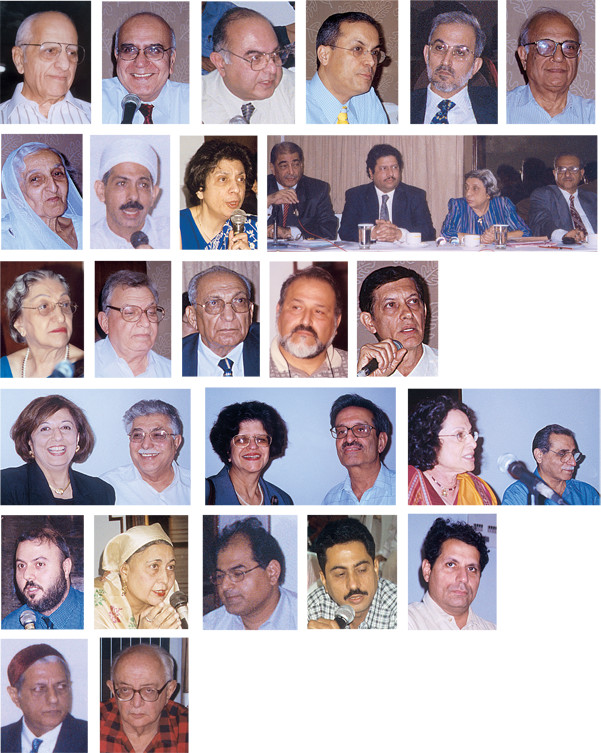
L to R 1st row: Shroff, Tamboly, Mehta, Mistry, Limath-walla and Tarapore. 2nd row: Kavarana, Karanjia, Karani-Araoz, Dastur, Mehli Colah, Master and Homi Mullan. 3rd row: Thrity Taleyarkhan, Meher-Homji, Savak Patel, Mistree and Dhalla 4th row: Jungalwala, Gandhi, Roshan Rivetna, Dalal, Karkaria, Rohinton Rivetna ; 5th row: Deboo, Master-Moos, Atashband, Palkhiwala and Bana 6th row: Murzban Giara and Dotiwala
To help these young athornans to widen their intellectual horizon the scheme is committed to provide adequate opportunities to receive knowledge, guidance, motivation and encouragement from scholars and senior priests by way of group discussions, etc. Tamboly, who is managing trustee of the WZO (World Zoroastrian Organisation) Trust Funds which raised Rs 90,00,000 from two donors to finance the scheme, said, "It is quite possible that such training and encouragement could inspire a young mobed from within our own group to emerge as a leader capable of providing religious and spiritual guidance and leadership to the community.”
Mehta clarified that neither of the two mobed councils in North America want to be under FEZANA control. Also, their "understanding of the faith and performance of rituals is very different. The Iranians will do the navjote if either parent or even one grandparent was a Zoroastrian.” Both councils have a program for training paramobeds. CIMNA has no bar against female paramobeds, he added. While there is no shortage of mobeds in North America, there are geographical pockets where they are unavailable. However, airlines there give a 50 percent reduction in fares for the clergy, he noted.
Mehta informed the gathering that funding for a consecrated facility in Western Toronto was underway. Master- Moos suggested that cattle-rich Texas might successfully consecrate a varasiaji but Mehta noted that the Zoroastrian Heritage and Cultural Center in Houston has no consecrated facility. He noted that the muktad prayers there were held in two rooms, one being for intermarried families because some mobeds are unwilling to perform in their presence. "We don’t want you to change but you must understand the reality we are facing. If need be we shall have three or four rooms at muktad (instead of two) so that people continue to participate,” he added.
ZTFE (Zoroastrian Trust Funds of Europe) president Dorab Mistry spoke of the strong liaison between their 18 mobeds (15 of whom are over the age of 60) and the ZTFE in the UK. "The ZTFE’s background and backbone is religion,” he noted. Despite their substantial number of mobeds — there is no mobed council in the UK — the demand outnumbers the supply. People now want to hold the Sarosh nu patru prayers, celebrate silver and gold anniversaries with jashans. The ZTFE has a fund for navar ceremonies but no facilities for teaching rituals which require the use of an urvisgah (inner area where higher liturgies are performed). However, these facilities may be available when their long-term desire for a consecrated atash dadgah materializes, noted Mistry. They also have a scheme for training paramobeds which is not underway yet, he added.
When Federation of Parsi Zoroastrian Anjumans of India honorary secretary Keki Gandhi questioned, "Will you dip into our pool?” Mistry countered, "It will help your young mobeds, give them scholarly facilities in SOAS (School of Oriental and African Studies), give them a career path.”
World Zarathushti Cultural Foundation (WZCF) president Dr Homi Dhalla noted that in the past 20 years the community acquired only four PhDs and then lost Darius Bajan to the professional field when he became a chartered accountant. "Unless we have enough provision for scholars, scholarship will die out,” he observed.
Mehta spoke of the scholarship fund instituted by the late Faridoon Zartoshty’s family for higher education/research in the Zoroastrian religion for any Zoroastrian anywhere in the world. The total amount on offer is $ 5,000 per annum.
Putting the costs of higher education into perspective Mistry noted that the course in Zoroastrianism at SOAS which has a chair because of the bridging finance provided by the Zartoshty Brothers, costs £7,500 p.a. for a foreign student. So far there have been two Zoroastrian students whom ZTFE has funded almost 100 percent plus part of one student’s living expenses. Two Zoroastrians — Rusi Dalal and Shahrokh Shahrokh — are on the governing board of the Zartoshty Chair in Zoroastrian studies, though 80 percent of the cost of maintaining it is borne by SOAS and the University keeps reviewing the costs to see how long they can continue to fund it. "ZTFE has to keep funding, praying and (maintain) public relations. Hence the efforts to involve the royal family and invite the great and good of upper crust English society. It was a great moment for Zoroastrians when Hello magazine published a picture of Ramiyar (Karanjia) with the Queen. Because unless the funding comes from public institutions and government it will be very difficult to maintain full-time students,” Mistry told the conclave.
The other part of the problem of religious scholarship is to find the right type of student. "And then what does the student do?” Questioning the career path of such a student Mistry noted that places of worship in the West where they could officiate, propagate the religion to a regular stream of visitors along with their pursuit of scholarship would provide them with a base and give our religion a higher profile. He noted that Mobed Keki Bhedwar, who had been well received by the Pope last year, has been invited to visit the Vatican again. Commenting on the ZTFE presence at various state events in the UK, Mistry noted that there is "not a single state occasion without a Zarathushti priest participating.”
"For the first time in the history of philately” Zoroastrianism appeared on a stamp in Singapore, noted BPP public relations officer Godrej Dotivala. Mehta spoke of efforts in North America for instituting such stamps as part of the community’s effort to spread awareness of its own religion and culture. The audience learnt that in Canada and the UK one can buy blank frames in which one can insert a picture of one’s choice to create a personalized stamp.
Rivetna urged the BPP to coordinate interfaith work, participate in the Delhi meet of the Parliament of Religions, December 7-11, 2003 along with the Delhi Parsi Anjuman.
Unresolved issues
Mehta spoke of the need to fund gifted Zoroastrian children in non-academic areas like games, sports, music, etc, adding that it costs upward of $100,000 to create a tennis star. BPP senior executive Sheroo Master noted that the trust provides funds for swimming, sports and karate and had fully funded sports participants at the Houston Congress. But Gandhi countered, "The issue is whether we are doing enough... If the amount offered is not sufficient, they can’t avail of it.” BPP trustee and noted solicitor Burjor Antia felt that sports must be encouraged though the Punchayet should not be tapped all the time. "There are other philanthropists in Bombay who give money,” he noted.
The BPP’s chief executive officer Behram Dastur’s note on unresolved issues brought to the fore questions of merging consecrated fires, unifying the calendars, adoption, sejdo by non-Parsis to demised Zoroastrians after the sachkar ceremony, intermarriages, high divorce rates and emigration at an average rate of one family each week from Bombay and one family each month from Calcutta. Master spoke about their difficulty in matching couples at the matrimonial bureau. Tamboly informed the gathering that the matrimonial meet in Baroda had succeeded in establishing seven unions even though the ratio of girls to boys at the meet was 1:10. People in the 40-45-60 year age group come to matrimonial meets, noted Tamboly. Zoroastrian social workers had organized a youth festival on the grounds of Rustom Baug and Tamboly hoped "nature takes its own course.”
BPP chairman Minoo Shroff spoke of the need to empower youth rather than give them readymade solutions. "Why should a youth earning Rs 25 to 30 lakh p.a. come to the Punchayet?” He said he would like to prevail on his colleagues to shift Punchayet priorities from housing to other areas, regenerate the ethos of the community. "Parsis are the softest of the soft,” said Shroff comparing the different psyches of India. "They are not prepared to upgrade their skills (while) other communities get into educational programs after work hours.”
If the Kabisa ritual to right the wayward Shahenshahi calendar required the addition of one month every 120 years (which has not been done for centuries) why can’t we perform six such ceremonies now and get it back in tune with the seasons? questioned Mehta. Karanjia said he was not aware of the ritual or ceremony of Kabisa but was aware of committees who had debated the issue: "The outcome was to leave it be,” he stated. He noted that there are people who follow the Fasli calendar. "They don’t need the clergy to tell them.” Mehta however was rooting for the community to embrace the change unitedly. Shroff said that the clerics have often contradicted themselves and noted that the youths are "not willing to accept anything that is not rational.”
Udvada: erosion and salinity
Exploring the two problems at Udvada — beach erosion and the intrusion of salinity in the wells of the village — Dr Zal Tarapore, former director of the Central Water Power and Research Station who has been advising the Save Udvada Committee (SUC), noted that the Periyali Creek which provides drainage of water during the monsoon, goes right up to the Iranshah: "There is a respite from salinity when nature closes the mouth of the Periyali. Now a new mouth has opened.” He noted that the building of dykes to stem the water stops the supply of sand to the beach. When this depleted sand is restored by augmenting it from elsewhere — a process known as beach nourishment — "salinity can’t come near the village wells of Udvada.” However, the funds required to prevent salinity will be substantial, he added.
Certain plants are said to provide a secondary line of defence against beach erosion. Horticulturist Dr Vispi MeherHomji noted that the plants chosen earlier had been washed away. They were now planting ‘pilu’ which withstands salt as well as sweet water and has economic uses for its seeds and roots.
The community, still owes one lakh rupees to the Government of Gujarat (GOG) towards the cost of the original wall. The ongoing battle against nature will need Rs 1.5 crore apart from regular refurbishing, noted SUC member Homai Modi referring to the difficulty of collecting funds since SUC founder chairperson Homi Taleyarkhan passed away.
The Government of India ministry of tourism has sanctioned a grant of one crore rupees to which the GOG has added 21 lakhs but all this amount is strictly for the organizing of a museum at Udvada and the reconstruction of the road from the station to the village in light of Udvada being nominated Pavitra Yatra Dham, noted Tamboly adding, "The Government of Gujarat said the ministry of water resources is looking after the erosion.”
It was the WZO Youth Wing’s (WZO-YW) correspondence with the GOG over four years that resulted in the declaration of Udvada as Pavitra Yatra Dham, stated its president Sarosh Bana. He rued the degeneration of the village with the crumbling walls and caving ceilings of its deserted houses. Availability of both electricity and water is erratic. The settled community there numbers about 50 and will further reduce as 70 and 80-year-olds pass away. Old houses are being torn down to make way for highrises, he noted. The WZO-YW runs the Ervad Ratansha Katila pilgrim lodge where guests can stay for Rs 20 per head per day for 48 hours and are provided clean sheets and hot water in a well-ventilated environment. Breakfast at Rs 25 is optional. A holiday home for school children, scouts, guides and the families of navarias is being planned in a house donated by the Bharda family, noted Bana.
World Zoroastrian Congresses
The Eighth World Zoroastrian Congress is due be held in the summer of 2005 in the UK. The ZTFE is scouting for a conference hall to accommodate 1,200-1,500 people at Cambridge University, failing which they would have to hold the Congress in London, said Mistry. People are not yet ready to commit themselves to rates for 2005, he noted, adding that the ZTFE has decided not to go public with information just yet.
The Third World Zoroastrian Youth Congress is being cohosted by the Federation of Zoroastrian Youth Associations of India (FOZYA) and the Zoroastrian Youth Association of Poona. The venue of the main program in the first three days (December 27-29, 2003) will be The Taj Blue Diamond, Poona, noted FOZYA president Sarosh Palkhiwala. Sightseeing and day visits are scheduled for December 30-31. An optional pilgrimage to Udvada, Sanjan and Bahrot is planned for January 1-3, 2004.
Two categories of accommodation are available — single, double or triple occupancy in the 5-star Blue Diamond at Rs 20,000, Rs 15,000 and Rs 12,000 respectively for the five-day stay. There is no charge for basic accommodation offered at a school hostel. The delegates are also free to arrange their own accommodation. The Congress registration charge of Rs 3,500 per head covers three days’ breakfast and lunch for everyone. Dinner everyday will be at different community centers, clubs or restaurants. The BPP will subsidize Indian delegates upto Rs 1,500 (so that the effective charge for them is Rs 2,000), if they meet certain conditions. (All this was announced on June 7, 2003 and superseded the earlier arrangements.)
The program will include talks, slide shows, demos on sudreh kusti making as well as Parsi culinary delicacies, games, fashion show, etc. A night at a 5-star discotheque and a New Year’s eve dinner dance is also being planned.
Rivetna suggested the inclusion of a presentation of the World Zoroastrian Chamber of Commerce by the convenor of the Bombay Chapter Kersi Limathwala; ZTFE joint-honorary secretary Malcolm Daboo pledged his association’s support for the meet and spoke of encouraging some people like Palkhiwala to attend the North American Youth Congress in Toronto in July 2003.
Concepts, values and culture
"Some change is necessary to adapt to the changing world,” conceded Zoroastrian Studies founder Khojeste Mistree, but in pursuit of some vague humanism "change should not be at the expense of Zoroastrian concepts and value system,” he cautioned. Will the proposed change benefit the community at large? Will the community infrastructure be able to absorb the changes envisaged? Will the change be progressive or cause the community to break into antagonistic forces? were some of the questions he raised.
Mistree referred to the redistribution of the population, the unenlightened clergy, lack of identifiable Parsi leadership, inroads of other religions and cultures and outmarriages as some of the warts of our time.
"What’s the point of building flats, saving Udvada, if we forget who we are?” challenged Mistree. He advocated greater youth involvement in community affairs, more transparency and accountability in our institutions, and a global think tank to consider what the community will need 20 years hence.
Dhalla spoke of the cementing bond of culture which has been neglected amid the religious and social controversies of the community: Revival of old Gujarati songs and the establishment of a choir at the A. F. Petit Girls’ School which was invited to Bangalore to perform before the Dalai Lama and was featured on BBC Channel 4; Gujarati classes which generated so much interest that Gujarati community parents requested permission for their children to attend; 51 girls learning to weave the kusti; the establishment of libraries at Poona and Baroda and the preservation of rare books and manuscripts on CD Rom; calligraphy in Avestan, Gujarati and English are some of the projects underway. Documentation of post 1965 Parsi history, in Bombay and Navsari, is being addressed by Hormuzdiar Dalal and the poems of Ardeshir Khabardar, Byramjee Malabari and others are being reprinted.
The most spectacular of WZCF projects however is the excavation proceeding in Sanjan in cooperation with the Indian Archeological Society which has created much excitement in the archaeological world because of the artifacts unearthed. No one had ever imagined that Sanjan was an important trade center. A mound at Sanjan is believed to be a dakhma buried under centuries of soil. A contour survey of the Bahrot Caves where the Iranshah was maintained for 12 years and representations to declare it a national monument with a proper road, due preservation and protection are being pursued, said Dhalla.
Dhalla is the man who persevered with the installation of solar concentrators over the dakhmas which have reduced the time required for a dead body to be reduced to skeleton to 2.5 days in summer as compared to the five months that it took earlier. "The National Georgraphic picked up the story and compared it to traditional cremation by Hindus, noting that the ecology of the country was being affected by the resulting deforestation,” said Dhalla, thanking Shroff and Tamboly for encouraging him on the project despite opposition. Apart from Bombay, Poona, Navsari, Baroda and Bulsar have opted to install solar concentrators over their dakhmas, noted Dhalla.
Preserving intellectual heirlooms...
Deboo who is also the ZTFE’s librarian, spoke of the need to conserve Zoroastrian manuscripts in Pahlavi and Persian, dating back to the 13th and 14th centuries, now in a deleterious condition because of white ants and climatic conditions. When Dastur (Dr) Firoze Kotwal came to Cambridge to work with Prof Almut Hintze bringing what is known as the E1 manuscript dating back to the 18th century, the scholars at the Ancient Iran India Trust were aghast to see the valuable heritage in a shoe box, noted Deboo. Estimates revealed a cost of £ 6,000 to rescue the manuscript but what would happen to it when it came back to Navsari? Therefore the ZTFE gave only sufficient funds for it to be photographed. "Some pages were so delicate, they couldn’t be photographed!... We’re talking of the real Mona Lisa — not copies!” Deboo underlined the worth of the decaying treasure.
He noted that Navsari’s Meherjirana Library with its wealth of valuable books is "caked with dust and insect eggs.” Acknowledging that Dr Shernaz Cama of the UNESCO-Parzor Project is microfilming the manuscripts, Deboo urged the community to undertake a report on what the situation requires to protect the Library’s contents against environmental damage. He also urged his listeners to be circumspect in their choice of restorative methods for the use of incompatible chemicals could make the situation worse: At the US Library of Congress the use of polyvinyl acetate had destroyed certain texts, obliterated the ink, said Deboo. He noted that books in the British Library are protected with funding from commercial firms.
Dhalla was more confident about the expertise available in India. Contents of the Tata archives in Poona and the national archives at Delhi were being properly preserved, he noted. But he argued that the Parsi Prakash and Kangaji’s Avesta Dictionary were in tatters. He said he had written to the BPP that they should pioneer a project to put important books on CD Rom. He was ready to help with what he expected to be a 15 to 20-year project. He was also concerned about the precious personal papers of Dadabhai Naoroji, Jamsetji Jejeebhoy and Pherozeshah Mehta lying in the Bombay University Library.
On behalf of the Punchayet Dastur interposed, "(It is) not just Rs 60,000 worth of equipment. The project works out to Rs 15 to 16 lakhs.” The project is not forgotten, he assured Dhalla, but they had not yet found a sponsor.
Would the technology work in our climate? wondered Master-Moos. CDs corrupt in six months, she said, adding, Oxfam/Christian Aid are aware that high technology only works in developing countires while their emissaries are there. She suggested that a "low key technical solution” would be more feasible in Indian conditions.
Former ZTFE president Rusi Dalal, one of 30 NRIs presented the Hind Ratan Award by former Indian president K. R. Narayanan, spoke of complete volumes of the Parsi Prakash preserved and used in the ZTFE Library, adding, "There are so many references to manuscripts in Geldner’s work which are not traceable any more.”
...and adding to them
Nationally acclaimed journalist Bachi Karkaria is working on "the ultimate book on Parsis” commissioned by Penguin. With an accent on visual archives, Karkaria’s account of Zoroastrian "survival, enterprise and identity” is to be all about the adventures of a people who came from Persia to Gujarat and fanned out to different parts of India and the British Empire — "not fiction, but faction,” she called it. Noting that "the big Parsi story is post Independence and post diaspora” because the diaspora has "reinvented the community’s uniqueness and sense of adventure” amidst a host of diverse cultures, Karkaria believes that the young "need to be talked to in a language which they understand, they need to come out of chauvinism and bigotry.”
Woes on the homefront
Multiplying the figure of about 105 births registered each year at the B. D. Petit Parsee General Hospital by five or six, Tamboly placed approximate annual Zoroastrian births in Bombay at 400 or 600 vis-à-vis 1,100 deaths recorded each year at the Doongerwadi alone. Added to that dismal ratio of births and deaths, is the age profile of the community where children under 15 account for 10.4 percent of the population while those aged 60 plus account for 33 percent. The figure for the 60 plus segment is three percent in India, eight percent in Japan and 13 percent in the western democracies. Also 51 percent of our males and 37 percent of females are single. Last year there were 340 marriages and 40 divorces, noted Tamboly. The BPP has set up a committee of gynecologists and social workers to provide premarital and pre-divorce counseling.
There was also reference to older members of the family being brutalized in the home. In contrast there were large flats with single widows who were averse to share the accommodation with young couples, noted Shroff.
Tamboly said the situation "called for an objective analysis of the state of the Zoroastrian community. (What is) required is an approach that is in harmony with the elements of the changing global scenario... We need to think and act as a united community, not as individuals or institutions with their own agendas.”
However, the discussion that followed was bogged down in housing related issues. Addressing the usual bogey of lack of housing for young people who want to get married, Shroff referred to the ample job opportunities and housing in Jamshedpur despite which the population there was declining. Referring to the community’s "allergy” to Bombay’s northern suburbs, Shroff maintained, "Everyone wants to concentrate in middle and south Bombay.” At the same time people don’t want to live together any more, he noted.
Kobad Avari of London asked, "What’s the hangup on South Bombay? What’s wrong with Poona or Bangalore?” "If you can solve that problem we’ll make you honorary trustee of the BPP,” quipped Shroff.
Dastur noted that the trust bore an annual deficit of Rs 1.68 crores on housing alone, which did not include the Wadia baugs, while the affluent Zoroastrians who resided there refused to share the BPP’s burden of maintenance. "We need Rs 1.4 crore per annum for repairs but we don’t have the funds.”
Tamboly unspooled a wealth of annual figures, each running into millions of rupees to attest to the array of the BPP’s social service provisions — aid for day care, employment and matrimonial bureaus, 100-bed Parukh Dharamshalla, the F. D. Alpaiwalla Museum, the Memorial Column and Dharamshala at Sanjan, the Health Unit at Gamadia Colony among a host of other facilities not forgetting its 490 buildings, Doon-gerwadi, educational and medical aid... "Where we... have erred is possibly not having been proactive in creating awareness to the facets of these multifarious activities. The continuous criticism that we have been subjected to over the years in the area of housing has perhaps resulted in our having gone into a defensive mode.”
"Over this conference we are realizing how many problems the community is facing,” noted Shroff as he thanked "the many who have made us wiser.” Grateful though Shroff was to Rivetna for germinating the idea of holding this convention, he firmly rejected Karani-Araoz’s suggestion of the meet as an annual event, noting that the BPP administration rises to the occasion but is already "under a lot of pressure.”
◆ ◆ ◆
From the archive