
Business
Schedule of expansion
Their new 3,800 sq ft central (corporate) office at Nirlon House, Worli is in tune with the times. The design is contemporary, the decor in soft shades adds to the brightness of the premises. Located on the well-known Dr Annie Besant Road in Bombay, The Zoroastrian Co-operative Bank Limited, now a scheduled bank, has other corporates all around for company.
"We were very short of space at the old central office at Kushesh Mansion in Fort, which were rented premises. We intend to grow and as we had generated reserves from profit and created a building fund, we went in for outright purchase of these premises,” explains Farokh Banatwalla, the Bank’s chief executive officer (CEO) and managing director. The neat, open-plan seating currently accommodates around 25 people, with provision for up to 65 people in future.
"This office is situated at the center of all our eight branches in Bombay, so that makes control and administration easy,” states the CEO. With a new Extension Counter (EC) opened on September 14 at the Rustomjee International School in Dahisar, the Zoroastrian Bank is exploring the possibility of opening more ECs in Parsi baugs or other residential areas. "The Bank has also obtained a license from the Reserve Bank of India (RBI) for opening a branch at Thana and negotiations have been finalized with the Thana Anjuman Trust for premises in a predominant locality,” states the Bank’s 76th annual report 2002-2003. More branches at Lalbaug, Santacruz and Malad are being planned and applications have been forwarded to the RBI, state Bank sources. All the existing nine branches (Mumbai Main at Fort, Tardeo, Dadar, Bandra, Mahim, Andheri, Lokhandwala and Borivli and one in Poona) are fully computerized and the Bank plans to soon network all its branches with the central office, according to the report.
With the RBI conferring the scheduled status with effect from March 8, 2003, Banatwalla remarks that the Bank obtained this rating in adverse market conditions: "There have lately been several scams in cooperative banks. It is to our credit that even in such circumstances the RBI had confidence in our operations and has granted us the new status.” The Bank will greatly benefit in the long term as depositors, borrowers and the public view scheduled banks with greater confidence, he asserts.
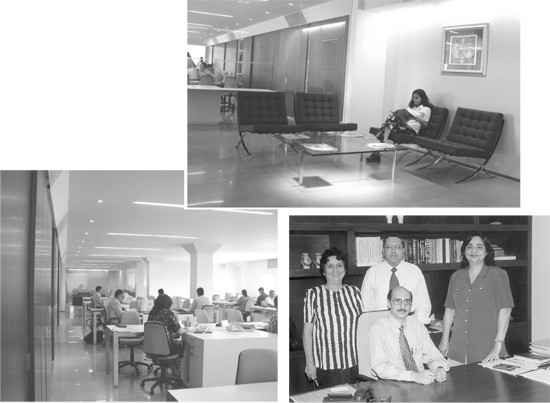
Zoroastrian Bank’s new office: contemporary corporate ambience (alongside and below left) and Banatwalla (seated) with senior manager Dolly Mistry (left), Hilla Avari (right) and general manager Aspi Katgara
In the last year the Bank was also granted a license for buying and selling foreign currency and travelers cheques. "One doesn’t have to be a Zoroastrian Bank customer to avail of this facility. This is a totally independent transaction,” says the CEO. The Bank has initially started this at its Mumbai Main branch under a tie up arrangement with Thomas Cook (I) Limited and American Express Travel Related Services, the report notes. "We are looking for other tie ups with travel agents to bring in more customers,” states Banatwalla. The Bank also seeks to attract more NRO (non-resident ordinary) and NRE (non-resident external) deposits. The 189 accounts in the non-resident (NR) portfolio stand at a total of Rs 286.89 lakhs as on March 31, 2003 with 80 percent of NR customers being Zoroastrians.
In the course of the year Hoshang S. Kohina took over as chairman from Jehanbux Gandevia who stepped down from office because of his age. Gandevia had been associated with the Bank from 1977-2002 as director, vice chairman and chairman (see "Banking on its balance,” Parsiana, December 1998). "The Bank achieved success due to his foresight in inducting professional executives and wide spreading the spectrum of banking activities. During his tenure as chairman, the Bank changed its policy so as to allow membership to all communities, which provided ample opportunities for the Bank to expand and improve the business, culminating in qualifying itself to rank as a scheduled bank,” the report acknowledges.
The Bank’s net profits for the year ended March 31, 2003 stood at Rs 477.03 lakhs and the Bank declared the maximum permissible dividend payable under the Maharashtra Co-operative Societies Act, 1960, working out to Rs 3.75 per share (@ 15 percent) amounting to Rs 70,68,949. Now into its 77th year, the Bank’s shareholders increased from 10,843 on March 31, 2002 to 11,061 a year later, comprising 389 firms and companies and 10,672 individuals. The subscribed and paid-up capital registered an increase of Rs 43,96,500, working out to 9.83 percent over the previous year.
Deposits increased to Rs 212.42 crore, a rise of 13.06 percent over the previous year’s Rs 187.88 crore. The Non Performing Assets (NPA) stood at Rs 461.58 lakhs in March 2003, compared to Rs 245.63 lakhs the previous March. This works out to 4.33 percent of the advances. The net NPAs continue to be reflected as nil as the Bank has provided an amount of Rs 726.32 lakhs as Bad and Doubtful Debts Reserve. An additional Rs 57.39 lakhs is provided as Reserves against Standard Assets as a prudent provisioning policy. "The Bank continues to lay emphasis on granting loans and advances to the priority sector and weaker sections,” like small scale industrial units, self employed persons including professionals such as architects, engineers, doctors, lawyers, chartered accountants, women entrepreneurs, etc, the report states. "Our collection machinery is quite good,” says Banatwalla. A non-payment of even one installment sees personal follow-ups from the recovery officer and the branch manager, if required. "Overdues are reported to us. We also follow up at the seniormost level,” he notes.
"The board of directors held a condolence (meeting) on December 30, 2002 on the untimely demise of Khushrooh P. Byramjee, director... the board recollected his contribution to the Bank and his vast experience and knowledge...,” the report states. The board also recorded its appreciation of services rendered over 16 years by internal auditor Sam Bajan who had completed the major part of the audit for the year ending March 31, but who passed away in May 2003 just before the signing of the accounts. The board appointed the same firm of chartered accountants, Damania, Panday and Bajan, as the internal auditor, with senior partner Dinyar Bhathena in charge.
Having achieved total business of Rs 318.96 crore in March 2003, as compared to only Rs 12.76 crore a decade ago, the Bank is aiming at a growth rate in general business of around 20 percent, according to Bank sources. More information on the Bank can be obtained from its website: www.zoroastrianbank.com
◆ ◆ ◆
From the archive