
Media
The Parsi Punch
The Parsi journalists enriched not only the field of Indian journalism but also the Gujarati language
The Parsi contribution to the Gujarati language, journalism and printing is legendary. The first Gujarati types were cut by a Parsi, the first Gujarati newspaper and the first Gujarati almanac were published by a Parsi.
Dr Ratan R. Marshall of Surat, a giant in the field of Gujarati literature, over 56 years ago submitted a dissertation on the "History of Gujarati Journalism.” He notes this was the first dissertation accepted for a PhD in the Gujarati department of Bombay University.
Two years ago Marshall prepared a paper on the contribution of Parsis to Gujarati journalism for a seminar on Irani-Parsi culture. The paper was translated into English by Prof Ashok N. Desai, head of the English department, Z. F. Wadia Women’s College and N. K. Jhota College of Commerce.
An edited and abridged version of Marshall’s paper is being serialized in five parts in Parsiana. The first four sections dealt with the establishment of the Mumbai Samachar, Jam-e-Jamshed, Kaiser-E-Hind, Saanj Vartaman and Rast Goftar.
The concluding section deals with the Parsi contribution to the Gujarati language and journalism in general.
•••
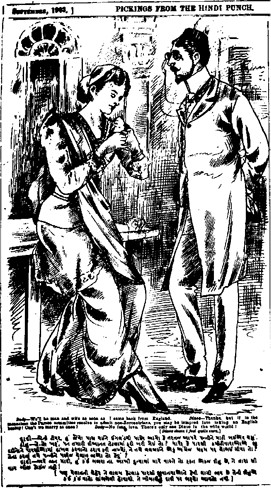
Dady: We’ll be man and wife as soon as I come back from England. Dinoo: Thanks but if in the meantime the Parsi committee resolve to admit non-Zoroastrians, you may be tempted into taking an English beauty! Can’t we marry at once?
Dadi: No fear, love. There is only one Dinoo in the wide world!
(Dinoo doesn’t feel quite sure)
The overseas Punch was famous for sarcasm and caricatures. Here, Barjorjee Apakhtyar successfully imitated Punch, which may be seen in the back issues of Hindi Punch. On the political front Hindi Punch had remained progressive. Every week it used to publish the caricatures of contemporary political leaders and also attacked the failings of the rulers.
The readers were provided humor by comic elements besides humorous columns. In the first era of Gujarati journalism some journals were established exclusively for presenting humor and sarcasm, eg Datardu, literally meant ‘the sickle.’ Manekjee Barjorjee Minocher Homji had started it on November 12, 1874. Although Minocher Homji was its editor, Khurshedjee Bamanjee Faramroz, who had become famous by the nickname ‘Birbal,’ was its soul. Another journalist of the times, Kaikhasru Kabrajee had command over the spoken and written language. Incorrect language irritated Kabrajee. He made an effort to bring about improvement in the use of the language. Pallanjee Desai showed deep interest in that task and for the purpose of retaining the original pronunciations of Persian words he started the practice of marking certain words with a Nukta under it.
The Parsi journalists profusely used Persian words and the Hindu journalists afterwards continued their use. For example, words like akhabar (newspaper), ahewal (report), azad (free), katar (queue), kamiyab (successful), jung (battle), jehangiri (absolute power), dil (heart), durast (just), dilawar (noble-minded), daftar (office), dost (friend), bandobast (arrangment), etc. have become an inseparable part of Gujarati. Writers believed that the use of such words made Gujarati more glorious, whereas those who insisted on pure Gujarati did not want their language corrupted by such words. Today it no longer remains a subject of discussion. The readers always welcome the use of comprehensible language in a newspaper. Under the influence of Gandhiji, Gujarati became easier besides being purer. But, that influence is no longer felt today.
One hundred and seventy-five years have passed since the beginning of Gujarati journalism. In the beginning the voice of Parsi journalists roared. The initial stage of Gujarati journalism was dominated by the Parsis who became a source of inspiration for all journalists. Social welfare was their main concern. Today, the picture has changed drastically. There is hardly any Parsi journalist deserving the first rank in the galaxy of Gujarati journalists. Several Parsis have come in the limelight in the field of English journalism to which they have contributed a great deal. Yet, the Parsi contribution to Gujarati journalism against all odds will be remembered forever.
Concluded.
◆ ◆ ◆
From the archive