
Media
The tryst with truth
Dadabhai Naoroji’s Rast Goftar was the voice of social reform within the community
The Parsi contribution to the Gujarati language, journalism and printing is legendary. The first Gujarati types were cut by a Parsi, the first Gujarati newspaper and the first Gujarati almanac were published by a Parsi.
Dr Ratan R. Marshall of Surat, a giant in the field of Gujarati literature, over 56 years ago submitted a dissertation on the "History of Gujarati Journalism.” He notes this was the first dissertation accepted for a PhD in the Gujarati department of Bombay University.
Two years ago Marshall prepared a paper on the contribution of Parsis to Gujarati journalism for a seminar on Irani-Parsi culture. The paper was translated into English by Prof Ashok N. Desai, head of the English department, Z. F. Wadia Women’s College and N. K. Jhota College of Commerce.
An edited and abridged version of Marshall’s paper is being serialized in five parts in Parsiana.
The first three sections dealt with the establishment of the Mumbai Samachar, Jam-e-Jamshed, Kaiser-E-Hind and Saanj Vartaman.
•••
The Parsis started a number of journals that disappeared, after a short or long life. The journals inspiring the otherwise progressive Parsis to adopt reforms died out relatively earlier. A journal that adopted a reformist policy was Rast Goftar, meaning ‘truth speaking.’
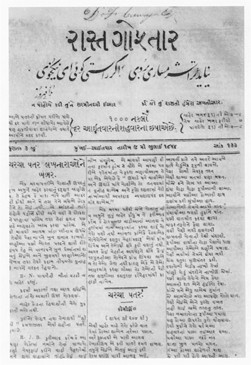
The Parsis owned all the five Gujarati newspapers that were published from Bombay in 1850. Their owners or editors were crushed under the heels of one or the other party. They were not in a position to follow their conscience freely. By and large, all those journals favored the old ideologies. There was no scope for reformist ideas. This situation was baffling to the reformists. Rustam Na-sarwanji Wachha Gandhi had long been thinking of starting an independent journal. He did have the efficiency and qualifications needed to manage such a journal, but he did not have sufficient finance. He narrated his problem to Kharshedji Nasarvanji, the devout worshipper of knowledge, and pleaded for assistance. Dadabhai Naoroji, the grand old man of India, was the chief in pursuing this request. Kharshedji Kama agreed to help. Kama would render financial assistance and Naoroji would run the journal as a mission and circulate it free of charge.
The first issue of Rast Goftar was published on November 15, 1851. It was naturally questioned why the new journal should start on such an odd date. There is a story behind it. In those days a magazine titled Chitra Gyan Darpan under the editorship of Beramji Jam-shedji Gandhi was published. As the title suggested, the readers were given details of different subjects with the help of pictures. Printing pictures was not that feasible then. Gandhi published pictorial biographies of leading personalities. He published the life sketch of Hazarat Mohmad Paygambar Saheb, with perhaps an imaginative photograph of the revered religious head of the Muslims. This gesture infuriated the Muslims and made the entire Parsi community a target of their anger. A riot ensued between the Parsis and the Muslims. The editor’s apology did not have the intended effect. The minority Parsi community had to suffer considerably in the riot. They were denied justice. With a view to voice the genuine cause of the Parsis, Naoroji immediately started the publication of the Rast Goftar. The initial three issues were filled with the effects of the riot.
In the beginning, Rast Goftar was a fortnightly, published on the 1st and 15th of every month. Naoroji went to England in 1855 but continued writing for the journal. For the purpose of managing the publication, a syndicate was formed of pre-eminent social workers. Three years later, the popular social reformer, Karsandas Moolji, was nominated on the committee. The journal advocated the cause of female education, fought against undesirable religious rituals and promoted the spread of knowledge. As the journal entered its seventh year, the editor stated that the fortnightly would not be confined to the Parsis but all the native people. An English section, too, was introduced from its issue dated January 3, 1858. The principal objective of the section was to give the British exposure to the ideology of the native people. Kawasji Edaljee Khambatta used to write inspiring articles for it. Kekhusaru Navroji Kabraji rendered invaluable service to the journal as an editor after Naoroji. For 40 continuous years he managed and developed the publication.
In social issues, Kabraji favored reforms, but on the political front he was loyal to the British. Hence, the demand for Home Rule was not approved of by the journal. Kabraji’s political ideology was radically different from Naoroji’s. He had expressed his agony over it in a letter to Wachha Gandhi. Although Kabraji was a supporter of the British, he was not blind to its blemishes. He had bitterly criticized the malpractice and autocracy of the bureaucrats. The government did not appreciate this criticism. During Lord Lytton’s tenure the Vernacular Press Act came into force.
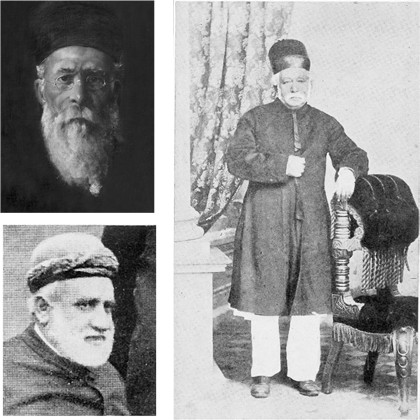
Rast Goftar stal-warts (clockwise from top left): Naoroji, Khambatta and Kabraji
Rast Goftar was essentially attuned to the Parsi community. The owner as well as the editor were Parsi, but later on, on account of the relations of Moolji and the merger of Satya Prakash with the Rast Goftar, the problems relating to the Hindu community also came to be elaborated in it. The journal gave a call to the Hindu community to embrace progressive ideologies. The Kapole community fussed about Moolji going abroad and his crossing the seas became a controversial issue. He and his family had to suffer on that account. Madhavdas Raghunathdas was the first Hindu to remarry for which his entire family was excommunicated. His son-in-law, Dr Ranchhoddas Vora, had traveled to a foreign country. Moolji Barbhaya had gone abroad with his wife. He was one of the first to visit a foreign land with his wife. All three of them were excommunicated. They faced the tyranny of the people of their caste for quite some time, but after the death of Barbhaya’s wife, Vora and Barbhaya expressed regret and after performing certain rites were accepted into the fold. Their retraction was bitterly criticized in Gujarati by Rast under the heading: ‘Kapole Reformers at the Shrine of the Idols of Caste.’
Kabraji passed away in 1904. Paalanji Bahdurji Desai succeeded him as editor of the journal. Since he joined Rast in 1874 he dedicated his life to the service of the journal. In 1918, the journal disappeared after its merger with Prajamitra and Parsi.
In Rast Goftar Naoroji championed social reform and his successors followed in his footsteps. They had to undergo a number of hardships in doing so. In spite of such odds, Rast never gave up its reformist policy, but there was no harmony between its progressive social ideology and its narrow political outlook. Senior journalists who had been the torch bearers of society, failed to remain neutral in political issues and frowned upon the struggle for freedom while vehemently advocating British rule in India. As a result, the importance of Rast was diminished.
Yet, it opened new horizons in journalistic history. It was a conspicuous milestone in the development of journalism and the Gujarati language. It remained meticulous in its policy of social service and contributed to social reformation. To be continued
◆ ◆ ◆
From the archive