
Cover Story
Ambassador for art
As the Metropolitan Museum of Art’s associate director of exhibitions,Dr Mahrukh Tarapor lives, breathes art
"An exhibition is like a visual book that tells a story. It has its own juxtapositions, arguments, theories. If those are weak, it’s like a bad book.” In a leisurely interview Dr Mahrukh Tarapor, associate director for exhibitions at the Metropolitan Museum of Art (MMA), New York (affectionately called the Met), explained to Parsiana the dynamics behind the shows organized by the institution.
Tarapor was in Bombay in December 2002 on one of her several annual visits. Chary of publicity she had evaded earlier attempts but, having succumbed to the request of friend and benefactor Nerges Erani, this purveyor of culture was a mine of information graciously shared.
Collating the Museum’s annual offering of anywhere between 30 to 50 shows keeps Tarapor moving around the world at a "frenetic pace.” And each major international show takes between five to seven years to mount.
Toting a special diary with schedules that run into 2010, Tarapor has to undertake four to five visits per loan or object displayed between her first request for its loan from the owner — be it private collector or foreign government — to their signature on the loan document. Between her trips to India in September and December 2002, her work had taken her to Syria, Greece, Munich, London, Milan, Cairo, Russia, back to Greece, and finally China.

The Met’s 100 plus curators — each of whom is an expert in his/her field of specialization "like a university faculty” — come up with the ideas, says Tarapor. For example the recent Mesopotamian exhibition, Art of the First Cities: The Third Millennium BC from the Mediterranean to the Indus, was proposed by its curator six years ago. The curator works on the theme, its intellectual justification, scope and format. Tarapor is initially involved in the overall approval of the project along with the Museum director Philippe de Montebello. The next stage requires her to work with the curator in selecting the objects required "to illustrate the idea behind the exhibition, planning on paper, talking things through.”
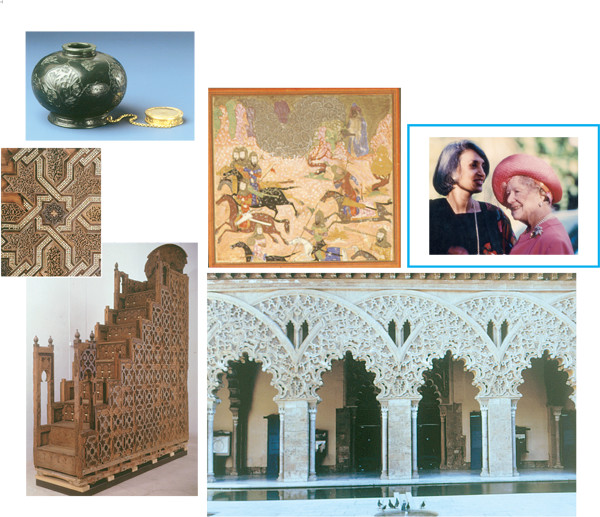
Top left : Inkpot of Emperor Jehangir at the MMA — the Sylmaris Collection gifted by George Coe Graves Below: Minbar from the Kutubiyya Mosque and (left) detail of the carved panels Photos: Bruce White; Top right : Below: Bazur, the Turanian Wizard at the MMA, bequest of William Milne Grinnell
Simultaneously planning begins on the shape of the catalogue, a photography campaign around the world, doing lots of traveling to identify and locate the pieces required for the show.
To secure those objects from around the world is "the international part” of Tarapor’s job and can go on for three to four years. "It is an expensive business to ship artifacts. We have to ensure that every piece is brought for a reason,” she says.
After the objects come in the curator works with the designer to evolve a floor plan. The Met’s largest galleries are like airplane hangars, says Tarapor. They have to be reconfigured to suit the subject for each exhibition. Tarapor gave the example of the Leonardo da Vinci exhibition where they had to apportion the big galleries because of the large number of viewers it would attract. But these had to be subdivided into small, intimate rooms by the designers "to suit the drawings.”
"You have to visualize a lot, have to decide on the layout of the room before the walls are built.” The "sheet-rock” walls may be painted or covered with fabric. "The curator tells the painters, ‘I want the blue of a Venetian morning’ and the painters do it! They have the talent, that’s why they’re a part of the Met,” her words echo her pride in the organization.
Before the objects are housed for display, the conservators are required to ensure that the peripheral materials providing the backdrop are compatible to them. As an example Tarapor states that a certain dye in an enclosed area could damage a metal object.
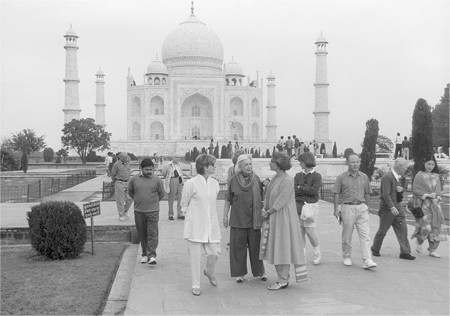
In Agra, on tour with MMA trustees
"Sometimes the conservator is overcautious; sometimes the designer gets carried away.” Clashes occur when the conservator refuses to accept what the designer likes and they land in Tarapor’s office for some "quiet handholding and diplomacy.” It is also her function to ensure that the design around the objet d’art does not overpower it.
In the negotiation of loans for exhibitions, reciprocity is the name of the game. "We don’t pay but we are very generous lenders to other exhibitors, lending 4,000 to 6,000 objects every year from our collections,” says Tarapor. In all cases the borrower covers the cost of transportation and insurance. When an object travels, it needs "nail to nail insurance (from taking a painting off the wall to the time it is returned to its home).”
Tarapor’s office also coordinates new acquisitions for the Met. The curators identify suitable objects; the conservators might run tests on them with the permission of the vendors and a special acquisitions committee comprising a group of the Museum’s trustees who are big individual collectors provide the endowments, interest on which finances the purchase. "When the curator makes a presentation about an object being worthwhile for the Met, these extraordinarily generous and enlightened people often will buy for the Met,” says Tarapor.
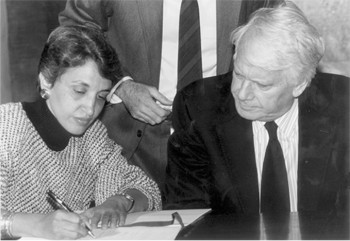
With Spain’s minister of culture, signing the exhibition contract
(Photo: Javier Algarra)
Tarapor describes herself as being "extraordinarily lucky. I never had to write a job application in my life. Ultimately I owe it all to my parents (Perin and the late Keki Tarapor). They had a modest background but my sister (Gool Clemensen) and I grew up observing them offering help to others in whatever way they could. I don’t think I’m as good as them, but I learn from my mother — even today! Maybe that’s why I keep returning to India so often — because, in the professional world you get caught up, sometimes too much, just in the pleasures and problems of your own life. Also, in America you don’t see as much obvious need...”
Keki Tarapor was manager of the Carlton Hotel in Kodaikanal when the property belonged to Nerges and the late Keki Erani of Steelage, and his daughters schooled at the Presentation Convent there — a grounding whose importance Mahrukh appreciates even now. "I owe a lot to Nerges aunty. If my father hadn’t had that job, I wouldn’t have gone to that school. Without a very high degree of education, and often making sacrifices themselves, my parents did everything they could to encourage and support us so that our dreams could be fulfilled. It’s a debt you can never fully repay...”
Tarapor’s dream came close to grounding. Wanting to major in Indian art, she learnt there was no such course available at Bombay University. She completed her English Honors from Bombay’s St Xavier’s College and earned a scholarship to Boston College where she completed her M.A. Following this, she sought an interview with Prof Morton Bloomfield, then head of the English department at Harvard University. The interview focussed on Harvard’s competitiveness and didn’t sound positive until Bloomfield suddenly asked, "Are you a Zoroastrian?” He considered Zoroastrians "the Jews of India.” Once the connection was made the interview became personal and Tarapor ended up in Harvard for the next seven years, doing her PhD in English literature.
Simultaneously she took courses in fine arts, spent a semester studying Indian archaeology at the University of Stockholm and Islamic Art in Cairo, spent summers in Greece taking courses in Greek philosophy and literature. By the time her doctoral thesis had been accepted, Tarapor had a job awaiting her in the English department of a university in Massachusetts. Then, one morning she woke in panic with the realization that she couldn’t spend the rest of her life teaching English literature...
"My career is a series of lucky accidents,” muses Tarapor as she recalls the extraordinary patience of Prof John Rosenfield, head of the Department of Fine Arts at Harvard (and an authority on Indian sculpture and Japanese art) who heard her out and proposed a way out: would she be willing to do her research in London? Tarapor was willing but hadn’t the finance to make it. Rosenfield requested her English professor not to sign off on her dissertation, so that he could arrange for Harvard to finance her trip and stay in London. Armed with introductions to the Victoria and Albert Museum and the India Office Library she put together a dissertation on "Indian painting and architecture under the British” that became part two of her doctoral thesis, the first part having been "India in British Fiction.”
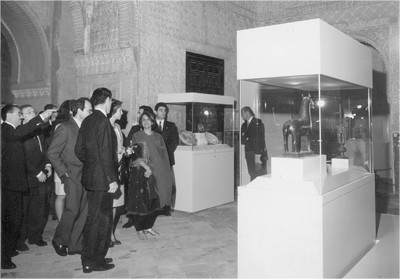
With King and Queen of Spain at opening of Al-Andalus exhibition (Photo: Dalda Fotogradia)
Three to four uneasy months of waiting ended when mentor Rosenfield called to acquaint her with a job opening as Head of Gallery Education at New York’s Asia Society — a small private institution established by John D. Rockefeller — where she worked for four years until another of her professors from Harvard, Stuart Cary Welch, a great connoisseur of Indian paintings, was appointed as special consultant in charge of the Department of Islamic Art at the Met. When his dream exhibition — India! — became his first big project there, he persuaded Tarapor to move over to the Met as curator to organize this exhibition. In the sumptuous catalogue titled India: Art and Culture 1300-1900, Montebello states in his Director’s Foreword, "In this latter task (Welch) was aided by Mahrukh Tarapor... without whose intuitive diplomacy and superb organizational skills it is fair to say the exhibition might never have come to fruition.” In his own acknow-ledgements Welch speaks of her as a "specialist in Indian art, ambassador plenipotentiary, able translator, a person whose enormous organizational, diplomatic and personal skills have been essential to the project... without (whose) devoted involvement and hard work this exhibition could not have taken place.”
There was no looking back after the success of India! In 1985 Tarapor was asked to set up a central office of exhibitions that would coordinate the Museum’s heavy schedule of programs, and to liaise as well with the Met’s active fundraising department. An exhibition can cost anywhere between 100,000 and three million dollars. In her 20 years at the Met, Tarapor says, "We have never not done an exhibition because we didn’t have money.” But she has to keep the fundraisers informed of the financial requirements. Most big exhibitions like the The Glory of Byzantium in 1997 which displayed pieces from over 100 institutions from about 20 countries, depend on corporate funding. The Museum tries to organize a balanced program of exhibitions that are popular as well as those that are scholarly. Though there is no entry fee — the program handouts suggest an appropriate contribution which is on par with movie tickets — the Museum recovers by way of sale from its shops, restaurants, parking fees, etc. The earnings on popular exhibitions then enable the institution to fund exhibitions on "esoteric subjects that the corporates would not be willing to sponsor” to promote scholarship in different fields. With nearly 2,500 on the staff, this "purely private institution” has an operating annual budget of $ 160 million which includes salaries, maintenance, etc but not the cost of the exhibitions, Tarapor informs us.
In the upward reach in endeavor and achievement came Al-Andalus: The Art of Islamic Spain which the Met mounted at the Spanish national monument, the Alhambra, in 1992 at the request of the Spanish Government to celebrate the 500th anniversary of the discovery of America. Tarapor tells us, "It was the first time ever that the Met undertook to do an exhibition in another part of the world.” In his Director’s Foreword to the catalogue Montebello credits Tarapor with "the idea to focus the exhibition on Spain’s Islamic heritage and to mount it at the Alhambra,” describing her as "the architect of the project for which she has been virtually the mind and the heart. This is a characterization she will no doubt protest. But... mind and heart best describe, on the one hand, the seriousness and scholarship and, on the other, the inspiration and encouragement with which she has infused this immensely complex transatlantic, even global, project.” Her effort netted Tarapor a gold medal from the King of Spain and the friendship of the Queen.
While she was working on the Islamic Spain project Tarapor desperately hunted for the Minbar (pulpit) of the Kutubiyya Mosque in Marrakesh, Morocco. She recalled having seen a picture of it in a French architectural journal of the 1940s but this masterpiece of Andalusian woodwork, created in Cordoba about 1137-45, seemed to have altogether disappeared from view. Then, during a sight-seeing session in Marra-kesh, Tarapor says she peered behind the closed doors of a storeroom of one of the city’s palaces and "there it was — a magnificent wreck!” Establishing its authenticity, obtaining the permission of Morocco’s King Hasan II, Tarapor undertook the coordination of the restoration of the fragile structure 3.86 m high, 3.46 m deep and 87 cm wide "on condition that it would never be moved out” of its location at Marrakesh. This was the first time that the Met undertook the restoration of a major work of art outside its own premises, noted Montebello in his foreword to the book documenting the successful completion of the project costing one million dollars, borne by Metropolitan Museum trustee Patti Cadby Birch. "The King was thrilled. He gave us all a decoration,” recalls Tarapor, delighted with her role in having tracked down and restored a noble work of art.
"India is a huge part of my life, and Parsis are a part of India... But museums don’t seem in the forefront of the interests of the community,” says Tarapor who claims that yoga and Indian friends recharge her batteries. So she is anguished by the thought of "India’s magnificent paintings languishing... Feel the lack of having done so much for other countries but not for India.” When they mounted an exhibition on Moghul carpets to celebrate the 50th anniversary of India’s freedom, nearly 18 countries took part "sending carpets twice the size of this room. But the Indian government refused to participate. They didn’t give me anything!” The only exception was an exquisite but fragile fragment ("all but falling apart”) from the collection of the Maharaja of Jaipur who allowed the Museum to restore it. Accordingly, Tarapor and a specialist from the Met came to Jaipur and prepared to transport it in a special case. The restoration cost $ 40,000 after which it was shipped back and now rests in the Jaipur museum, says Tarapor. "We would love to do more with India. I’ve often spoken to the Indian government. They say ‘good idea’ but there’s never any follow-up.”
International negotiations even in the art world need to accept political realities. Planning the exhibition on Art of the First Cities: The Third Millennium BC from the Mediterranean to the Indus, with its focus on Mesopotamia and the peripheral region, nearly derailed after the World Trade Center bombing. Having made her fourth trip in 2002 to Syria, Tarapor notes, "Every time (US President George) Bush makes some remark about going into Iraq, the Syrians, quite understandably, freeze!” Though the Met was reconciled to postponing the exhibition by a couple of years if need be, Tarapor emphasizes that "culture is one way of keeping the channels of communication open, despite what happens politically.”
As it happened, Art of the First Cities opened to rave reviews on May 5, 2003. In his inaugural address Javier Solana, former minister of culture for Spain and currently secretary-general of the European Union, complimented the Met and his "good friend Mah-rukh.” Said Solana, "You have in this museum a director who is exceptional, no doubt about that, but you have in Mahrukh an asset that is impossible to compete with.”
Writing in The New Yorker (May 5, 2003) Calvin Tomkins noted, "The Sumerian people had invented cities, writing, irrigation farming, monumental architecture, government by law...” Forty-eight museums around the world contributed to the show in New York even as looting of the National Museum in Bagdad was underway. Though nothing was ever expected from there because of the political embargo, even the protracted negotiations with Syria broke down when the US invaded Iraq. "This is the most complicated show I have ever been involved with... Your success in any country is related to how much you’re ready to earn people’s trust,” Tomkins quoted Tarapor, describing her as "an elegant and subtle woman.”
The international traveler dresses conservatively, an abaya (burkha) and a long black skirt being sartorial staples when she travels in the Middle East — or when she is visiting monasteries , nunneries or the Vatican to negotiate loans. Apart from the physical act of travel which she does not enjoy, Tarapor loves being in another place. "There is no country where I felt I don’t want to go back there.” Her regret is that she speaks no Arabic. Nonetheless she gets by with German, French, English, Spanish, Greek and has "never had difficulty making connection with people.” Her small house in Greece beckons to her and she hopes to go there four to five times a year to unwind because "the only negative (part) about my life is that it’s almost too much — the deadlines, the travel...” She says she "adores” animals — there is a pet dog she visits in a monastery, her bulletin board is filled with pictures of animals to whom she has become attached.
Her work however is to her the most absorbing part of her life. Her thoughts veer back to the exhibitions. "You are working with masterpieces and people who care for them, working with collectors and people who love art, socializing with them... To me the lenders are important. They are the stars. If they don’t feel good, I haven’t done my job well.”
◆ ◆ ◆
From the archive