
Awards
Benchmarks of achievement
Five high achievers of the community were felicitated by the Federation of Parsi Zoroastrian Anjumans of India
Intrepid field commander Col Jahangir Anklesaria, artist-entrepreneur Jehangir Vazifdar, architect and town planner Percy Nazir, sportsman and social worker Zubin Amaria and body builder Jimmy Muglai received the Federation’s shield of excellence and a citation at the awards distribution ceremony at Bombay’s Banaji Atash Behram Hall on November 23, 2002. These "tokens of excellence” were bestowed on them "in recognition of their dedication, commitment and sacrifice over decades,” noted Bombay Parsi Punchayet former trustee Rustom Tirandaz. Their achievements were "benchmarks for future generations,” he added.
Commanding the sixth battalion of the fifth Gorkha Rifles on the line of control during the turbulent months between March 1998 and October 2000, Anklesaria maintained exceptionally high morale despite intense engagements on difficult terrain. Operation Vijay and Operation Rakshak tested his devotion to duty, "his resolute personal example... rallied the battalion to give of its best... preventing enemy infiltration and inflicting heavy casualties on the militants in his area of operations,” notes the citation.
Anklesaria’s civic actions — reviving water supply schemes, establishing vocational training centers for men and women — were successfully completed with the expertise of his troops and the cooperation of the public. His high professionalism, missionary zeal and dynamic leadership earned Anklesaria the Government of India’s Vishisht Seva Medal in January 2001.
After receiving the Lt Col Adi B. Tarapore Memorial Award for 2000 at the hands of Lt Gen (retd) Adi Sethna, the Ahmedabad born Anklesaria told Parsiana he would like to "groom the community youth in various facets of life.” With wife Anita and daughters Tanaz and Freyan he has been posted all over India but can "see hardly anybody (coming up) in the defence and administrative services. Unless parents inculcate the idea at a very young age, it doesn’t happen,” he notes.
Artist, architect, builder, entrepreneur Vazifdar received the Jamshed and Shirin Guzder Award for the performing and fine arts for the year 1987. Vazifdar was the first to introduce the concept of ownership flats in India in 1945; started the first college of building industries; first to introduce a color alphabet and dictionary in 1965; the first to create three dimensional portraits ("his technique is so difficult and intricate that no artist in the world can copy his paintings”), notes the citation. Among his many notable buildings are Washington House for the American government, the Bharatiya Vidya Bhavan and Ashoka Hotel in Delhi. He has painted the portraits of Indira Gandhi and Cardinal Gracias and exhibited his paintings at the Taj Art Gallery in 1981 and 1987. The owner of Studio Windsor where 15 Maharashtrian artists recreate old masters’ paintings, the citation notes that over 1,000 such paintings have been exported to five star hotels, clubs and mansions. Vazifdar told Parsiana that Studio Windsor which receives orders from hotels and museums in Europe, was one of only three such establishments in the world. The artists who work there are specially trained in the style and technique of the classical painters for two years after they graduate from the J. J. School of Art.
Vazifdar, a navar-maratab, is a Renaissanace man whose several interests include a string of trophy winning race horses, two hotels and creative modern art ("You create what you can’t see in nature”).
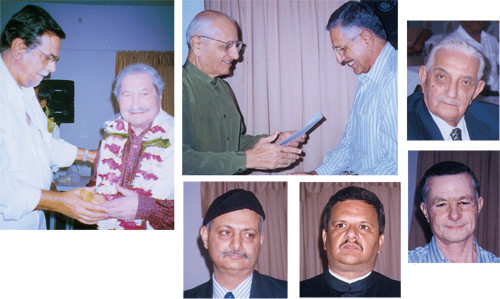
L to R (top): Irani felicitating Guzder, Minoo Shroff awarding Nazir; Vazifdar.(alongside): Anklesaria and Muglai. Professionalism and zeal became their own reward; Bottom right: Above: Amaria — a love for aquatics and automobiles
The Nargis Adi Gandhi Memorial Award for professional competence in 2001 was presented to Nazir. Setting up over 70 model townships in remote locations of Madhya Pradesh, Uttar Pradesh, Bihar, Orissa and Maharashtra as senior executive engineer (architect) of Coal India Limited, Nazir’s standardized drawings included hospitals, schools, stadiums, administrative and welfare buildings, notes the citation. He was also deeply involved in city beautification, public utility works, etc. As a member of the Coal India Special Task Force for the Latur earthquake, Nazir had successfully rehabilitated the village by constructing 150 permanent houses in six months, the speed and quality of his work earning him special appreciation. Prior to his deputation to Coal India Nazir had worked for 12 years with the Border Security Force, planning and designing its four training institutes in Gwalior, Indore, Hazaribag and Bangalore.
Nazir’s papers on low cost housing, building collapses and inadequate specification, his sincerity and commitment has been recognized by non-political organizations, earning him the Rashtriya Nirman Ratan Award 2000, the National Gold Star Award 2000, the Hind Gaurav Award 2001 and the Rashtriya Shiromani Award 2001.
Amaria won the Jamshed and Shirin Guzder Award for best youth in 2000. Representing Maharashtra State and Shivaji University in swimming and water polo, Amaria earned a diploma from the Swimming Federation of India and also qualified with the Federation Internationale de Natation Amateur. He also officiated as international referee at the First South Asia Swimming Championship at Calcutta and at the Asian Games in Delhi. The youngest vice president of the Maharashtra State Amateur Aquatic Association, Amaria is chairman of the selection committee for diving and a member of the selection committee for swimming, notes the citation.
Dhalla: "Culture is the agent of redemption from conflict”
Founder of the Solapur Automotive Racing Association, Amaria was its first charter secretary, was twice its president and is currently a director on its managing committee. He has passed the technical officials’ examination for stewards conducted by the Federation of Motorsports Club of India and has served as steward in several competitions.
Bachelor of law and master of commerce, Amaria works as a development officer with the Life Insurance Corporation of India. The citation records that he was awarded a gold medal in 1999-2000 for procuring the maximum business in the shortest possible time. Judged Best Rotary President 2000-2001, Amaria also received the Best International Activity Rotary Trophy, was named Paul Harris Fellow of Rotary International, Master Mason of the Lodge Royal Jubilee 742 S.C. and Grand Steward of the Grand Lodge of India, Mumbai, Scottish Constitution. Amaria was instrumental in building a Rotary Fish Aquarium and a community welfare hall on land acquired from the Solapur Municipal Corporation.
Body builder Muglai was awarded the Jiji D. Irani Memorial Award for Sports in 2000. An employee of the Central Bank of India, commerce graduate Muglai started on body building guided solely by the diet and program charts in an American body building magazine. Within a year he was acclaimed Mr Lion in a competition sponsored by the Lions Club of Ahmedabad. Between 1971 and 1984 Vesu-born Muglai received the title Mr Gujarat seven times, notes the citation. For two successive years 2000 and 2001 he won the Gujarat State Body Building Championship in the 60 kg/50 plus age group.
On behalf of the Iranian Zoroastrian Anjuman Behram Irani presented BPP chairman emeritus Jamshed Guzder with a shawl, flowers and a coconut.
The emphasis on religious controversies surrounding dakhmenashini, conversion, intermarriage, over the past 100 years had sidetracked the community’s cultural aspect, noted Dr Homi Dhalla, president of the World Zarathushti Cultural Foundation (WZCF). In the subcontinental "crucible of cultures,” Zarathushti culture has been able to flower without interference, he added. With our community divided into various groups from orthodox to radical, with no single leader, common country, common scripture or common rituals, "culture is the agent of redemption from conflict.”
Dhalla spoke about the excavations being carried out in Sanjan and Bahrot with an initial grant of six lakh rupees from the Government of India. The excavations have revealed Sanjan as a once thriving urban port with close trade connections with Iran and the Persian Gulf area. At Bahrot plans are underway to preserve the ancient caves where the Iranshah took refuge for 12 years, create a proper pathway for devotees to access the caves.
Total cost including a proposal to establish an archeological museum in Sanjan, the erection and maintenance of a six-kilometer pathway to the caves and their conservation as well as further excavations at Sanjan would amount to 54 lakh rupees, according to a flyer published by the WZCF. Local donations are exempt under Section 80G of the Income Tax Act. Cheques favoring "WZCF—Bahrot Project” may be mailed to its Tardeo office.
An audiovisual presented some of the other activities and projects of the WZCF like the preservation of Avesta-Pahlavi manuscripts, the reprinting of valuable books, classes in Gujarati, kusti weaving, the revival of calligraphy, monajats and prayers sung to music, etc. Dhalla thanked Guzder for the donation that enabled the WZCF to create the impressive documentary.
◆ ◆ ◆
From the archive