
Seminar
Enhancing social capital
A round table conference of community leaders from various parts of the world discusses global cooperation and assistance
What can you do in childhood to prevent osteoporosis in adulthood? What is holding back the natural rate of growth of the Parsi population? Why is it that the bottom 20 percent of the community in India is ‘unemployable?’ How must the community address misrepresentation in the media and in public documents? How can substantial funds locked up in private trusts be made available for prime community needs? On what grounds will the venues and hosts of forthcoming world congresses — both youth and adult — be decided?
A substantial segment of international Zoroastrians who had converged in Bombay to attend the annual general meet of the World Zarathushti Chamber of Commerce (WZCC) gathered at the informal round table convened by Rohinton Rivetna of Chicago at the Mancherji Joshi Hall of the Dadar Athornan Boarding Madressa on January 8, 2007. This was the third such meet choreographed by the founder president of the Federation of Zoroastrian Associations of North America (FEZANA) and WZCC. The first had been held under the aegis of the Bombay Parsi Punchayet (BPP) in 2003; the second as part of the Eighth World Zoroastrian Congress in London in 2005. As an aftermath to the London discussions where a request from the Zoroastrians of South Africa for a mobed had been tabled, two ordained priests from Canada — Ervads (Dr) Jehan Bagli and Firdosh Balsara of Toronto — had spent a few days in Durban and Johannesburg performing jashans for the community there in 2006. A message from Paurushasp Jila, president of the Zoroastrian Trust Funds of Europe (ZTFE), the London host, urged the use of technology and provision of community stewardship to "bond our people together and enhance our social capital.”
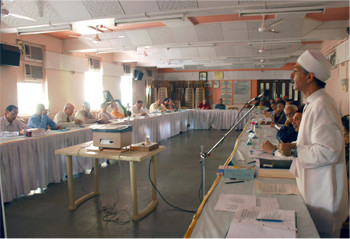
Starting the session with a prayer Below: Rohinton Rivetna
As the need for funds predominates all activity, the issue of how associations in the US can collect funds and transmit them to the old countries and still avail of tax deductions was a major imperative. As noted former FEZANA president Firdosh Mehta, "It would be easier if the receiving association is also a registered body” for tax deduction. Not only that, the donation needs to be channeled through a tax exempt body like FEZANA and the purpose for which the donation is being extended to the home country, for instance, must be also a part of FEZANA’s objectives as defined in its constitution. "In Canada you need an agent of the receiving organization,” remarked Bomy Boyce, WZCC president, while Dr Sam Kerr of Sydney, Australia, observed that according to Australian rules, there is no tax exemption for donation to any charity outside Australia.
Binding the global community together through the Internet is in progress. Yezdi Tantra, international director of the WZCC and an information technology expert, noted that 35,000 names (the figure has now crossed 50,000) had been incorporated in Parsidirectory.com over the past one-and-a-half years. A user friendly creation started with Ader Gandhi, the list (which can be accessed with any spelling of Parsi or even as Zoroastriandirectory. com) is not sold or given to anyone as a whole. It is only available for "one to one use,” Tantra confirmed when other delegates referred to privacy laws and threats of stolen identities. Nor is it necessary to give all one’s information. "One contact, telephone or e-mail, is enough. The rest is optional,” he reassured those worried about being targeted for spam e-mails.
Zareen Karani Araoz who is the webmaster of ZWIN (Zoroastrian Women’s International Network) and ZSIN (Zoroastrian Students International Network) was particularly keen that students studying away from home remain in touch with the community through the websites: "It is critical for the community that students don’t get lost in the non-Zoroastrian world.”
Tantra also alluded to his online Parsi store (theparsimall.com) meant to encourage small Parsi business people to put their items online. Aimed at non-perishables like books, cassettes, sudreh-kusti, etc, the registrants become known to the community at nominal cost. Referring to the popular Parsi store Appoo Menis in central Bombay, Tantra noted that they "had said they needed something like this.” It could even help to send flowers for a funeral or chocolates, cakes, or a ses for the madavsara, saris or antique borders…” essayed former FEZANA Journal editor-in-chief Roshan Rivetna. Her concern was, "Where do I put in my request as a buyer?” Social worker and trustee secretary of the K. R. Cama Oriental Institute (KRCOI) Homai Modi suggested Tantra include the Liaison Committee (LC) — an institution under the BPP which helps to market the sudreh-kusti produced by economically challenged individuals — on his list. "Can your list help locate a priest?” asked Rati Cooper whose connection with Lahore and Rajkot made her anxious for the agiaries at both places. But Tantra had to disappoint her: "No one has registered as a priest in the parsidirectory.com.”
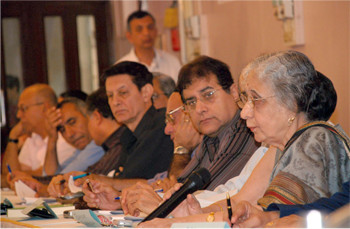
Participants at the round table. Rustom Engineer second from right
Cooper’s concern prompted Jimmy Mistry, architect and founder of the Parsi Resource Group (PRG), to suggest she contact the PRG’s Mobed Association as "700 mobeds are registered with us.” He also added however that he had tried to get one for the Quetta agairy but the remuneration was not adequate.
BPP chairman Minoo Shroff’s concern for funding for the third child program — the BPP provides a monthly subsidy of Rs 1,000 to the parents of a third child in an attempt to overcome financial restraints in raising the size of families — prompted Mistry to speak of PRG’s educational program for the children of mobeds. Stating that 197 children are being sponsored after their needs, educational levels and extracurricular activities have been monitored in a detailed survey, Mistry said the program had begun in Gujarat and that the quality education, counseling and advice the group provided would cost Rs 2,500 per month per child. Mistry guaranteed that every cent of donated money was used for the purpose of the charity, "Not even one rupee goes into administrative expenses.” Mistry also announced that the PRG has insured cashless medicare for mobeds. "Hoshang Sinor and Keki Mistry of the ICICI and HDFC banks respectively have worked out medicare including cancer and pre-established diseases…There is no reason why mobeds should be asking for money… We have taken pains to inspect each household. The mothers (of the children on their rolls) are called to the PRG office every month…We want to ensure complete transparency and integrity, build up enough credibility at the end of the day…” Shroff, who had been concerned about duplication of applications for funds to various trusts ("Parsis and mobeds are taking us for a ride. How do you ensure the funds reach the child or children for whom they are meant?”) now said he would caution the BPP staff regarding applications from mobeds.
"Frustrating exercise”
The discussion turned towards the lack of coordination between trusts. Shroff agreed that computerization of data would minimize misuse of funds. The NRIs urged Tantra to create a program to eliminate duplicate applications, but "trusts are sitting on crores of rupees of income and refuse to come on a common platform. It is a frustrating exercise,” noted Shroff. "The moment they come on a website they will become answerable, that’s why they refuse (computerization),” endorsed Mistry. Shroff suggested that journalists ask questions that would effectively break their silence, use the Right To Information Act, break the old school tie network.
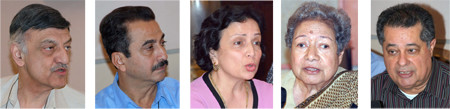
L to R: Bomy Boyce, Kersi Commissariat, Hutoxy Contractor, Rati Cooper, Alayar Dabestani
Pat came the questions "Are we supplying more than there is demand for? Are we spoon-feeding? Will it help the community to grow?” The BPP’s frustrations were voiced by Shroff: "The culture of professional trusteeship is lacking. (Also) the bottom 20 percent of Parsi society is unemployable. Forget English, they can’t spell out their needs in Gujarati. The Bhabha Sanatorium in Bandra is in the hands of the Parsi mafia…People with an income of four lakh rupees ask for the 1,000 rupee subsidy for the third child! Who are poor, who are needy, has to be better appraised.” It was pointed out by one of the speakers that way back in 1932 the point had been made that Parsis were becoming professional beggars. It was in response to just such a situation — to ascertain the true needs of people and to ensure that there was no duplication of doles from various member trusts — that the LC had been established, recalled former director of the Tata Institute of Social Services Dr Armaity Desai. "In the beginning the LC was a very professional body with well trained people. Unfortunately it is now at its nadir. The salaries are minimal. No one worthwhile is working there,” she described the present scenario, suggesting that it be revived for the purpose it was meant to serve. When Shroff demurred, "It’s a very small organization…” Desai retorted, "That’s what you (BPP) have reduced it to.” Modi supported her: "The trusts don’t support, don’t pay for services.” "Unless you professionalize services, you will never be able to get the job done,” Desai assured the gathering and Rivetna added the revival of the LC and the creation of public awareness to make private trusts accountable to the round table’s list of community priorities.
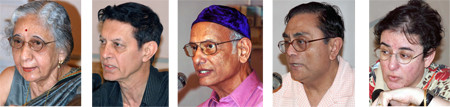
L to R: Armaity Desai, Homi Dhalla, Soli Dastoor, Russy Gandhi, Natalie Wania
Desai, an active member of the UNESCO-Parzor team researching the community’s arts and crafts as well as its skewed demography, declining economic strength and typical diseases to which it is heir, noted that the employment rate of Parsis is "very low – just above that of the Muslims. Muslim youths begin working at 15 years, Parsis only after 21. We know too many well skilled Parsis who are not in employment.” The Parzor project on Parsi textiles and embroidery could generate exports and employment for the community if hand embroidered garments and accessories could be marketed to the developed world, she noted.
Conceding that there are "a lot of unknowns…psychological factors,” Desai wondered what it was that prevented an increase in the Parsi population. According to her the dependency ratio in the community (those under 15, plus those over 60) is currently at 47 percent. The over 60s account for 37 percent of the population, she stated, adding, "we won’t be able to institutionalize all of them when the time comes.”
"Calcutta has a surfeit of properties and funds. Also Jamshedpur. Maybe, we could evolve a process of looking after the aged there,” suggested Shroff, urging Desai to add that as an epilogue to her report on research on the aged.
Referring to the research projects initiated by Parzor, Desai homed in on the constraints: the need for a research and archival documentation center for health, genetics, molecular and cellular research where tissue and blood samples can be stored, to enable scientists to learn enough about the effect of Parsi lifestyles. It could help to prevent diseases like osteoporosis. The knowledge would also aid other small communities like the Jains and the Kashmiris, she said.
Noting that the Masina Hospital had provided 800 sq ft of space and more, Desai’s concern was to raise funds for the necessary infrastructure and staff salaries. Another Parzor project thirsting for funds was the publication of two books – one an illustrated book on Zoroastrianism for children by Dr Shernaz Cama, the other on the heritage of Navsari.
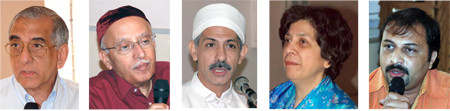
L to R: Russy Ghadially, Sam Kerr, Ramiyar Karanjia, Zareen Karani Araoz, Nauzer Kasad
User friendly libraries
Offering to publish the Navsari history project under the auspices of the World Zarathushti Cultural Foundation (WZCF) that he heads, Dr Homi Dhalla said it would also be translated into Gujarati. The WZCF also teaches Gujarati, Zoroastrian prayers and monajats to Parsi children in Bombay and Gujarat. But Dhalla’s overriding concern has been the establishment of user friendly libraries in various parts of India, not only to disseminate knowledge but to ensure that old knowledge is not destroyed in the eventuality of a natural or manmade disaster. He said he had already put 45 books published 70-80 years ago on CD Roms to send them to different parts of India and the world. He also held out the bait of another collection of 4,000 books available for distribution against donations for WZCF projects. "Rohinton Rivetna and Firdosh Mehta have helped with carbon dating of the Sanjan excavations,” he told the gathering, referring to the excavation of a 14th century port side settlement and a dakhma unearthed there. With five lakh rupees in the kitty, another five lakhs would enable them to build a canopy over the latter, noted Dhalla. He is keen that the DNA of the 700-800 bones in the bhandar of the dakhma could be compared with current DNA.
Speaking of the KRCOI, the best known of Zoroastrian libraries around the world, Modi articulated its trustees’ struggle to maintain the manuscripts in their possession. Over the past few years they have commissioned the Indian National Trust for Art and Cultural Heritage (INTACH) to repair and preserve some of the priceless items in their possession, many of which, she noted, had been inherited in poor condition. "Our problem is our old building. The rear portion is in bad shape with water seeping into the walls.” They were then in the fourth phase with INTACH, each phase costing six to seven lakh rupees a year. "Can you help us with this last phase?” asked Modi, adding, "We’ll try and do our best with the repair of the building, but once the laboratory is disrupted it would be very difficult to restart it.”
Russy Ghadially of Singapore was in favor of bequeathing our ancient assets to world organizations who had the capacity to maintain them. "Think of giving these to museums and libraries of the world (that are) more interested in our religion. The Alpaiwalla Museum’s artifacts are priceless. Try not to hold it to ourselves. Let the world know what we are and what we have.”
"We in the diaspora are waking up,” admitted Mehta, wondering if the striking exhibition of Parsi textiles, crafts, photographs, etc mounted by Parzor to celebrate the 3,000th anniversary of Zoroastrianism could become the prototype of a traveling exhibition as a supplementary project at the various congresses.
Dr Behram Pastakia of Washington DC who regularly represents FEZANA at the United Nations (UN) sought a new generation of leadership. "FEZANA need not be the only Zoroastrian organization in the UN. Others too can develop a similar status…Preserving items? There is no point in preserving if we don’t share them. Create a traveling exhibition. The UN has offered us its main hall in New York. It is interested in showcasing the community to the world.” He also noted that he was working on getting a Zoroastrian logo – the fire or the asho farohar — among the others at the UN chapel across the street from its headquarters in New York. "We are ready to help any Zoroastrian organization across the globe that wants to acquire an NGO status with the UN. The more Zoroastrian organizations, the better,” added Rivetna.
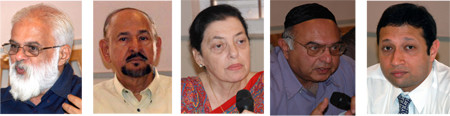
L to R: Prof Faredoon Kapadia, Ness Lakdawalla, Homai Modi, Firdosh Mehta, Jimmy Mistry
Misinformation
Sam Billimoria of California referred to a report on CNN that allegedly spoke of the Zoroastrian community as terrorists. Boyce decried the community’s tendency to "laugh it off,” noting that the label then sticks by default. He wanted to establish a protocol, have one organization authorized to take up the issue. Roshan Rivetna noted that FEZANA has given substantial authority to its public relations team to respond to misinformation.
Among other issues that were discussed was the funding need of the Mancherji Joshi Parsi Colony in Dadar as it faced a new wave of builders wanting to create highrises in the tranquil area. As the covenant stands, non-Parsis can build but not reside in the colony. But another wave of litigation is likely. "At present it is in the High Court but it may go to the Supreme court,” noted Zarine Engineer, the granddaughter of Mancherji Joshi thanks to whom the colony came into being. They are also fighting to preserve the Five Gardens as the area’s green lung. Engineer acknowledged the legal help they were receiving from noted counsels Nadir Modi and Bomi Zaiwalla.
Alayar Dabestani of Seattle, who has made a name for himself in North America with his many cinema houses, referred to fellow Iranian Homer Abramian’s project to erect 99 statues of Cyrus the Great and locate them at the UN and in major cities of the world. Abramian’s idea is to revive the Zoroastrian sense of belief and identity among Iranians in exile. Dabestani also spoke of the need for the Zoroastrian community in the free world to create an ad hoc committee to deal with any political or cataclysmic event in Iran that would affect the community there. As a measure of information he referred to a donation of more than two million euros by Dr Sasanfar of France to establish a Zoroastrian House in Paris and to raise the Zoroastrian population in France and Belgium to two million souls. A brief discussion followed with suggestions that the statues of Cyrus be replaced with his cylinder acknowledged all over the world as the first bill of human rights. Zoroastrian Studies and The World Alliance of Parsi Irani Zarthoshtis (WAPIZ) founder Khojeste Mistree suggested that statues of Darius might be more appropriate, considering that his likeness has been preserved in ancient monuments. He also voiced his disapproval of the acceptance of neo Zoroastrians, citing the unfortunate assassination of Prof Kasra Vafadari in 2005 (see "The price of commitment,” In Memoriam, Parsiana, August 21, 2005) and the recent case in the US where some individuals arrested and charged with illegal possession of marijuana had pleaded they needed it for Zoroastrian rituals. [Their plea was dismissed by the US judge on evidence to the contrary by Ervad (Dr) Jehan Bagli on behalf of FEZANA and the North American Mobed Council (see "Cognizance trial,” Zoroastrians Abroad, Parsiana, February 21, 2007).] Cooper voiced disapproval of the statues from another point of view: "If the bottom line is lack of funds, why are we putting up statues?...How many people even look at statues?”
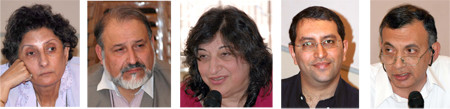
L to R: Nawaz Mody, Khojeste Mistree, Shirin Mistry, Oorvaksh Medora, Behram Pastakia
Connect youth
Federation of Zoroastrian Youth Associations (FOZYA) president Nauzer Kasad’s frustration with Zoroastrian youth in India and even more with trustees who look at them as beggars ("paachha paisa maagva aya”) was an eye-opener for Zoroastrian NRIs familiar with the independence and nonchalance of the Zoroastrian Youth of North America (ZYNA) who function under the FEZANA umbrella. Noted Firdosh Mehta, "In FEZANA we understood the need of the youth to be empowered… They want empowerment, not mollycoddling… We opened an escrow account for them. The youth committee handles and manages its own affairs.” "All our youth functions are financed by the youths and they have made money. Our youths are not drifting!” concurred Zarolia. "At the Miami youth congress every speaker was a youth. It was a small but very interactive turnout…and we made money,” added Freyaz Shroff, the youthful co-chair of FEZANA’s Critical Assistance Committee who also referred to zspeakerbox – an online youth chat group.
"The biggest challenge is that there is no consolidated program for Parsi Zoroastrian youth even in Parsi colonies. We developed a fantastic training program, gave free time and effort, but it was very difficult to pull the youth out. Ninety percent of our energy was spent there. But once that’s done, they are motivated,” said Mistry, claiming a mass movement of 600 after his motorcycle rally that had the youths so charged up, he said "at the end of the day (they) didn’t even accept petrol vouchers!”
"The challenge everywhere is to motivate and keep the youth, make them understand that the community is important, make it their responsibility. At the next congress we’ll try to connect youth worldwide,” promised Rivetna.
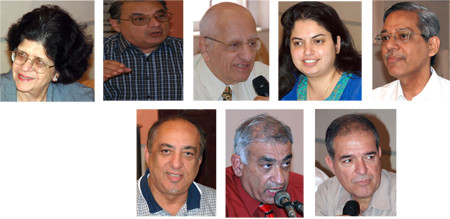
Clockwise from top left: Roshan Rivetna, Dara Rivetna, Minoo Shroff, Freyaz Shroff, Yezdi Tantra, Khodayar Attaie, Sam Billimoria, Kobad Zarolia
"It’s one of the themes of the Fourth World Zoroastrian Youth Congress (4WZYC),” stated Shirin Mistry, secretary of the 4WZYC committee. Scheduled for the last week of 2007, at the University of Ballarat in the hinterland of Melbourne, Mistry noted, "At the moment it is very Parsi loaded. We want help from Iranians. We want to show Zoroastrianism to Australians and to our own youth.”
Mention of the 4WZYC led Mehta to note that world Zoroastrian congresses have been very arbitrarily held in various places. "What happens after Australia? Who decides? Is there a body to decide the time and place? So far there has been no mass failure of a congress, but we need a process, a proper procedure.” "Put in a RFP – request for proposal. Once prepared, we could assign the task of deciding on future congresses,” ventured Rivetna. "Who will vet the proposal?” Shroff wanted to know. Mehta explained that it would be a draft document sent to all associations and elected bodies to establish its credibility. A small group would then implement it, he noted.
Dhalla and Rivetna were concerned about the lack of interest in the community for interfaith dialog and events. "There is a lot of misinformation regarding interfaith in the community,” noted Dhalla. "People feel it would lead to conversion.” He referred to the Foundation for the Unity of Religions and Enlightened Citizenship launched by the President of India Dr Abdul Kalam, asking what religious leaders can do regarding violence everywhere. Pastakia spoke of lectures at universities which are well attended, followed by essay competitions for youths on the basis of which they get funding for education.
Ideas and suggestions flowed thick and fast. There was neither time nor energy to address them all. The biggest achievements were a sense of togetherness and an appreciation of different points of view. As Ervad (Dr) Ramiyar Karanjia, principal of the Madressa had enunciated at the start of the day, hamazori exists on three levels: between people, between people and all cosmic creation and between humans and celestial beings. Though no tangible action program seemed to emerge from the day’s talkathon, the first level of hamazori was palpable.
The next meet is tentativelly set for January 15, 2008 at the same venue.
◆ ◆ ◆
From the archive